JDBC Drivers Manager
DbSchema talks to each database through a JDBC driver: one or more .jar files that the database vendor publishes.
DbSchema downloads the right driver the first time you connect.
The JDBC Drivers Manager is where you see, update or replace those drivers.
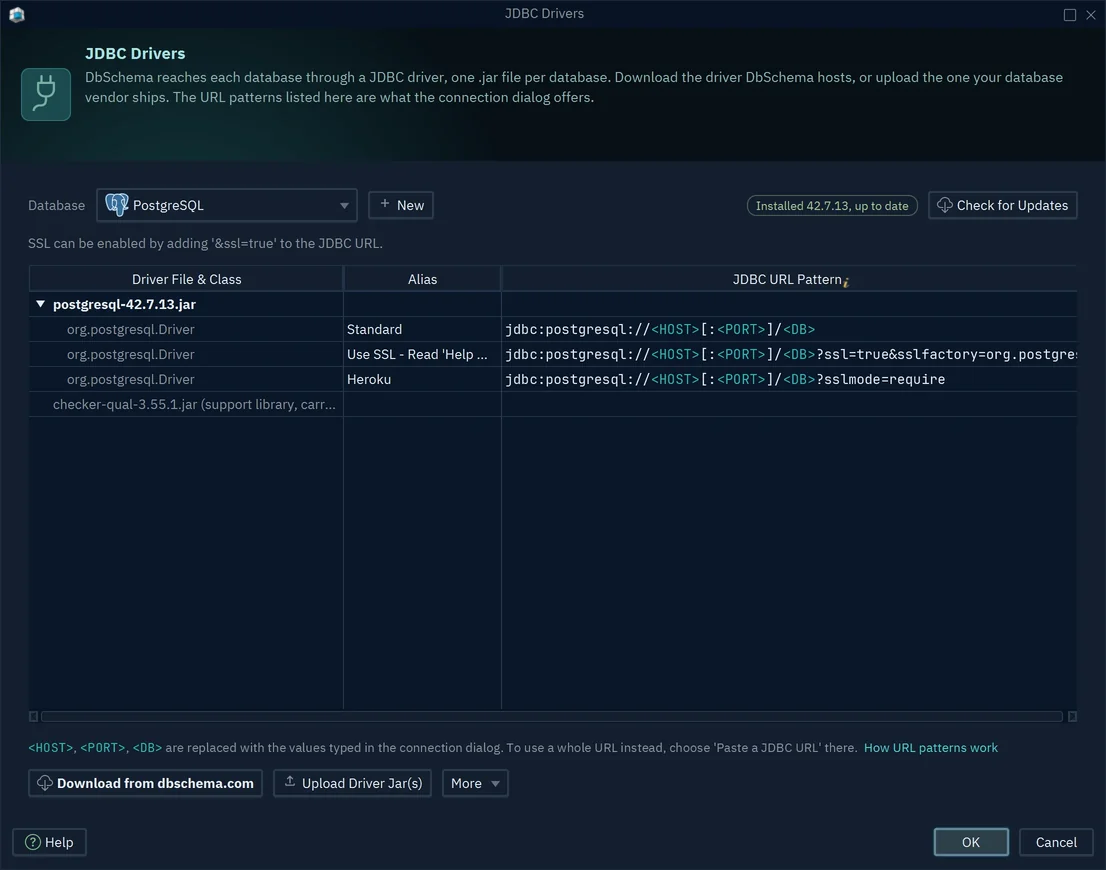
You need the manager only when the automatic download is blocked, when you want another vendor's driver, or when a driver needs an update.
Open the JDBC Drivers Manager
- Choose Database → Manage → JDBC Drivers Manager.
- Pick the database in the Database list at the top.
Before any model is open, the start window has the same entry under Help → JDBC Drivers Manager. The wrench button next to JDBC Driver in the connection dialog opens it too.
The table lists each driver file, the driver classes it holds, and their URL patterns. A badge at the top right says which version is installed and whether it is up to date.
Update a driver
DbSchema checks its drivers against the ones it hosts on dbschema.com.
- Press Check for Updates. The JDBC Drivers Updates window lists every installed driver, under Available when a newer one exists and under Up to date otherwise.
- Tick the drivers to update.
- Press Update. The button counts the drivers it will update.
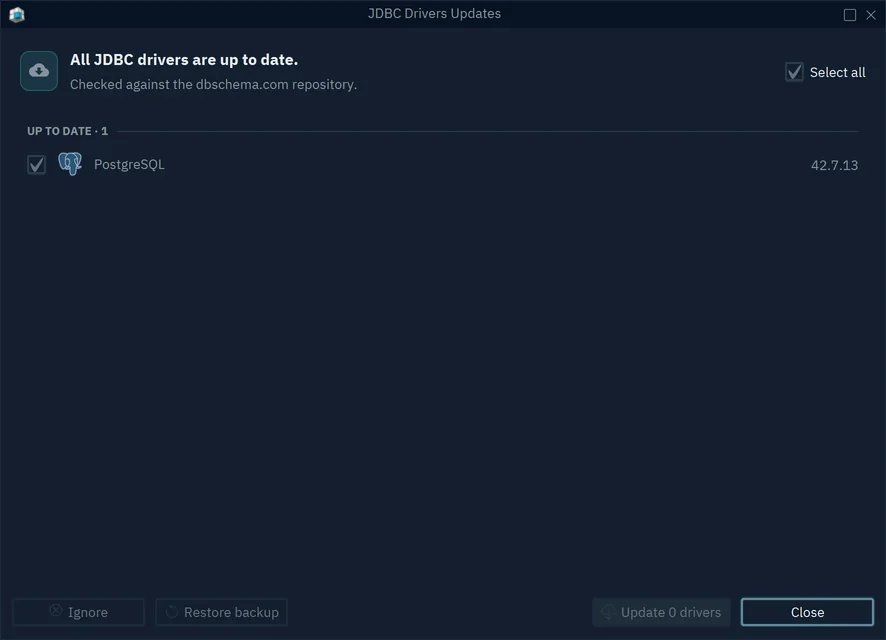
The new drivers replace the current ones the next time DbSchema starts.
DbSchema keeps the replaced version in the drivers-old folder, next to the drivers folder in your DbSchema home folder.
Restore backup puts it back.
Upload your own driver
Upload a driver when DbSchema cannot download it, for example on a computer without internet access, or when you prefer another vendor's driver.
- Pick the database.
- Press Upload Driver Jar(s).
- Choose the
.jarfile or files.
A database can hold more than one driver file. Each lists its own URL patterns, and the connection dialog offers them all. Download from dbschema.com brings back the driver that DbSchema hosts.
Edit a JDBC URL pattern
A JDBC URL is the address of a database in one line, such as jdbc:postgresql://localhost:5432/shopdb.
A URL pattern is the template DbSchema builds that address from.
Each pattern is one entry in the Method list of the connection dialog.
DbSchema replaces <HOST>, <PORT> and <DB> with the values you type in the connection dialog.
A part in square brackets, such as [:<PORT>], is left out when you leave its field empty.
- Select the pattern in the table.
- Choose More → Edit the Selected URL Pattern. A double-click on the pattern does the same.
- Change the pattern and confirm.
To undo your changes, choose More → Reset the URL Patterns of All Databases. It puts the patterns of every database back to the defaults.
To use a URL you already have, you do not need a pattern: choose Paste a JDBC URL in the connection dialog.
Add a database that DbSchema does not know
DbSchema supports more than 100 databases, listed in the Database list. If yours is missing, you can define it, but DbSchema then knows nothing of its data types and SQL.
- Press New next to the Database list.
- Type the database name.
- Upload the JDBC driver
.jarfrom the database vendor.
Remove a driver
DbSchema keeps its driver files open while it runs, so you remove them with DbSchema closed.
- Choose More → How to Remove a Driver... to see which folders hold the driver.
- Choose More → Open the Drivers Folder to open the folder of the selected database.
- Close DbSchema.
- Delete the
.jarfiles.
Each database has its own folder in .DbSchema/drivers, in your home folder.
A database you defined with New is such a folder too: delete the folder, and the database leaves the list.
Common problems
I can't find the JDBC Driver Manager
In DbSchema 10.5 it moved to Database → Manage → JDBC Drivers Manager. The window's title is JDBC Drivers.
The driver download fails
DbSchema downloads drivers from dbschema.com. Behind a company proxy, set the proxy in Edit → Settings → Network → Proxy, as Firewall, Proxy & SSH explains. Otherwise, download the driver yourself and upload it.