Design and Manage Snowflake Databases Visually with DbSchema

DbSchema lets you design, manage, and document Snowflake databases. Create ER diagrams, define tables and columns, and generate SQL scripts - with or without a live database connection.

Use Git to share the design, compare it with the Snowflake database, and deploy changes. DbSchema also includes a data editor, query builder, and HTML5 documentation - everything you need in one tool.

DbSchema Database Designer

Download DbSchema Download Snowflake JDBC Driver

Navigating Snowflake's Multi-Layer Schema Structure


Snowflake organizes data across accounts, databases, schemas, and tables — a four-level hierarchy that grows complex as your data warehouse scales. DbSchema maps this entire structure into a visual canvas, letting you trace relationships across schemas and databases without switching between Snowflake worksheets. Whether you are a data engineer maintaining hundreds of tables or an analyst learning the warehouse layout, the diagram view provides immediate orientation across the full organization structure.

Build Queries Without Writing SQL

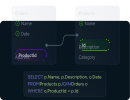
DbSchema's visual query builder lets you construct SELECT statements by clicking tables, joining columns, and setting filters — no SQL required. The generated query runs directly against your Snowflake warehouse and returns results in the built-in data grid.

DbSchema visual query builder constructing a Snowflake SQL query

Auto-Generate Shareable Schema Documentation

DbSchema renders your Snowflake schema as HTML documentation with embedded ER diagrams, table definitions, and column descriptions. Export once and share a self-contained reference with analysts, engineers, and stakeholders who do not have direct warehouse access.

Auto-generated Snowflake schema documentation with ER diagrams in DbSchema

Explore and Filter Warehouse Data

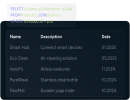
The data explorer lets you browse table contents, apply column filters, and paginate through large result sets without writing a query. It is particularly useful when verifying transformations or auditing rows after a data pipeline run.

Browsing Snowflake table data in the DbSchema data explorer

Connecting DbSchema to Snowflake

DbSchema automatically downloads the Snowflake JDBC driver on first connection — no manual driver installation needed. The JDBC URL follows the format jdbc:snowflake://account.snowflakecomputing.com/, where the account identifier matches your Snowflake account URL. Required connection parameters include db, schema, warehouse, and role; configure these in DbSchema's connection properties panel. For production environments, key-pair authentication is available by supplying a privateKey value in the advanced connection properties instead of a password, eliminating the need to store credentials in plain text.

Why Teams Use DbSchema with Snowflake

  • Visualize cross-database foreign key relationships that Snowflake's worksheet UI does not render
  • Let analysts run ad-hoc queries without needing to write SQL or consume warehouse credits in the editor
  • Generate and version schema documentation alongside code in Git
  • Design schema changes offline, then apply them through DbSchema's synchronization workflow
  • Compare schemas between Snowflake environments (dev, staging, production) to detect drift