PostgreSQL Database Design Tools: Visual Comparison
For the developer or architect who designs a PostgreSQL schema before it ships and has to get the change reviewed, versioned and deployed.
On this page
The next release needs eleven new tables, and the only record of them is a pile of CREATE TABLE statements nobody has reviewed. DbSchema is the PostgreSQL design tool for that: you draw the change in a model file, keep the file in Git next to the application code, and let DbSchema generate the migration when you reconnect to the server.
pgModeler, SqlDBM, dbdiagram.io and ChartDB each cover part of that job, and this comparison is about design and modelling only. For the day-to-day PostgreSQL GUIs and clients (pgAdmin, DBeaver, Navicat, DbVisualizer and dbForge), see Best PostgreSQL Database Tools.
The PostgreSQL schema design shortlist
Start from the job. If the design has to open with no server running, be edited offline and be compared against the database afterwards, that is DbSchema, which keeps the whole design in a local project file. pgModeler is a PostgreSQL-only desktop modeler. SqlDBM keeps the model in a browser workspace the whole team signs into. dbdiagram.io turns typed DBML into a diagram. ChartDB draws one from a single read-only query.
Four capabilities separate them: working with no connection, how deep the comparison against a live database goes, whether the design file belongs in version control, and which PostgreSQL-specific objects survive the round trip. Drawing the diagram is the easy part. What you are choosing between is what happens between the diagram and the migration script.
| Tool | Free tier | PostgreSQL reverse-engineering | Where it runs | DDL generation | Price |
|---|---|---|---|---|---|
| DbSchema | Community Edition: diagrams and the SQL editor | Over JDBC, from the live catalog | Desktop: Windows, macOS, Linux | Migration script from a visual diff | Community free; Pro and Architect perpetual or monthly |
| pgModeler | Source code, GPLv3 | In the paid Plus edition | Desktop: Windows, macOS, Linux | SQL export free; diff and sync in Plus | Source free; Plus from $59.90 per 6 months |
| SqlDBM | None listed | DDL import or a cloud connector | Browser | Forward and alter scripts | Quote on request |
| dbdiagram.io | 10 diagrams | SQL import; live pull via the CLI connector | Browser | Schema exported as SQL | On the vendor's pricing page |
| ChartDB | 1 database, 10 tables | A read-only query you run yourself | Browser or self-hosted | Schema and DDL export | Self-hosted free; Pro $25 per month |
The split runs between the two desktop modelers, which keep the model in a file on your own disk, and the three browser products, where it lives in the vendor's workspace unless you self-host ChartDB.
Offline design and schema synchronization in DbSchema
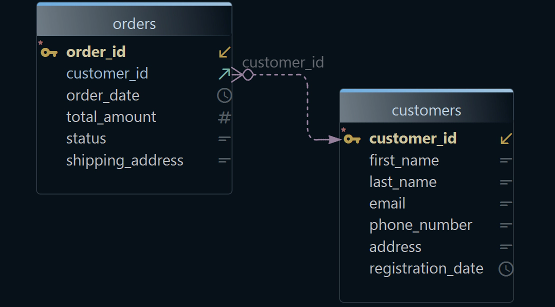
DbSchema separates the design from the connection. You connect over JDBC and reverse-engineer the live catalog into interactive diagrams, or you work on the model with the connection set to Disconnected and nothing at all reaches the server. Every structural change you make while disconnected is written to the model file, so an experiment costs nothing until you decide to deploy it.
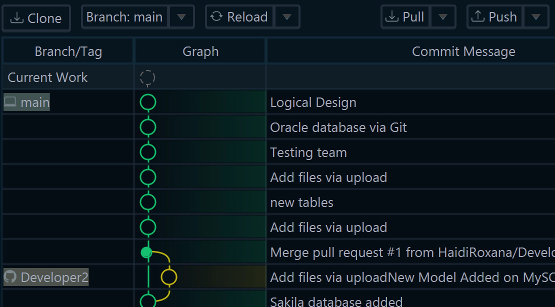
That model is a local XML file with the extension .dbs, readable in any text editor. It holds the schema structure, the diagram layouts, the virtual foreign keys and the comments. Keep it in the Git repository beside the application code, where a design change is reviewed like a code change. Saving it is a Pro feature, as is working disconnected.
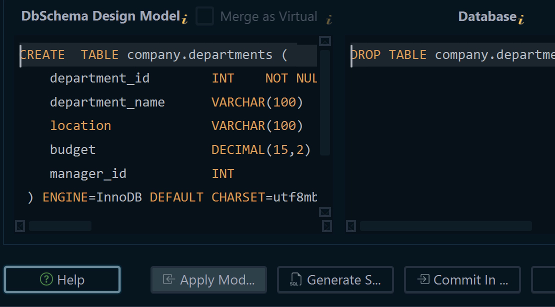
When the change is ready, schema synchronization compares the .dbs file against the target PostgreSQL database, shows each difference in a side-by-side tree, and lets you apply it to the database, take it back into the model, or generate the migration script and run it yourself later. Nothing is written to PostgreSQL until you choose it in that dialog.
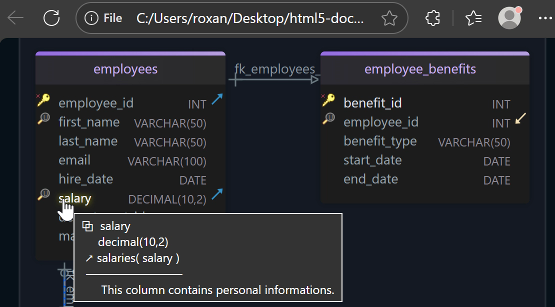
For the people who will never install a database client, DbSchema exports interactive HTML5 documentation from the same model: a vector diagram, a searchable table list, and column descriptions that appear as mouse-over tooltips. To see the disconnected workflow in more detail, read offline design mode and the notes on visual database design.
pgModeler, built for PostgreSQL alone
pgModeler is an open-source design tool written in Qt for PostgreSQL and no other engine, and it runs natively on Windows, macOS and Linux. It supports over 30 PostgreSQL object types, so domains, custom types, enumerated and range types, functions, triggers, row-level security policies and PostGIS geometry columns are all objects you place on the diagram rather than free text you attach to one.
The Community Edition is free software under the GNU General Public License v3[2], and you can download the source from GitHub and compile it yourself at no cost. The parts that touch a running server sit in the commercial Plus edition: reverse engineering from a live database, incremental diff and sync, the database management module, SSH tunneling and the Git-friendly split-model format. Plus is also where the pre-built installers come from, from $59.90 per six months.
SqlDBM and browser-based enterprise modeling
SqlDBM is a data modeling platform delivered as a browser application, so there is nothing to install and a model opens from any machine that can log in[3]. Team members comment on the model in the core platform, and the history and lineage views track how it changed.
Alongside PostgreSQL, SQL Server, Oracle, AlloyDB and MySQL, it names Snowflake, Databricks, BigQuery, Amazon Redshift, Azure Synapse and Microsoft Fabric, which is where its cloud focus points. You import a DDL script or connect a cloud platform, build conceptual, logical and physical models from it, and export DDL and alter statements to run yourself. Both tiers, Data Modeling and Context Layer, are priced on request rather than published. Context Layer lists AI Copilot, MCP, semantic modeling, global modeling, Model of Record, an Agent Framework and Catalog Sync on top of everything in Data Modeling.
Writing a schema as DBML in dbdiagram.io
dbdiagram.io takes the schema as code. You define tables, columns, types and foreign keys in Database Markup Language, a compact text syntax, and the diagram redraws in the pane beside the editor as you type[4]. The schema is written rather than drawn.
An existing SQL script can be imported to generate the layout, and a finished diagram exports as PDF, PNG or SVG, or as a link you share or embed in a documentation site. The free plan covers 10 diagrams; private diagrams, unlimited tables and version history are on the paid Personal Pro plan, and a Team plan adds shared workspaces and user management. dbdiagram.io does not compare a diagram against a live database or generate a migration from the difference.
ChartDB and its single-query diagram
ChartDB never asks for a connection. You run one read-only JSON metadata query against PostgreSQL yourself and paste the output into the browser, and ChartDB renders the diagram from that[5]. The query runs on your side, so no credentials, host address or network route reach ChartDB at all.
From there you can edit the layout in its DBML editor, annotate it with sticky notes, and export the design and the DDL statements that create it. The cloud-hosted free plan covers one user, one database and up to 10 tables; the Pro plan at $25 per month raises that to 100 tables, and Teams at $59 per month covers three users, five databases and 200 tables per database. The repository is open source, so you can self-host it instead.
How to reverse-engineer a live PostgreSQL database
Reverse engineering reads the system catalog and turns what it finds into a diagram. In DbSchema it takes five steps.
- Select Connect to Database, choose PostgreSQL, and enter the host, port, database, user and SSL settings in the Connection Dialog.
- Choose the schemas to read,
publicor the application schemas you care about. - Let DbSchema reverse-engineer the catalog, which reads the tables, columns, primary keys, foreign keys, indexes and constraints.
- Arrange the result on the diagram, move the tables of one subsystem onto a diagram of their own, and draw virtual foreign keys where the database declares none.
- Save the model as a
.dbsfile so you can reopen and edit it with no connection.
Only step 1 and step 3 touch PostgreSQL, and both only read it. The layout, the extra diagrams, the virtual foreign keys and any column you add afterwards are changes to the .dbs file alone; the server sees them when you open the Synchronization Dialog and approve them. That separation makes it safe to try a change on the model of a production database. A step-by-step PostgreSQL schema design starts in the model rather than in psql for the same reason.
Download DbSchema at https://dbschema.com/download.html and point it at your PostgreSQL server. The free Community Edition reverse-engineers the database, draws the diagrams and runs your SQL. Saving the .dbs model file, designing while disconnected, schema synchronization, the HTML5 documentation and the Relational Data Editor are Pro, a one-time perpetual licence with the first year of maintenance included and a yearly renewal after that[1]. Logical and conceptual design are in Architect, sold the same way. Draw the new tables in the model with the connection set to Disconnected, then let the Synchronization Dialog generate the migration once the review is done.
Frequently asked questions
What is the best PostgreSQL database design tool?
DbSchema, when the design has to exist before the database does: it keeps the model in a file you edit offline, then generates the migration from a diff against the live server. pgModeler models over 30 PostgreSQL object types natively, and its live reverse engineering ships in the paid Plus edition.
Can I reverse-engineer a live PostgreSQL schema?
DbSchema connects over JDBC and reverse-engineers tables, foreign keys and indexes into a diagram you can edit and save. ChartDB reaches the same picture through a read-only query you run yourself, and pgModeler does it in its paid Plus edition.
Are there free tools for PostgreSQL schema design?
The DbSchema Community Edition connects, reverse-engineers and diagrams a PostgreSQL database at no cost, with the SQL editor in the same window. ChartDB is open source and can be self-hosted, and pgModeler publishes its source under GPLv3 for you to compile.
How do I document my PostgreSQL database?
DbSchema generates HTML5, PDF or Markdown documentation from the design model, with the diagram, a searchable table list and every column description. Publish the HTML5 output on an internal server and everyone reads the current schema without installing anything. Documentation generation is a Pro feature.
How much does a PostgreSQL data modeler cost?
DbSchema Pro is a perpetual licence with the first year of maintenance included and a yearly renewal after that, and Architect is sold the same way. The DbSchema pricing page carries the current figures, and the Community Edition is free. pgModeler Plus starts at $59.90 per six months, and SqlDBM is quoted on request.
Sources
Model your PostgreSQL schema offline, then sync it
DbSchema reverse-engineers a live PostgreSQL database over JDBC, keeps the design in a Git-versionable .dbs model file, and generates the migration script from a visual diff. Interactive diagrams and the SQL editor are in the free Community edition.