Which Database Tool Edition a Team Actually Needs
For the engineering manager buying a database design tool for a team, with every edition boundary and every figure taken from the DbSchema pricing page.
On this page
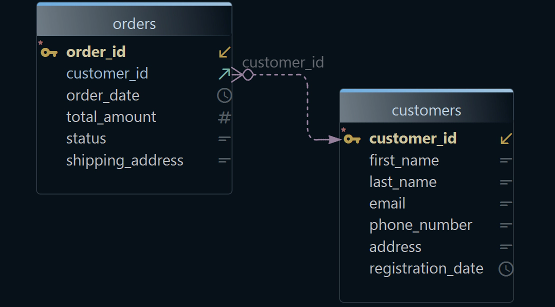
When a schema review ends with someone pasting a screenshot of a diagram into a chat window, what is missing is an edition rather than a process. The edition you want is the cheapest DbSchema edition that still covers what your team does with the schema: Community reads a database and draws it, Pro covers the work that starts once the diagram is there, and Architect adds modeling before any database exists. Below is how to tell which of the three a given piece of work needs, what separates them row by row, and what each one costs today.
The criteria that decide the edition
DbSchema sits in the path of application development and deployment, so the wrong edition is felt twice: once as spend on features nobody opens, and once as a workflow that stops because the schema cannot be saved, compared, or handed to anyone. Four capabilities separate the DbSchema editions, and each maps to a piece of work your team either does or does not do.
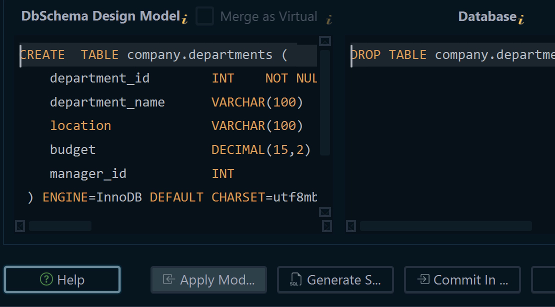
Offline schema design means creating and editing tables with no connection open, and keeping the result. In DbSchema that result is a .dbs model file, and saving it is where the Community line ends[1]. Multi-engine support means one window for relational engines such as PostgreSQL, MySQL, SQL Server, and Oracle alongside document engines such as MongoDB; DbSchema covers every supported engine in every edition, Community included, so this criterion never forces an upgrade.
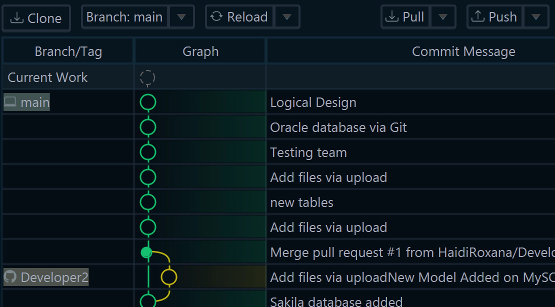
Git-native schema version control means the design lives in a text file that a reviewer can read. The DbSchema .dbs file is plain XML, diff-friendly by design, which is what lets a column change arrive in a pull request as a readable diff[2]. Schema synchronization means comparing that file against a live database and generating the DDL from the difference before anything is executed. Both of those are Pro.
Answering those four for your own team is usually enough to place the edition, because the questions are about work you can observe rather than about features you would have to trial blind.
How to test each one
Run the trial against a clone of your production schema rather than a sample database. A synthetic schema of ten tables shows you nothing about how a diagram behaves at two hundred, and it never produces the migration script you actually care about reading. A new DbSchema installation starts a 15-day free Architect trial, which includes every Pro feature, from the same installer as Community, extendable by another 15 days[3], so one installation covers the whole evaluation.
- Connect DbSchema to a database with at least fifty tables, foreign keys, composite indexes, and views, and reverse-engineer it. Watch how long the diagram takes and check that the constraints came across.
- Disconnect from the network, add a table and change a column type on the diagram, then reopen the model and confirm the layout is where you left it. These edits change the model file, not the database.
- Save the model, make one small change such as an index or a nullability constraint, and read the Git diff. The
.dbsfile is XML, so the diff should name the object you touched. - Open Schema → Compare Model with Database against a staging database and read every generated ALTER and CREATE statement before you run it. This is also where a schema comparison tool earns or loses your trust.
Step four is the one to insist on. DbSchema shows the SQL it intends to run and waits for you to click Execute, so an engineering lead can cancel the plan and nothing reaches the database unseen. That is the moment the live database changes; every step before it touched only the model file.
What the Community Edition can and cannot do
DbSchema Community Edition is free forever, for any use, with no registration and no expiry. It connects to every supported SQL and NoSQL engine, reverse-engineers the schema, draws interactive diagrams you lay out yourself, creates tables and columns visually, and runs a SQL editor with autocompletion[1]. For an engineer who needs to read a live structure, follow the foreign keys by eye, and run ad-hoc queries, that is the whole job.
What Community leaves out is the work that happens after the diagram exists, and all of it is one purchase away on the installation already in place.
| Capability | Community | Pro | Architect |
|---|---|---|---|
| All databases, connect and reverse-engineer | Included | Included | Included |
| Interactive diagrams, create tables and columns | Included | Included | Included |
| SQL editor with autocompletion | Included | Included | Included |
| Design offline and save the model to a file | Not included | Included | Included |
| HTML5, PDF and Markdown documentation | Not included | Included | Included |
| Query Builder | Not included | Included | Included |
| Schema synchronization | Not included | Included | Included |
| Relational data browse | Not included | Included | Included |
| Data Generator and Data Importer | Not included | Included | Included |
| AI Assistant subscription | Included | Included | Included |
| Logical and conceptual design | Not included | Not included | Included |
| AI Assistant with your own provider key | Not included | Not included | Included |
One row runs against the pattern. The AI Assistant is sold as its own subscription and works on every edition, Community included; only bringing your own provider key is restricted to Architect[1].
When to upgrade to the Pro Edition
DbSchema Pro is the edition for a team that keeps the schema under review rather than only reading it. The trigger is any one of four pieces of work, and each of them is impossible without it.
Saving the design to a .dbs file is the first, because it turns the schema into an artifact. The file holds the tables, the layout, the groups, the notes, and the virtual foreign keys in one XML document you commit next to the application code[2], which is what makes offline design and a reviewable plain XML model possible at all.
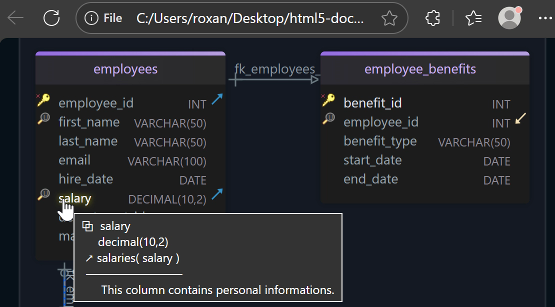
Documentation is the second. Diagram → Export HTML5 or PDF Documentation writes an interactive page with the diagram as a vector image, a searchable table list, and column descriptions that appear as mouse-over tooltips, so a frontend engineer or an analyst reads the schema in a browser with nothing installed.
Schema synchronization is the third. DbSchema compares the model file against a local, staging, or production database, lists the differences object by object, and generates the migration SQL from them. Relational data browse and the Query Builder are the fourth: the Relational Data Editor opens several tables at once along foreign keys and virtual foreign keys and refilters every child pane when you select a parent row, and the Query Builder assembles a multi-table SELECT with INNER JOIN, LEFT JOIN, or EXISTS from tables you drag onto the canvas. The Data Generator and the Data Importer come in the same edition.
DbSchema Pro is 294.00 USD one time plus taxes, with the first year of maintenance and upgrades included and 75.00 USD a year afterwards to keep receiving them, or 29.40 USD a month on the subscription plan[1]. Those are the figures on the Business tab of the pricing page, read on 6 September 2026; the same page carries a Personal tab and a Universities & Students tab showing lower amounts, and it prices in the visitor's own currency, so open it before you raise the purchase order.
What the Architect Edition adds
DbSchema Architect is Pro plus one workflow: modeling before a database exists. On the Business tab of the pricing page, it is 470.40 USD one time plus taxes with 120.00 USD a year to renew, or 47.04 USD a month, and a Pro licence upgrades to it for the 176.40 USD difference[1].
The workflow is logical design: you define entities, attributes, and relations with no engine chosen, so the model says what data exists and how it relates without committing to SQL syntax or to one vendor's data types. A naming dictionary then decides how a logical attribute name becomes a physical column name, and a conversion dictionary maps each logical type to the physical type of the target engine. Convert Model → Generate Physical Design turns the result into an editable physical schema for the database you pick, and you can generate more than one from the same logical model. All of that happens in the model file; nothing reaches a database until you synchronize.
The other Architect row is own-key AI. The DbSchema AI Assistant works on every edition through its own subscription, and connecting your organization's own OpenAI, Azure OpenAI, Claude, Gemini, or DeepSeek account instead is the Architect variant[4]. The assistant reads the DDL you attach to a question and never your data, in either case.
Buy Architect when someone on the team draws a model before the engine is chosen, or when the same domain model has to land on two different databases. Otherwise Pro is the edition, and nothing is lost by starting there.
What the cost is over three years
DbSchema sells both shapes, so the three-year question is about how you want to pay rather than about which product you get: the perpetual licence and the monthly subscription carry the same features. The table below adds up the Business tab amounts read on 6 September 2026, and the pricing page shows those amounts in your own currency, so take the totals for a budget from the page itself[1].
| Over three years | Pro perpetual | Pro monthly subscription |
|---|---|---|
| Year 1 | 294.00 USD once, first year of updates included | 12 payments of 29.40 USD |
| Year 2 | 75.00 USD if you renew, nothing if you do not | 12 payments of 29.40 USD |
| Year 3 | 75.00 USD if you renew, nothing if you do not | 12 payments of 29.40 USD |
| Three-year total | 294.00 USD, or 444.00 USD with both renewals | 1,058.40 USD |
| If payments stop | The purchased version keeps running | Access to the latest release ends |
The renewal is optional in the perpetual case, and that is the part worth reading twice. DbSchema's perpetual licence includes one year of updates and technical support; after that you keep the version you are entitled to, and a renewal buys the latest features, security fixes, and support rather than the right to keep working[5]. A team that upgrades tooling on its own schedule pays once and renews when a release is worth it.
The subscription is the better shape when tooling has to come out of an operating budget rather than a capital one, or when you want every release the moment it ships without deciding each year. Both are per developer.
The questions to ask a vendor
Five questions separate a design tool you can leave behind from one you cannot, and DbSchema's answers are on its documentation pages rather than in a sales call.
- The format the design is stored in, and whether Git can diff and merge it
- Working with no connection open and no schema metadata leaving the machine
- Reassigning a licence when someone leaves the team
- Whether the installed licence keeps working after maintenance lapses
- Installers for Linux, macOS, and Windows
DbSchema answers the first with the plain XML .dbs file[2], the second with offline design in Pro, the fourth with the perpetual licence that keeps running after a renewal lapses, and the fifth with installers for all three operating systems on one download page. On the third, commercial licences can be reassigned from the Customer Area: each seat shows its assigned email and can be changed, with a seat that was assigned by hand locked for three months from that date[5].
Download DbSchema at https://dbschema.com/download.html and reverse-engineer your own database into a diagram on the free Community Edition first. Then start the trial and run one comparison against staging: if the generated migration script is something your team would use, Pro is the edition you are buying, and Architect only if someone draws models before the engine is chosen.
Frequently asked questions
What is the difference between DbSchema Community and Pro?
DbSchema Community reads a database and draws it; DbSchema Pro covers what a team does with the schema afterwards, starting with saving it to a .dbs file. The row-by-row split is the table under what the Community Edition can and cannot do.
How much does DbSchema Pro cost for a team?
DbSchema licences are per developer, and one person may install DbSchema on two computers as long as both are not in use at the same time. A team that opens DbSchema in bursts rather than all day buys a floating licence instead, where the purchased quantity caps how many people work at once rather than how many are on the list. The per-developer figures are under when to upgrade to the Pro Edition.
What extra features does DbSchema Architect offer?
DbSchema Architect adds logical design, where the vocabulary changes with the level: a table is an entity, a column is an attribute, and a foreign key is a relation carrying identifying, non-identifying, and many-to-many forms with cardinality. A many-to-many relation is resolved into a junction entity when the logical model is converted to a physical one. What that workflow is for, and what the edition costs, is under what the Architect Edition adds.
Can a DbSchema licence be moved to another developer?
Only commercial licences can be reassigned; personal and educational ones cannot. On a commercial licence, seat 1 is assigned automatically to the owner's email and the remaining seats start unassigned, and an automatically assigned seat can be moved freely. The lock that applies to a seat assigned by hand is under the questions to ask a vendor.
What happens if we stop renewing DbSchema maintenance?
A perpetual DbSchema licence keeps running when maintenance lapses, and what stops arriving is new releases, security fixes, and technical support. How that compares with the monthly plan, which ends access to the latest release instead, is under what the cost is over three years.
Sources
Try the edition your team actually needs
DbSchema Community connects to any database, reverse-engineers the schema and draws interactive diagrams for free. Pro adds the saved model file, schema synchronization, the Query Builder and HTML5 documentation. Architect adds logical and conceptual design. Start with Community and move up only when a feature forces it.