Licensing a Database Design Tool for a University Course
For the instructor or department picking licences for a database course, with every edition boundary and every figure taken from the DbSchema pricing page.
On this page
A database course has to be licensed twice: once for thirty students who will each install something on a laptop, and once for the lab machines a cohort rotates through. DbSchema covers the first at no cost, because the Community Edition is free forever for any use and reverse-engineers any supported engine into a diagram, and it prices the second from a Universities & Students tab that sits alongside the Business one on the pricing page[1].
Choosing a database design tool for a course
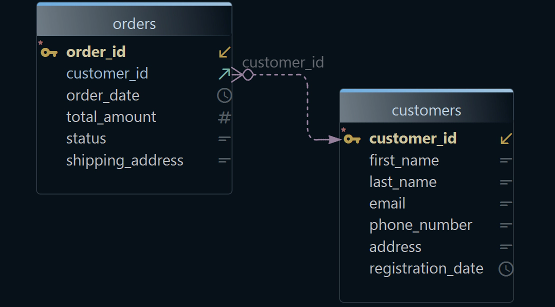
Normal forms, keys, and constraints are hard to teach through DDL text alone, because nothing on the screen shows a student that two tables are connected until they read the constraint and hold it in their head. A diagram does that work: the relation is a line, and the cardinality is visible on it. Reverse-engineering matters even more early on, since a first assignment usually starts from a schema that already exists rather than a blank canvas, and DbSchema draws that schema from the live database in the free edition.
The other thing a syllabus needs is one application for the whole term. Courses now mix relational engines with document stores, and switching products halfway through the semester means teaching a second interface instead of a second data model. DbSchema connects to PostgreSQL, MySQL, SQLite, Oracle, and MongoDB from the same window, in every edition, so the relational and document halves of the course sit in one tool. Students who work offline stay productive too: the design lives in a local model file rather than on a server the campus network has to reach.
What the free Community Edition covers
DbSchema Community Edition is free forever, for any use, and it is not a trial. The 15-day clock advertised on the download page belongs to the Pro features; Community itself never expires[2]. For an introductory class that is often the whole licensing decision.

Students on Community connect to a local or remote database, reverse-engineer the schema, explore interactive ER diagrams, create tables and columns visually, and run queries in the SQL editor with autocompletion[1]. What that covers is every lab exercise built around reading an existing schema, drawing it, and querying it.
| Feature | Community | Pro | Architect |
|---|---|---|---|
| All databases, connect and reverse-engineer | Included | Included | Included |
| Interactive ER diagrams, create tables and columns | Included | Included | Included |
| SQL editor with autocompletion | Included | Included | Included |
| Design offline and save the model to a file | Not included | Included | Included |
| HTML5, PDF and Markdown documentation | Not included | Included | Included |
| Query Builder | Not included | Included | Included |
| Schema synchronization | Not included | Included | Included |
| Relational data browse | Not included | Included | Included |
| Database management applications | Not included | Included | Included |
| Data Generator and Data Importer | Not included | Included | Included |
| AI Assistant subscription | Included | Included | Included |
| Logical and conceptual design | Not included | Not included | Included |
| AI Assistant with your own provider key | Not included | Not included | Included |
The rows Community leaves out are the ones a multi-week group project runs into, and each is a single purchase on the same installation rather than a different product. That boundary is worth checking against your assignment sheet before the term starts, and the wider free-tier trade-offs are set out separately.
What Pro adds for semester projects
DbSchema Pro is the edition for a project that is graded on how the design changed, not only on where it ended.
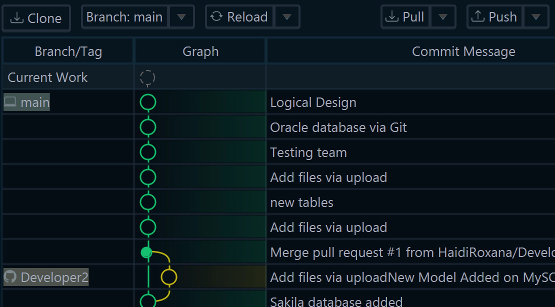
The reason is the model file. Pro saves the schema as a .dbs file in plain XML, so a student team commits it to a Git repository, works in branches, and produces a readable diff for every column they added[3]. Marking iterative design work becomes reading commits rather than comparing screenshots. Offline design comes with the same row: the model opens and edits with no database connection at all, which matters for coursework done on a train or in a room with no access to the department server.
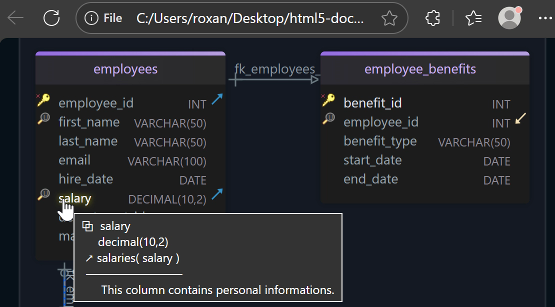
Two more Pro rows earn their place in a course. Diagram → Export HTML5 or PDF Documentation turns a model into an interactive page with a searchable table list and column descriptions as mouse-over tooltips, which is a submission format that needs nothing installed to grade. Schema synchronization compares the model file against a live database and generates the migration SQL from the difference, so a deployment exercise ends with a script the student reads before running it. Everything before that click changes the model file only; the database changes when the generated script is executed.
Which database tool edition a syllabus needs usually comes down to whether those three rows appear in an assignment.
Prices on the Universities & Students tab
The pricing page carries three audience tabs, and the Universities & Students one is where academic buyers should read the figures[1]. Licences are per developer, and one user may install DbSchema on two computers as long as both are not in use at the same time.
| Universities & Students tab | Perpetual, one time | Monthly | Optional renewal, year 2 onwards |
|---|---|---|---|
| DbSchema Community | Free | Free | None; upgrades stay free |
| DbSchema Pro | 98.00 USD | 9.80 USD | 25.00 USD a year |
| DbSchema Architect | 156.80 USD | 15.68 USD | 40.00 USD a year |
All figures exclude taxes, are per developer, and were read on 6 September 2026. The same editions are 294.00 USD and 470.40 USD on the Business tab, so the academic tab is the one to open. The page also prices in the visitor's own currency: every dollar amount in this article is what that page shows in US dollars, so open it once to read the same figures in yours before a purchase order goes out. The perpetual licence includes one full year of updates and technical support, after which renewal is optional: skip it and the version you bought keeps working, with new releases the only thing you stop receiving[4].
Teaching logical modeling with the Architect Edition
An advanced course usually wants students to model before choosing an engine, and that is the one workflow DbSchema Architect adds on top of Pro.
In DbSchema logical design you define what data exists and how it relates without committing to SQL syntax, vendor data types, or physical tuning. The vocabulary changes with the level, which is itself a teachable point.
| Physical design | Logical design | Notes |
|---|---|---|
| Schema | Subject Area | |
| Table | Entity | |
| Column | Attribute | |
| Foreign Key | Relation | Identifying, non-identifying, many-to-many, plus cardinality |
Relations carry the properties a modeling class spends weeks on: identifying against non-identifying, mandatory against optional, and cardinality of 1:1, 1:n, or many-to-many, with a many-to-many relation resolved into a junction entity when the model is converted. A naming dictionary then decides how a logical attribute name becomes a physical column name, and a conversion dictionary maps each logical type to the physical type of the target engine. Convert Model → Generate Physical Design produces the editable physical schema, and running it twice against two engines shows a class exactly where abstract structure meets vendor specifics.
On the Universities & Students tab DbSchema Architect is 156.80 USD per developer one time plus taxes, against 470.40 USD on the Business tab, with an optional 40.00 USD a year afterwards[1]. A department budgets by seat rather than by institution, so the count that matters is how many people run the Architect workflow. Whether a one-off purchase or a monthly fee suits the budget cycle better is covered in perpetual or subscription for database tooling.
The AI Assistant in a course
The DbSchema AI Assistant is an optional add-on subscription at 9.00 USD a month plus taxes, and it works on every edition, Community included; only supplying your own provider key is restricted to Architect[1].
What makes it usable in a teaching context is what it sends. The assistant is schema-aware and reads the DDL you attach to a question, never the data in the tables[5], so a class working against a shared instance is not shipping rows to a model provider. Answers come back as Markdown with SQL in code blocks, ready to paste into the SQL editor.
That fits three kinds of exercise directly: writing a query from a plain-English description and then explaining why the generated SQL is right or wrong, asking why an existing query is slow, and asking for a design review of a schema a student just drew.
Where even table names count as sensitive, selecting Ollama in AI Settings runs the model on the machine itself, so nothing leaves the computer at all. Ollama is one of the own-provider routes, so that setting needs the Architect edition, while the DbSchema subscription that serves the model works on Community[5]. Where a department forbids AI features outright, clearing the Enable checkbox in Edit → Settings → General → AI Assistant removes the assistant from DbSchema after a restart.
Floating licences for a shared computer lab
A lab is the case a floating licence exists for. A DbSchema floating licence is per team rather than per person: a shared pool in which the number of people working at the same time equals the purchased quantity, while the list of allowed users can be as long as you like[4]. A seat is checked out when someone starts DbSchema and released when they close it, so consecutive cohorts rotating through the same room reuse the same seats.
Administration is a list of email addresses. The licence owner opens Manage Users & Keys on the floating subscription in the Customer Area and adds the allowed users on the Manage Users tab; each person then activates from Help → Register License with their own allowed-listed address. Where lab machines cannot reach the internet, DbSchema runs a Floating License Server you host yourself, from the official Docker image or from DbSchemaCLI[4].
The floating licence is quoted on the Business tab rather than the Universities & Students one, at 1,168.00 USD one time plus taxes with the first year of updates included and an optional 280.00 USD a year afterwards, read on 6 September 2026[1]. DbSchema ships Windows, macOS, and Linux installers from one download page, so a mixed lab needs one arrangement rather than three, and the mechanics of the pool are set out in how floating licences work for a database team.
Perpetual or subscription for a department budget
Both shapes exist for the same editions, and a department usually picks by budget cycle rather than by feature.
| DbSchema perpetual | DbSchema monthly subscription | |
|---|---|---|
| Year 1 | One payment per seat, first year of updates included | A payment every month |
| Year 2 onwards | Optional renewal at the published annual rate | The same monthly payment |
| Budget treatment | A single line, approved once | A recurring line, every term |
| If payments stop | The purchased version keeps working | Access to the latest release ends |
A perpetual licence fixes the cost of a course for as long as the syllabus is stable, and skipping the renewal in a lean year costs new releases rather than the software. The subscription suits a course that runs once and then changes, or a budget that has no capital line at all.
For an introductory class, the free DbSchema Community Edition is enough on its own. Download it at https://dbschema.com/download.html, point it at the course database, and let it reverse-engineer the schema into a diagram in the first lab. Add Pro for the offline model file, the documentation export, and schema synchronization when a project is graded on how the design evolved, and Architect where the course teaches logical modeling before an engine is chosen.
Frequently asked questions
Is there a free version of DbSchema for students?
DbSchema Community Edition is free for any use and needs no licence at all, so a class installs it without a purchase order. The paid educational licence is a separate user type, for students and teachers, that buys the Pro or Architect rows; what Community itself covers is under what the free Community Edition covers.
What features are omitted from the free Community Edition?
Community leaves out the rows a multi-week group project runs into, starting with saving the design to a file, and all of them are DbSchema Pro or Architect on the same installation. The row-by-row list is the table under what the free Community Edition covers.
How much is the DbSchema educational price?
On the Universities & Students tab of the pricing page, DbSchema Pro is 98.00 USD per developer one time plus taxes and Architect is 156.80 USD, in the US dollar rendering of a page that prices in the visitor's own currency. The monthly figures, the renewals, and the Business-tab comparison are in the table under what Pro adds for semester projects.
What is the DbSchema renewal cost after the first year?
A perpetual licence includes one year of updates and technical support, and the renewal after that buys the latest features, security fixes, and continued support rather than the right to keep working. The academic renewal figures are in the same table under what Pro adds for semester projects.
Can a university buy a DbSchema floating licence for a computer lab?
A floating licence is the only DbSchema licence that several people may share, which is what a lab of rotating cohorts needs. On a self-hosted Floating License Server, license server -l in DbSchemaCLI lists who is holding a seat, so a pool can be sized against a real cohort rather than a guess; the rest of the lab arrangement is under floating licences for a shared computer lab.
Can an educational DbSchema licence be reassigned to another person?
Only commercial licences can be reassigned to another person; educational and personal licences cannot. A department that expects seats to move between staff should buy commercial licences and reassign them from the Assign Users tab in the Customer Area.
Sources
Open a design model against your own database
DbSchema reverse-engineers a live schema into interactive ER diagrams. The free Community Edition covers all supported databases, connect and reverse-engineer, interactive diagrams and the SQL editor. Saving the model to a file, HTML5, PDF and Markdown documentation, the Query Builder and schema synchronization are Pro and Architect features; logical and conceptual design is Architect.