MongoDB Relationships – Embed vs Reference and Visualize in DbSchema | DbSchema

- Introduction to MongoDB
- Installation & Database Creation
- CRUD Operations
- Embedded Documents and Arrays
- Validation Rules - Enforcing Structure in MongoDB
- Visualize MongoDB Relationships (Embedded vs Referenced) (You are here).
- What Is an Index in MongoDB?
- Aggregation Pipeline Explained
Table of Contents
- Referenced relationships
- Embedded relationships
- Embed vs reference comparison
- Common MongoDB relationship patterns
- Why visualization matters
- Visual relationships with DbSchema
- FAQ
MongoDB is flexible, fast, and great for modern applications. But that flexibility comes with a challenge: how do you organize and connect your data without the strict structure of relational databases?
In this article, we’ll break down how relationships work in MongoDB using two main approaches: referencing and embedding. Then we’ll look at how you can bring structure and visibility to those connections using virtual relationships in DbSchema - a visual design tool for MongoDB.
Referenced Relationships
Referenced relationships work a lot like foreign keys in traditional SQL databases. One document stores an _id, and another document refers to it using a field like user_id or movie_id.
Example
Let’s say you have three collections: users, reviews, and movies.
// users
{
  "_id": ObjectId("64fabcde1234567890abc001"),
  "name": "Bob Johnson",
  "phone": "0723-731-652"
}

// movies
{
  "_id": ObjectId("64fabcde1234567890abc002"),
  "title": "Inception",
  "genre": "Sci-Fi",
  "release_date": "2010-07-16"
}

// reviews
{
  "_id": ObjectId("64fabcde1234567890abc003"),
  "user_id": ObjectId("64fabcde1234567890abc001"),
  "movie_id": ObjectId("64fabcde1234567890abc002"),
  "rating": 4,
  "comment": "Great movie!"
}
In this case, the user_id in the reviews collection points to the _id in the users collection, and the movie_id points to the _id in the movies collection.
These relationships are not enforced by MongoDB like foreign keys in SQL, but you can use $lookup in aggregation queries to join the data when needed - for example, to show the user who wrote a review and the movie it refers to.
Embedded Relationships
Another way to model relationships in MongoDB is by embedding documents directly inside other documents. This works well when the related data is tightly coupled and usually accessed together.
Instead of storing users, movies, and reviews in separate collections, we can embed the review (and even some user details) inside the movie document.
Example
// movies
{
  "_id": ObjectId("..."),
  "title": "Inception",
  "genre": "Sci-Fi",
  "release_date": "2010-07-16",
  "reviews": [
    {
      "user_name": "Bob Johnson",
      "phone": "0723-731-652",
      "subscription_plan": "Standard",
      "rating": 4,
      "comment": "Great movie, but hard to follow."
    }
  ]
}
In this case:
-
The movie and its reviews are stored together in a single document.
-
Each review includes user information like name, phone number, and subscription plan.
This model is great when:
-
You typically read the movie and its reviews together.
-
You don’t need to access or update users separately.
-
The embedded data won’t grow too large over time.
However, if a user leaves multiple reviews for different movies, or if user details change often, embedding can lead to duplication and make updates harder to manage. In those cases, referencing is the better choice.
Embed vs reference comparison
| Choose embedding when... | Choose references when... |
|---|---|
| child data is always read with the parent | the related data must be reused elsewhere |
| document growth stays small and predictable | child documents change independently |
| you want fewer read operations | you want to avoid duplication |
| the relationship is tightly coupled | the relationship is large or many-to-many |
This decision is one of the most important MongoDB design trade-offs. If you are moving from SQL, think of embedding as denormalization and referencing as a softer equivalent of foreign-key-based modeling.
Common MongoDB relationship patterns
Top-ranking relationship guides usually cover more than one-to-many examples, because users want help modeling real schemas:
- One-to-one - profile details stored in the same document or as a referenced collection.
- One-to-many - a movie with reviews, or a customer with orders.
- Many-to-many - tags, users and teams, or products and categories, often modeled with references plus
$lookup.
When relationships get complex, $lookup becomes more important. For practical join examples, read MongoDB $lookup and MongoDB aggregation pipelines.
Why visualization matters
Collections and documents can stay understandable for a while in code alone, but larger MongoDB projects usually benefit from diagrams:
- new teammates can understand the schema faster
- virtual relationships expose hidden dependencies between collections
- validation rules and indexes become easier to review together with the data model
- teams can document decisions about when they embedded data and when they referenced it
The Challenge: MongoDB Doesn't Enforce Relationships
Because MongoDB doesn’t enforce relationships between collections, there’s nothing built-in to guarantee data consistency across them.
For example:
- A
user_idin anotificationscollection might not actually exist in theuserscollection. - There are no automatic checks, constraints, or warnings if data goes out of sync.
- Joining related data requires manual
$lookupqueries - and those can get complex, especially as your data grows.
This flexibility is part of what makes MongoDB powerful - but without structure, it can also become a hidden risk. You lose some of the clarity and safety that comes from defined relationships in relational databases.
Visual Relationships with DbSchema
That’s where DbSchema helps.
Even though MongoDB doesn't have built-in foreign keys, DbSchema lets you define virtual relationships between collections. You can drag a line from users._id to notifications.user_id, for example - and visually connect the dots.
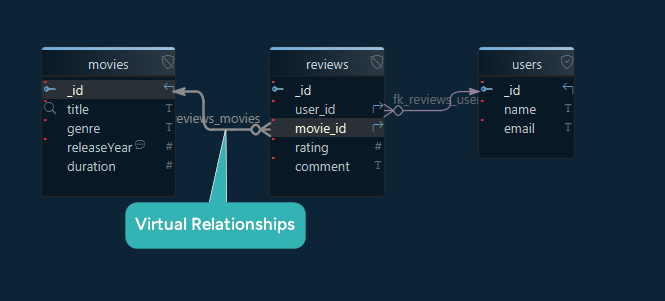
These virtual relationships are:
- Not stored in the database
- Used only inside DbSchema
- Incredibly useful for understanding structure and exploring your data
Read how you can create virtual relationships in MongoDB in this article.
You can even use them in the Data Browser to follow connections across collections - without writing any joins by hand.
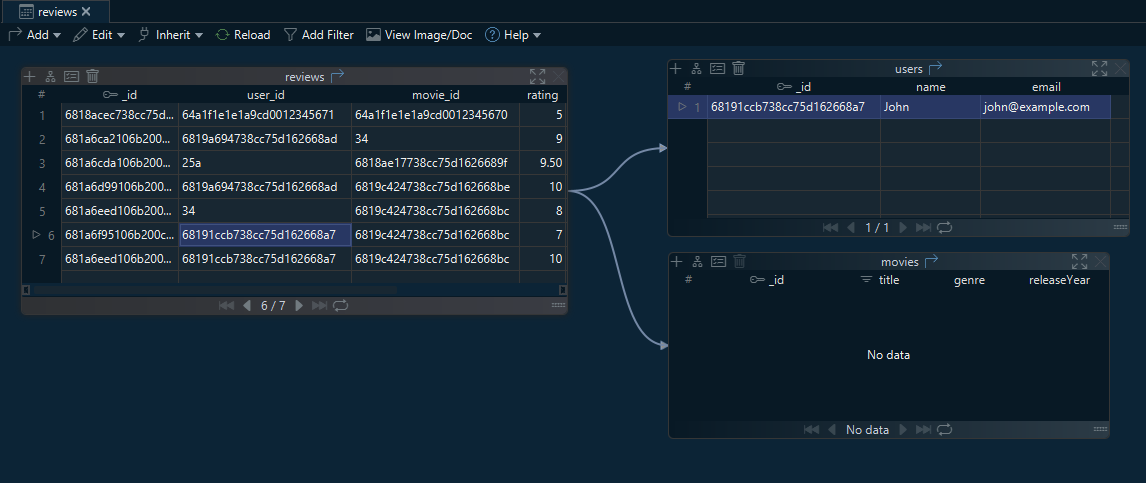
Read how you can explore related collections using virtual relationships in DbSchema in this article.
It’s a great way to bring back structure, clarity, and teamwork - without giving up MongoDB’s flexibility.
For a broader product workflow, combine this with the diagram documentation, the MongoDB tool page, and the guide on MongoDB schema design.
FAQ
Should I embed or reference in MongoDB?
Embed when the related data is small, tightly coupled, and usually read together. Reference when the data changes independently, is shared by multiple collections, or can grow large.
Can MongoDB support many-to-many relationships?
Yes. MongoDB can model many-to-many relationships with arrays of references, bridge-style collections, or a combination of references and $lookup.
Does MongoDB enforce foreign keys?
No. MongoDB does not enforce foreign keys the way relational databases do, which is why visual modeling and validation rules are helpful.
How do I visualize MongoDB relationships?
You can define and inspect virtual relationships in DbSchema, which gives you diagram-based visibility without changing the actual database.
Next Chapter
Indexes in MongoDB - Boosting Performance and Query Speed
Learn how indexes work in MongoDB and how they can improve query performance. This guide covers different types of indexes and when to use them:
-
What indexes are and why they matter in MongoDB
-
The difference between single-field, compound, and text indexes
-
How to create and manage indexes manually or visually in DbSchema