Affordable Data Modeling Tools for Small Teams, Compared With Enterprise Suites
What a small team gets from a one-time data modeling license, what enterprise modeling suites cost per user, and how to share one model without a model server.
On this page
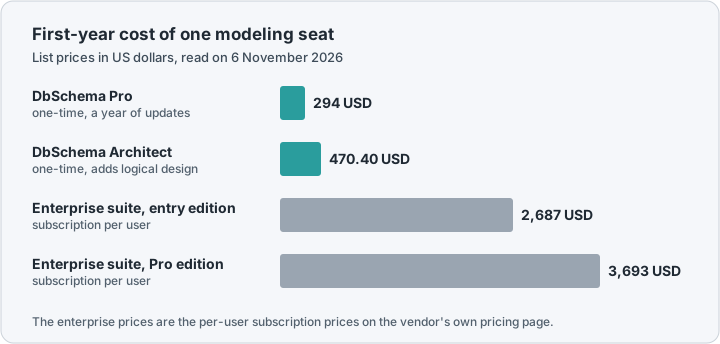
DbSchema gives a small team real data modeling at a fraction of an enterprise suite's price per seat. The suites you looked at may cost more per seat than the rest of your tooling together. DbSchema Pro gives a small team physical modeling, schema compare and a model kept in Git for 294 USD per seat, once. DbSchema Architect adds logical and conceptual modeling for 470.40 USD. ER/Studio Data Architect lists 2,687 USD per user as a subscription.
Short answer
A small team needs the modeling, not the model server around it. DbSchema keeps the model in a file you commit to Git, generates the SQL for your database, and compares the model with each environment. Pro covers the physical model; Architect adds logical and conceptual design.
- DbSchema Pro, 294 USD once per seat: physical model, Git, schema compare, documentation.
- DbSchema Architect, 470.40 USD once per seat: adds logical and conceptual design.
- Enterprise suites share models through a model server; a small team can share the model file in Git.
What enterprise modeling suites cost per user
The two best-known modeling suites publish prices that add up fast for a handful of people. ER/Studio lists Data Architect at 2,687 USD and Data Architect Pro at 3,693 USD, each as a total subscription price per user, on its own pricing page (read on 6 November 2026). The Enterprise edition is quote only. Quest's UK government price list from January 2026 puts erwin Data Modeler Standard at 2,139.59 GBP for the first year of a term license.
Those suites are built around a shared model repository. ER/Studio, for example, offers its Git integrations through Team Server Core at additional cost, according to its edition comparison. A team of five that keeps its code in Git already has the place where a shared model can live.
What a small team needs from a modeling tool
Strip the suite down to the work, and a small team needs five things from a modeling tool. Each one is in DbSchema, and the licensing documentation lists which edition covers it. Which edition a team actually needs goes through them feature by feature:
| What the team does | DbSchema edition |
|---|---|
| Reverse-engineer a database into a diagram | Community, free |
| Save the model to a file and share it through Git | Pro |
| Compare the model with a database and generate the migration script | Pro |
| Export HTML documentation of the schema | Pro |
| Design the logical and conceptual model before choosing a database | Architect |
What to see: four of the five jobs need Pro or less, so most people on a small team need a Pro seat at most.
A person who connects, reads the diagram and runs SQL stays on the free Community Edition. The people who change the schema need Pro. The one who models the business domain before the database exists needs Architect, which is 176.40 USD more than Pro per seat. A five-person team with four Pro seats and one Architect seat pays 1,646.40 USD once. That is less than one ER/Studio Data Architect user.
Share one model through Git instead of a model server
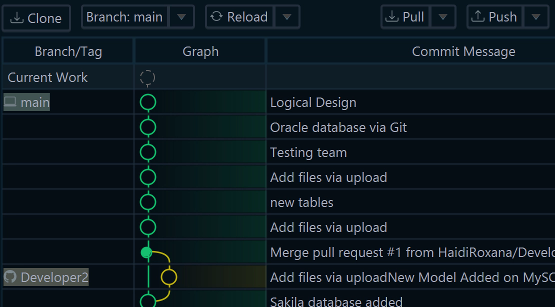
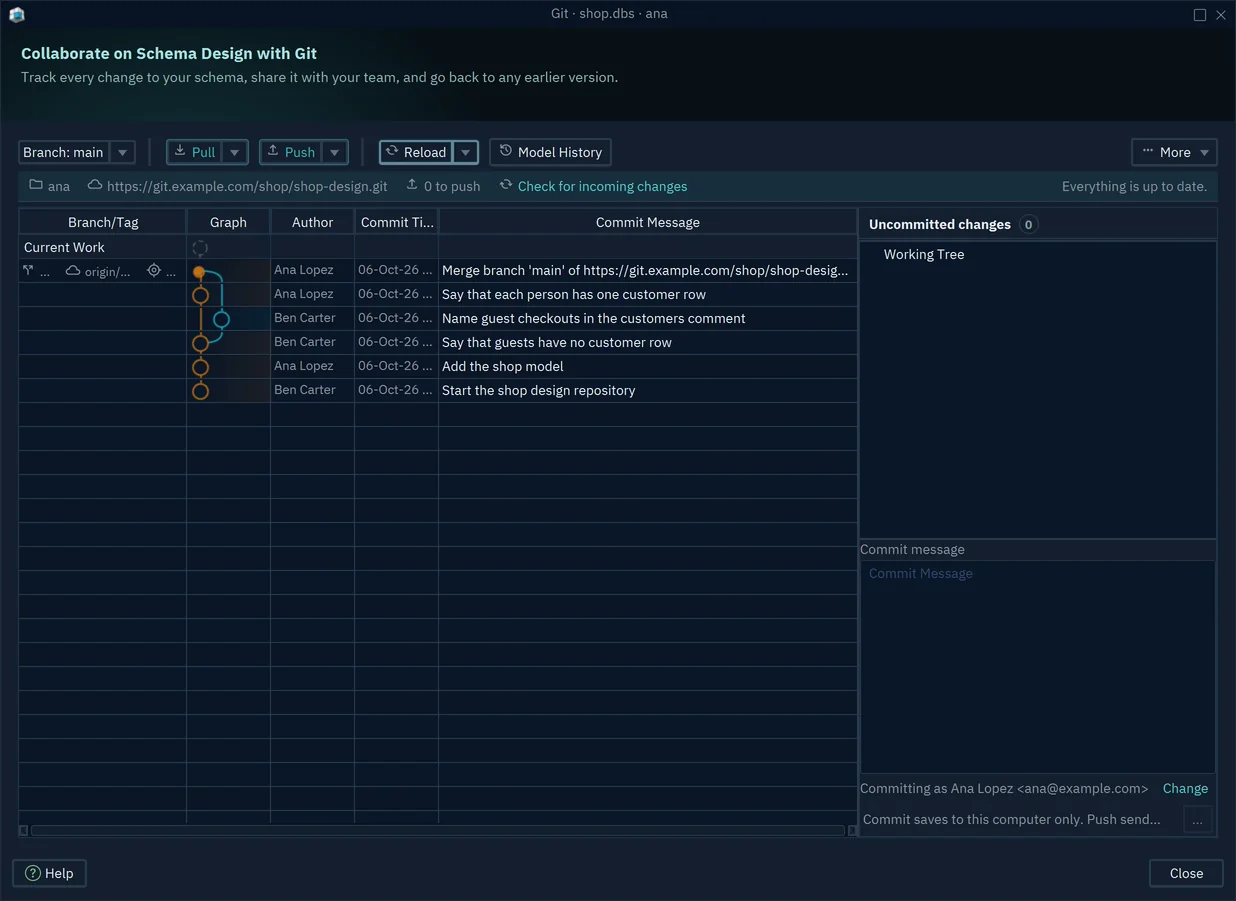
In DbSchema the model is a .dbs file on your disk. You commit it to the same Git repository as the application code. A teammate pulls it, changes it and pushes it back, as the Git documentation shows. DbSchema reads the history of the model file and shows who changed which table.
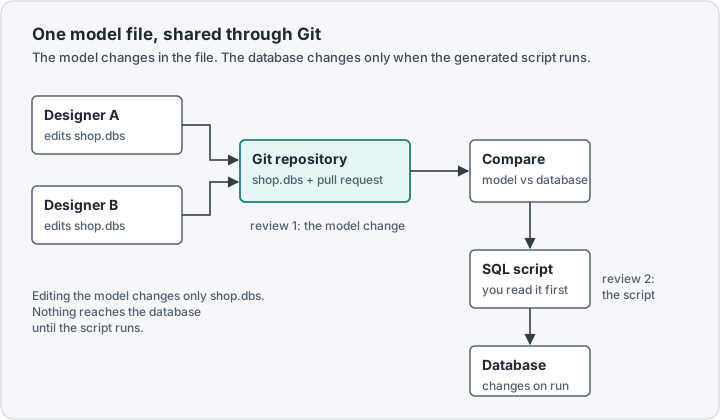
A change to the model changes the file only. It reaches a database when someone compares the model with that database in DbSchema and runs the generated script. So the review happens twice: once in the pull request on the model file, and once on the script before it runs.
When two people change the model at the same time, Git reports a conflict on the .dbs file. DbSchema then opens a merge window with both versions side by side. Team collaboration in schema design with Git walks through that workflow.
Logical design without the suite price
Logical and conceptual modeling is often the reason a team looks at an enterprise suite in the first place. In DbSchema Architect, a logical design holds entities, attributes and relations with general data types, and connects to no database. When the team picks a database, DbSchema converts the logical model into a physical model for PostgreSQL, SQL Server or another database. The logical model stays as it is.
That covers the step that sits between a whiteboard and the first CREATE TABLE. Logical design for databases shows the workflow from entity to generated table.
Other modeling tools in the same price range
A few other tools sit below the enterprise suites, each with a limit worth checking for a small team. These facts come from each vendor's own pages, read on 6 November 2026.
Redgate Data Modeler runs in the browser only: "No setup, no installation, all in the cloud", in Redgate's words. Its Standard edition costs 189 USD per user a year and caps a model at 100 tables. Logical design is in Pro, at 303 USD per user a year. Hackolade's free Community edition has no forward- or reverse-engineering and allows 50 objects per model. Its Workgroup edition, the one with Git, costs 1,750 EUR per seat a year. SqlDBM publishes no prices and sells per user by quote.
DbSchema runs on Windows, macOS and Linux as a desktop application and keeps the model on your disk. Its free Community Edition already reverse-engineers a live database. What a free database design tool can actually do shows how far Community goes before you buy a seat.
Download DbSchema and model your own schema in the 15-day trial. Git, schema compare and documentation need DbSchema Pro, and logical and conceptual design need DbSchema Architect.
Sources
Model your own schema in the trial
Every DbSchema download starts with a 15-day trial of all features. Git, schema compare and documentation are in DbSchema Pro; logical and conceptual design is in DbSchema Architect.