What a Free Database Design Tool Can Actually Do
For the developer, student or teacher choosing a database design tool with no budget, who needs to know exactly where the free tier stops.
On this page
Every free database design tool draws a diagram. They separate on the second task: reading an existing database, running a query against it, still being usable in a month. DbSchema Community edition connects to every database DbSchema supports, reverse-engineers the schema into an interactive diagram, creates tables and columns, and runs SQL in the editor, free for any use and with no time limit[1]. Saving the model to a file, the documentation export, schema synchronization and the data tools start at Pro.
Can I create my own database for free?
The engine costs nothing. PostgreSQL, MySQL Community Edition, SQLite and MongoDB Community Server are all free to download and run, on a laptop or on a server, which is why they turn up in university coursework and in commercial software alike. The cost question is never about the engine.
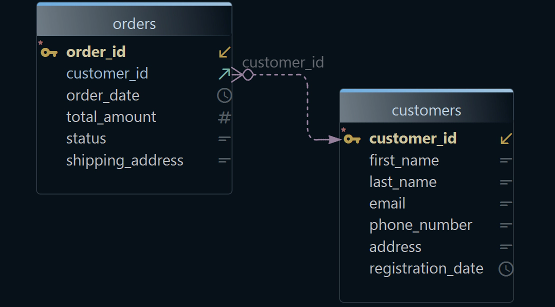
The cost lands on the software you put in front of the engine. psql and the mysql command line do everything the engine offers, and neither shows you the foreign keys of a schema you did not design. DbSchema Community closes that gap: it connects to the free engine you already run, reads the catalog, and draws the tables and the relationships between them, so you see the shape of the data before you write a query against it. Where each product's free tier stops is the whole question, and the answers differ sharply.
What is the best free database design software?
For visual modeling against a real database, start with DbSchema Community edition. It is free for any use with no expiry, covers every engine DbSchema supports rather than one, reverse-engineers a live schema into interactive diagrams, and includes the SQL editor with autocompletion and an editable Result Pane. Nothing in it counts tables or days.
If you would rather write the schema as text, dbdiagram.io renders diagrams from DBML, a markup language whose documentation shows the syntax mapping to SQL output[2]. It is a different way of working rather than a smaller one: you type a definition and the picture follows, instead of reading a picture out of a database.
| Tool | Design starts from | Free tier covers |
|---|---|---|
| DbSchema Community | A live database or the diagram | All engines, reverse-engineering, diagrams, SQL editor |
| dbdiagram.io | DBML text | Diagrams rendered from markup |
The choice matters most when you are teaching. A student who builds a foreign key by dragging a column onto another sees the relationship as a line; a student who writes DBML learns the syntax first and sees the line afterwards. Both arrive at a schema, and only one of them also connects to the database the schema is supposed to describe. For a broader field, see the evaluation of free database design tools.
Is there a free version of MySQL Workbench?
Yes, and it is Oracle's own. The MySQL Workbench Community release is a free download for Windows, macOS and Linux, and the reference manual documents the Community and Commercial releases together for versions 8.0 through 8.0.47[3]. The manual splits the product into database development, database design and modeling, administrative tasks, performance tools and a database migration wizard, which is a wide spread of work for a free tool.
The boundary is the engine. MySQL Workbench is documented against MySQL servers, so the moment a project adds PostgreSQL, Oracle or MongoDB, the diagram of that half of the estate has to come from somewhere else. DbSchema Community covers those engines from one installation and one diagram set, which is the difference that shows up in a course covering more than one database, or in a project whose reporting database is not the one the application writes to. The comparison of MySQL database design tools goes through the multi-engine options in detail.
Does Navicat have a free version?
PremiumSoft publishes Navicat Premium Lite as a free edition of its commercial client, described as carrying the core features for basic database operations and usable across up to five user accounts. It connects to MySQL, PostgreSQL, SQL Server, Oracle, MariaDB, SQLite, MongoDB and Redis among others, edits records in grid, tree and JSON views, and imports and exports TXT, CSV, XML and JSON[4].
What that adds up to is a data browser rather than a schema designer. Records are the unit of work: you find a row, change it, move data in and out. Designing means working with tables, keys and the lines between them, then producing the SQL that puts the design into a database, and that is where DbSchema Community starts: reverse-engineer the schema, edit tables and columns on the diagram, and run the SQL yourself in the editor.
Is SQL Compare free?
Redgate SQL Compare has no permanently free edition. It ships a fully functional 14-day trial, after which a commercial licence is needed to keep comparing and deploying SQL Server schemas[5]. The product itself is specialized: Microsoft SQL Server and Azure SQL, with command-line deployment in the paid product for scripted comparisons in a pipeline.
Two weeks is enough to prove a migration and not enough to own one, so a schema diff you will run every sprint has to come from somewhere that does not expire. In DbSchema the comparison is Schema → Compare Model with Database: it lists the added, removed and modified tables, columns, indexes and foreign keys, and for each difference you choose whether to update the model or push the change to the database. The generated statements are editable before you execute them. Schema synchronization is a Pro feature, bought once rather than rented.
Is Liquibase free to use?
Liquibase Community is free, under the Functional Source License, which the release notes for version 5.0 describe as a Fair Source licence that converts to Apache 2.0 or MIT after two years[6].
The work it asks for is different in kind from a design tool. Liquibase applies database changes from changelogs you write in XML, YAML, JSON or SQL, and records what it has applied in a tracking table inside the target database, so environments stay in step. The changelog is precise, and it is also the thing you maintain: a column added on a diagram has to be re-expressed as a changeset before it deploys anywhere. DbSchema takes the diagram as the source instead and writes the migration SQL from the difference between the model file and the database, which is the trade covered in Liquibase alternatives with a visual schema diff.
What the Community edition covers, and where Pro starts
DbSchema Community is free forever and for any use, with no table limit and no expiry. The table below is the edition split as the pricing page lists it, so you can see before installing anything which side of the line each capability sits on[1].
| Capability | Community | Pro | Architect |
|---|---|---|---|
| All supported databases | Yes | Yes | Yes |
| Connect and reverse-engineer | Yes | Yes | Yes |
| Interactive diagrams | Yes | Yes | Yes |
| Create tables and columns | Yes | Yes | Yes |
| SQL editor | Yes | Yes | Yes |
| HTML5, PDF and Markdown documentation | No | Yes | Yes |
| Visual query builder | No | Yes | Yes |
| Design offline and save to file | No | Yes | Yes |
| Schema synchronization | No | Yes | Yes |
| Relational data browse | No | Yes | Yes |
| Data generator and data importer | No | Yes | Yes |
| Logical and conceptual design | No | No | Yes |
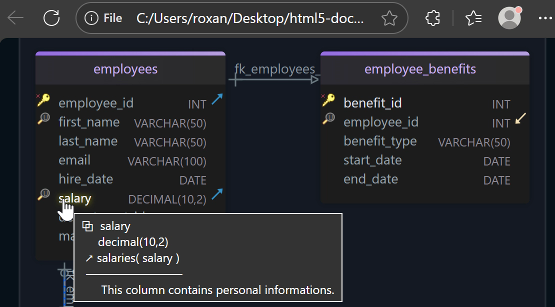
Read that table as a sequence rather than as a wall. A course, a prototype or a first look at an inherited database lives entirely in the Community column: connect, reverse-engineer, read the diagram, create a table, run the query. The Pro column is what a schema that ships needs, because it is the point at which the design has to exist as a file, travel through a repository, appear as documentation somebody else can read, and turn into a migration script. Trying that boundary out costs nothing either: the free SQL client workflow starts in Community and the paid features run for 15 days on the same installation.
Download DbSchema at https://dbschema.com/download.html, point the free Community edition at the database you already run, and read the first diagram it draws off the catalog. Connecting, the diagrams, creating tables and columns and the SQL editor stay free after the 15-day Architect trial ends; the model file, the documentation export and schema synchronization are the Pro side of the line.
FAQ
What are the limitations of free database design tools?
Crossing the line is a one-time purchase of DbSchema Pro, priced on the purchase page in your own currency and on three tabs, Universities & Students, Personal and Business, the first of them the lowest[1]. What that buys is the half where the design leaves the screen: the .dbs file, the HTML5 documentation and the generated migration script. Connecting, reverse-engineering, editing the diagram and running SQL cost nothing at any point.
Can I reverse-engineer an existing database with a free tool?
Yes, and DbSchema Community fetches the JDBC driver for you: pick the database in the Connection Dialog and DbSchema downloads the matching driver from its own public repository, or you upload the .jar yourself in the Driver Manager on a machine with no internet access. Keeping the diagram it draws as a file you reopen later, with your layout and notes intact, is where Pro begins.
Is DBML a good alternative to visual database design?
DBML's documentation defines tables, columns, relationships, indexes, enums and check constraints, so a schema written in it carries the constraints and the shape together[2]. The trade is that the text is the source of truth, so nothing reads an existing database back into it, which is the half DbSchema Community covers by reverse-engineering the catalog.
Do free database tools support offline work?
Desktop tools do, browser-based ones do not. DbSchema Community and MySQL Workbench both run on your own machine against a local or remote server, so no schema is uploaded to a vendor's service to be drawn. In DbSchema, designing with no database connected means saving the model to a file, which is Pro; Community works against the connected database.