Erwin Compared With ER/Studio and PowerDesigner
Compare erwin Data Modeler, ER/Studio, and PowerDesigner on repository features, cross-platform support, and team licensing costs for database architects.
On this page
For database architects and the team leads who sign the renewal: you already model logical and physical schemas, and you need to know which of the three enterprise suites fits your team, what each seat costs, and when DbSchema Architect, a file-based alternative, is worth testing before the next renewal date.
Three enterprise modellers and who owns each
The three suites have each changed hands more than once, and the current owner decides the licence you sign, the roadmap you depend on, and who answers when support is needed.
| Suite | Current owner | Owned since |
|---|---|---|
| erwin Data Modeler | Quest Software | 2020 |
| ER/Studio | IDERA | 2015 |
| PowerDesigner | SAP | 2010 |
erwin Data Modeler was built by Logic Works, which Platinum Technology acquired in 1998 and Computer Associates in 1999. Parallax Capital Partners took the product from CA Technologies in 2016 under the erwin, Inc. name, and Quest Software acquired it on 31 December 2020. ER/Studio came from Embarcadero Technologies, which IDERA acquired in 2015. PowerDesigner went from SDP Technologies via Powersoft to Sybase, and SAP acquired Sybase in 2010.[1]
The three are frequently evaluated together, and buyers comparing the category commonly weigh them alongside other data modelling tools before choosing.
The file-based alternative this comparison ends with is DbSchema Architect Edition. It was nominated for Best Data Modeling Solution in the 2026 DBTA Readers' Choice Awards.
Logical and physical modelling in each suite
PowerDesigner covers conceptual, logical and physical data models alongside business process models, in model files or a database repository, and runs as a Windows application or an Eclipse plug-in. It is an enterprise data modelling and architecture tool.
erwin Data Modeler and ER/Studio both produce logical and physical data models and keep the two views separated. A review published in ER/Studio's own resource centre describes both tools as mature players in the data modeling tools market, focused on producing logical and physical data models, with utilities for reconciling the differences between any two models and a bi-directional merge that lets you choose which changes to apply to either side.[2]
DbSchema Architect Edition builds database-independent logical and conceptual design that maps to physical targets. You define entities, attributes and relations with no engine chosen, so the model says what data exists and how it relates without committing to SQL syntax or to one vendor's data types. A naming dictionary decides how a logical attribute name becomes a physical column name, and a conversion dictionary maps each logical type to the physical type of the target engine: the logical type Text can become VARCHAR(255) in MySQL and NVARCHAR(255) in SQL Server. Convert Model, then Generate Physical Design, turns the result into an editable physical schema for the database you pick, and you can generate more than one from the same logical model. Model validation checks the model against naming rules you set, such as upper or lower case conventions.
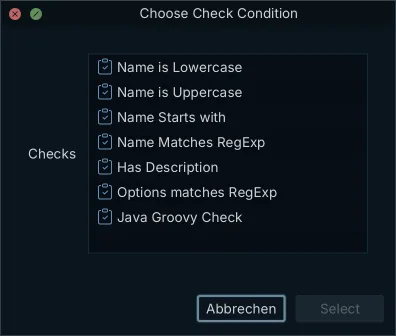
Logical and conceptual design, the dictionaries and the data type converters are Architect features. Community and Pro design the physical schema.
Repository, collaboration and operating systems
erwin and ER/Studio rely on centralized repositories for team collaboration. erwin Workgroup adds the centralized model repository, collaborative modelling with conflict resolution and change auditing.[3] ER/Studio Data Architect Pro adds the central repository with check-in/check-out and version history.[4] PowerDesigner stores models in files or a database repository.[1]
All three legacy suites run natively on Windows. The PowerDesigner Wikipedia page states it runs under Microsoft Windows as a native application or in an Eclipse environment through a plugin.[1]
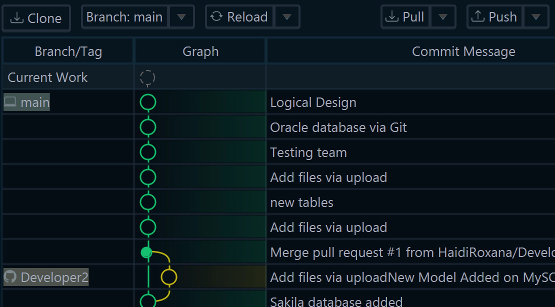
DbSchema runs on Windows, macOS and Linux from the same installation kit, and the design model each of them saves opens unchanged on the other two. Teams collaborate on the .dbs design model file, which is plain XML and versioned in Git through a built-in Git client, with model comparison and migration scripts. The file holds the tables, columns, keys, foreign keys, comments and diagram layouts of one database design in a single text file that needs no server to open.
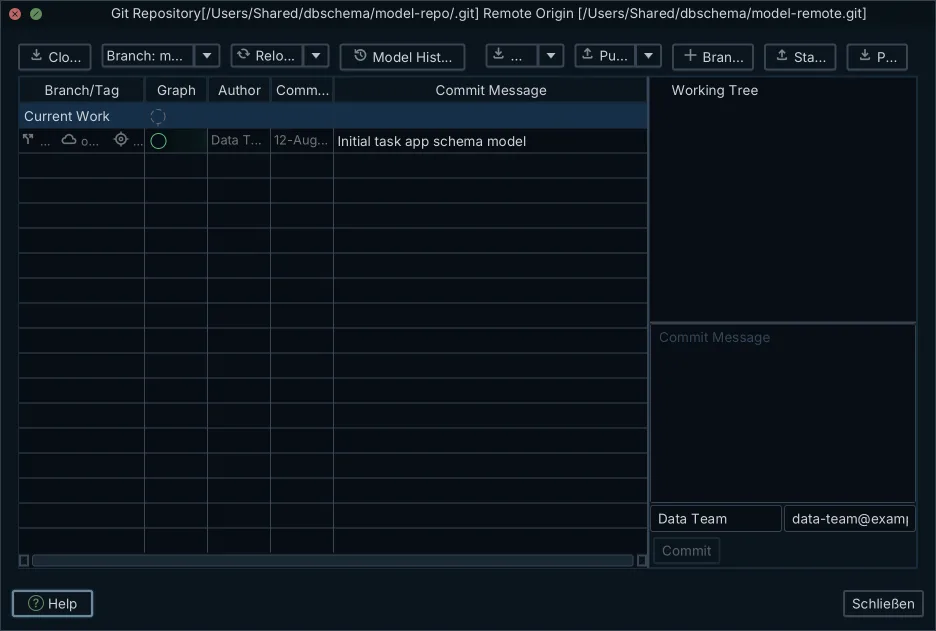
Because the file is XML, it diffs line by line in a pull request, so a schema change arrives in review as a readable diff you can approve without opening the modelling tool.
Published subscription prices for each suite
erwin Data Modeler is sold as an annual subscription per named user through the Quest web store, which shows prices in the currency of your location at checkout. The store lists Standard and Workgroup editions; the repository features each edition carries are covered below.[3]
ER/Studio publishes per-user subscription prices on erstudio.com. Read on 25 September 2026, Data Architect was $2,687.00 and Data Architect Pro was $3,693.00, which adds the central repository with check-in/check-out and version history. ER/Studio Enterprise is on quote, with a business glossary, an enterprise data catalog and Microsoft Purview and Collibra integration.[4][5]
SAP does not publish a list price for PowerDesigner. The per-seat range on Wikipedia rests on an old Sybase reference, so the current price comes from SAP sales.
The Architect Edition is licensed per developer as a perpetual one-time payment or a monthly subscription. The Business tab of the editions and licences page showed Architect perpetual at $470.40 one time including one year of updates, then $120.00 per year to renew, optional, or $47.04 per month. A licence covers two computers but not at the same time.
| Suite | Edition | Price per user | Billing |
|---|---|---|---|
| DbSchema | Architect Edition | $470.40 one-time | Perpetual, incl. 1 year of updates |
| erwin Data Modeler | Standard | Shown at checkout in your currency | Annual subscription |
| erwin Data Modeler | Workgroup | Shown at checkout in your currency | Annual subscription |
| ER/Studio | Data Architect | $2,687.00 | Per-user subscription |
| ER/Studio | Data Architect Pro | $3,693.00 | Per-user subscription |
| PowerDesigner | Not published | Contact SAP sales |
The editions and licences page compares Community and Pro feature by feature, and lists logical and conceptual design as the workflow Architect adds.
Licence cost for a team of five
The table below adds up five seats over three years at net list prices, with no discount negotiated. The erwin and ER/Studio figures are annual subscriptions that renew every year; the DbSchema figure is a one-time perpetual payment plus two optional renewal years.
| Suite and edition | Calculation | Five seats, three years |
|---|---|---|
| DbSchema Architect perpetual | 5 seats x $470.40 + 2 renewal years x 5 seats x $120.00 | $3,552.00 |
| ER/Studio Data Architect | 5 seats x $2,687.00 x 3 years | $40,305.00 |
| ER/Studio Data Architect Pro | 5 seats x $3,693.00 x 3 years | $55,395.00 |
The DbSchema total assumes you renew updates in years two and three. Skip both and the five seats cost the five perpetual payments alone, because the perpetual licence keeps running when a renewal lapses.
For shared seats, the DbSchema Floating License is a concurrent licence: a seat is checked out when DbSchema starts and released on close, users are allowed by email in the Customer Area, and no licence server is needed. The purchase page lists floating licences as a shared option alongside the per-developer licences.
The erwin and ER/Studio figures are net list prices in the currency each vendor publishes. Never convert between them for a budget; take the figure in your own currency from the vendor's page.
When a central repository and governance matter
The legacy suites are built for infrastructure requirements: repository servers, process modelling and catalog integrations.
- erwin Workgroup adds the centralized model repository, collaborative modelling with conflict resolution and change auditing.
- ER/Studio Enterprise adds a business glossary, an enterprise data catalog and Microsoft Purview and Collibra integration.
- PowerDesigner covers business process models alongside its data models, in model files or a repository.
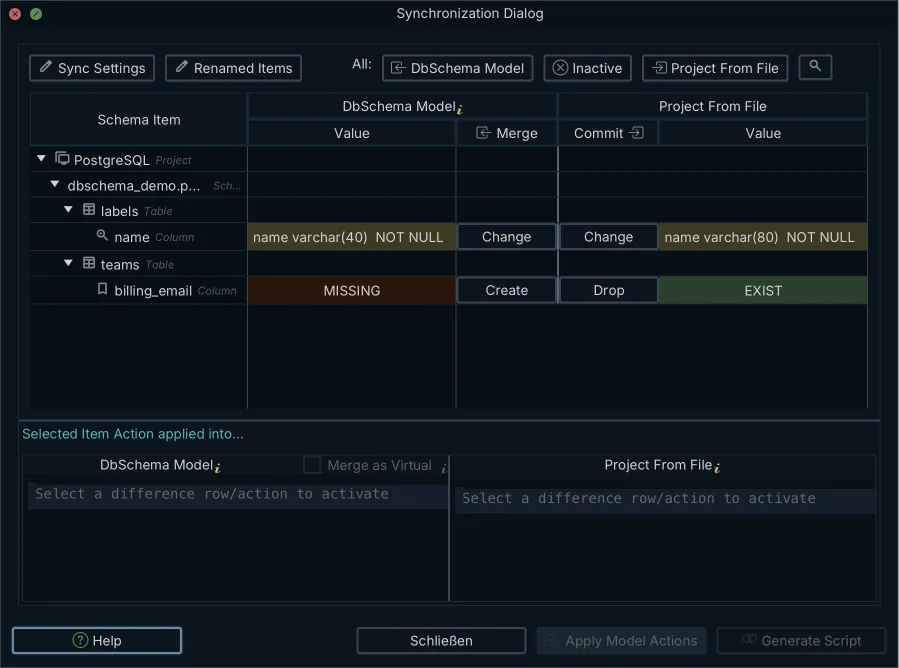
In DbSchema, teams collaborate through the .dbs model file in Git with the built-in Git client, and share seats through the Floating License managed in the Customer Area. If your governance programme asks for change history and review, the .dbs file in Git records every schema change as a commit, and branches and merges handle parallel work.
Which teams each suite fits best
The decision rule is infrastructure and governance, not features.
- DbSchema Architect Edition fits teams that manage their infrastructure via Git, develop across Windows, macOS and Linux, and want to keep schema files alongside their application code.
- The legacy suites fit organizations that have standardized on Windows and already run dedicated repository servers and governance catalog integrations.
If your team already runs a Git repository for application code and reviews schema changes in pull requests, a file-based model lands in the workflow you already have. If your organization requires check-in/check-out and audit trails, the .dbs file in Git records each schema change as a commit you can compare, and DbSchema generates the migration script between versions.
Platform matters too. If half the team is on macOS and the rest on Windows, or whoever looks after the warehouse is on Linux, a Windows-only suite means a virtual machine or a remote desktop for part of the team.
Where DbSchema Architect fits for teams moving on
Teams leaving a legacy suite can reverse-engineer their current live database into a model to build a database-independent logical model. DbSchema connects to the database, reads the schema and draws the ER diagram; from there you can build the logical and conceptual model on top.
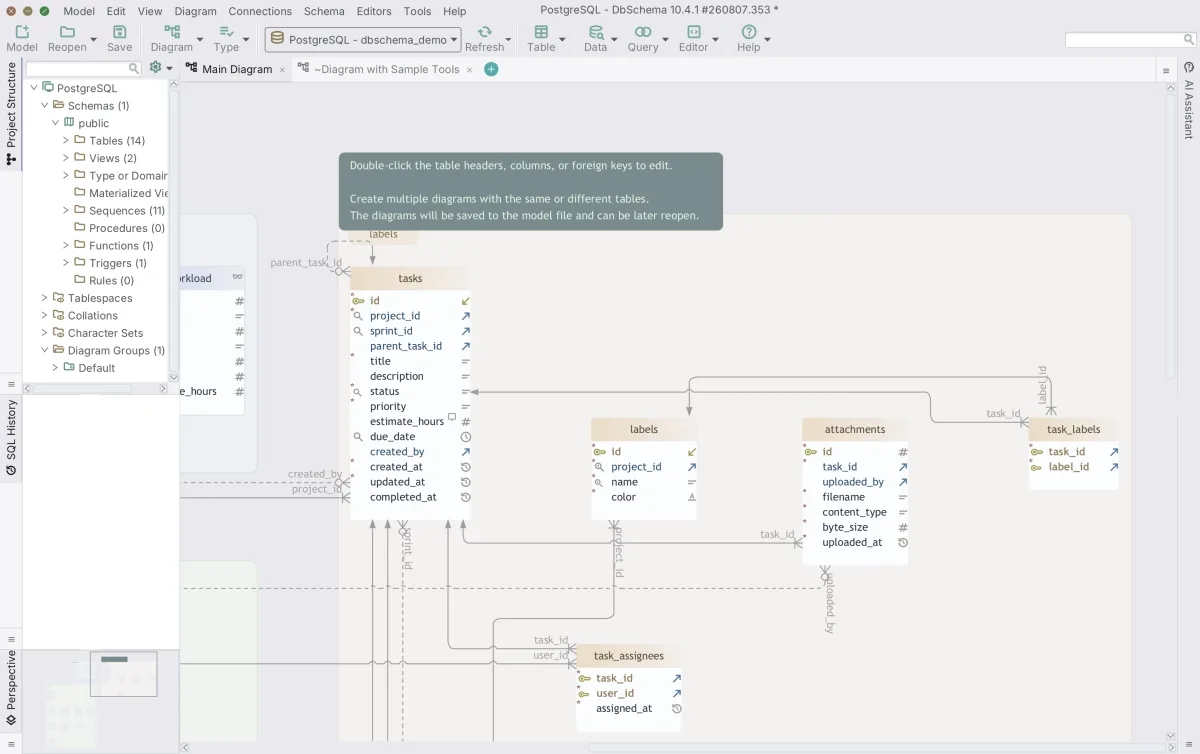
The 15-day Architect trial ships in the same installer as the free Community Edition, with no registration required. You can extend the trial by a further 15 days.
For shared seats, the Floating License caps how many people work at once rather than how many are on the list, with no licence server to deploy.
If you already own a DbSchema Pro licence, you upgrade to Architect by paying the difference.
The migration path out of each suite is its own article: what carries over when you leave erwin, migrating a PowerDesigner model, and replacing ER/Studio in a regulated environment are covered separately.
Download DbSchema, start the 15-day Architect trial and reverse-engineer the schema your current modeller holds into a model you can review before your renewal date. The Architect Edition is the one that covers logical and conceptual design, the naming and conversion dictionaries, and the per-database type converters described in this comparison, along with the HTML5, PDF and Markdown documentation, schema synchronization and migration scripts that Pro carries.
Frequently asked questions
What is the difference between Erwin and ER studio?
erwin Data Modeler is owned by Quest and uses a centralized repository for team collaboration on Windows. ER/Studio is owned by IDERA and offers similar centralized repositories, but adds specific integrations with Microsoft Purview and Collibra in its Enterprise edition. Both modellers are Windows desktop applications.
What is PowerDesigner used for?
PowerDesigner is an enterprise data modeling tool used to design conceptual, logical, and physical data models, as well as business process models. It runs as a native Windows application or an Eclipse plug-in.
Who owns PowerDesigner?
SAP owns PowerDesigner. The company acquired the software when it bought Sybase in 2010.
How much does erwin data modeler cost?
erwin Data Modeler is sold as an annual subscription per named user through the Quest web store, which shows the price in your currency at checkout. The Workgroup edition adds the centralized model repository.
How much does an Er studio cost?
ER/Studio Data Architect costs $2,687.00 per user for a subscription. The Pro version, which includes a central repository and version history, costs $3,693.00 per user.
Is there a free alternative to PowerDesigner?
DbSchema Community Edition is a free alternative that covers all databases, schema reverse-engineering, interactive ER diagrams, and a built-in SQL editor. It stays free with no time limit.
Sources
Model before the database exists
DbSchema Architect draws logical and conceptual models with no engine chosen, then generates the physical schema for any supported database. The 15-day Architect trial is in the free download.