DataGrip Alternatives: Tools for Visual Schema Design
For the database architect who keeps DataGrip open for queries and needs a diagram, an offline model file, and documentation the rest of the team can read.
On this page
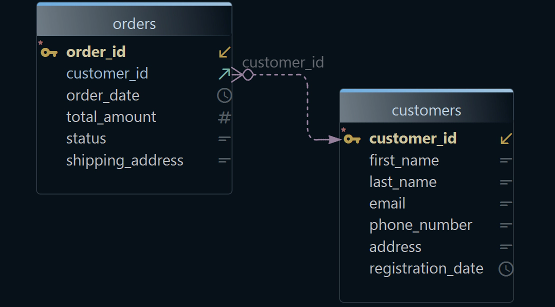
You keep DataGrip open all day for queries, and the schema diagram that went into the last design review still sits in a drawing app nobody has touched since. DbSchema is the alternative that closes that gap. It reverse-engineers the schema into a diagram you edit, keeps the design in a .dbs model file you commit next to the application code, and generates the migration SQL from the difference between that file and the live database.
JetBrains describes DataGrip as a cross-platform IDE for relational and NoSQL databases, whose headline features are an intelligent query console and context-sensitive code completion. Two other tools come up on the same shortlist for the design half of the job: Oracle SQL Developer Data Modeler and Aqua Data Studio.
The schema design gap in DataGrip
A query console answers what the data is doing right now. Designing a schema asks a different question: what the tables should look like after the next release, and how they get there without a migration written by hand. Three things that question needs are a diagram whose layout survives being closed, a design that exists when the database does not, and a change script you can read before it runs.
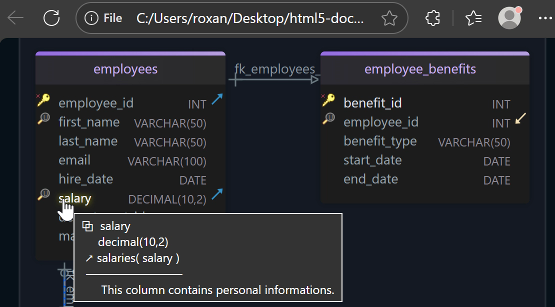
A diagram generated from live metadata is redrawn from the connection every time it opens, so the arrangement made for the review is not the arrangement the next person sees. DbSchema saves the table positions, the groups and the notes in the .dbs model file, which makes the diagram a document rather than a view of a connection. Planning a change against production means working on a model instead of on the live database. DbSchema's offline mode lets you add tables, columns and constraints with no connection open at all. Sharing the result means handing a colleague something they can open without installing anything, and Diagram → Export HTML5 or PDF Documentation in DbSchema writes an interactive HTML5 page with a searchable table list and column descriptions as mouse-over tooltips.
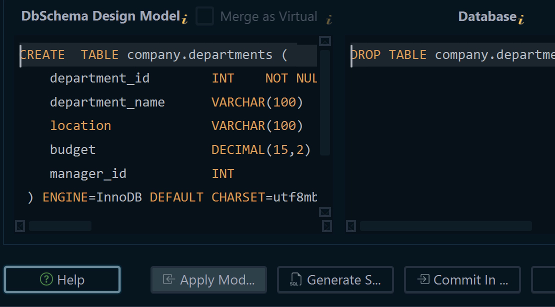
Everything you do on the DbSchema diagram lands in the model file, and only there. The live database changes at one point: when you open Schema → Synchronize Model with Database, read the SQL that DbSchema generated, and click Execute. Saving the design to a file, the documentation export and schema synchronization are Pro features.
What is the alternative to Liquibase?
Liquibase tracks how tables change by having you write changesets by hand, in XML, YAML, JSON or SQL[1], and replaying them across environments from a pipeline. The files are precise, and they are also the thing you maintain: a column added on a diagram has to be re-expressed as a changeset before it deploys anywhere.
DbSchema keeps that history in the model file instead. Edit the table on the diagram, and DbSchema compares the .dbs file against the target database and writes the SQL migration script from the difference, which is the pattern the visual schema migration tools follow.
| Capability | DbSchema | Liquibase |
|---|---|---|
| Change definition | Visual diagram editing | Hand-written changesets |
| Change format | XML model file | XML, YAML, JSON or SQL |
| Deployment | Synchronization Dialog | Command-line pipeline |
| Licence scale | Per user | Per application and database type |
Each Liquibase paid tier states how many applications and how many database types it covers, and only the Enterprise tier is unlimited on both[2]. A DbSchema Pro licence is priced per user, so the number of applications and engines you point it at does not change what it costs.
What is the alternative to Lucidchart?
Lucidchart draws shapes on a canvas, and the canvas is not connected to a database. An ER diagram drawn there is accurate on the day it is drawn and drifts from that day on, because nothing pulls the tables back in as they change.
DbSchema connects over JDBC and reads the schema itself: tables, columns, data types, primary keys and foreign keys come from the database, and the diagram is drawn from what is there. Connecting, reverse-engineering and the diagrams are in the free Community Edition. When the database moves ahead of the design, Schema → Compare Model with Database lists what differs object by object, and you decide per difference whether to update the model or push the change to the database.
Index coverage arrives with the same connection. DbSchema lists the indexes it read from the database in the Indexes tab of the Table Dialog and again in the exported documentation, so you can see which lookups have an index behind them before the schema ships.
The shortlist and why each is on it
Three tools cover the design work a query IDE leaves aside, and they divide it differently.
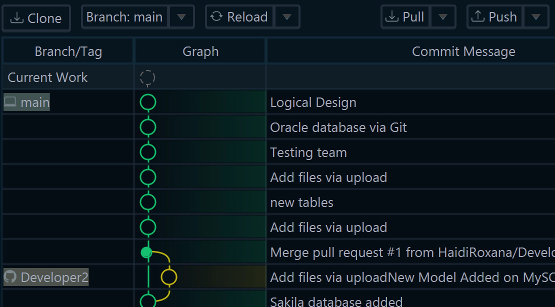
DbSchema is a multi-database visual modeler. It reverse-engineers SQL and NoSQL engines into diagrams and stores the design in a .dbs model file, which its Git dialog stages, commits and pushes like any other file in the repository. From that same file it exports interactive HTML5 documentation and generates the migration script against a live database. Virtual foreign keys link tables the database never constrained: you drag one column onto another in the diagram, and DbSchema saves the link in the model file instead of writing it to the database. The Relational Data Editor then browses several tables at once along those links. Browsing tables that way is a Pro feature.
Oracle SQL Developer Data Modeler is Oracle's free modeler, built around a strict separation between the logical model and the physical model for Oracle Database[3].
Aqua Data Studio is a database IDE that puts diagramming next to querying. Aqua describes it as creating and managing entity relationship diagrams, reverse-engineering existing databases, and designing physical ER diagrams that run to thousands of entities, alongside visual query builders and integrations with BI tools[4].
| Tool | Design focus | Offline design file |
|---|---|---|
| DbSchema | Visual modeling, documentation, schema sync | .dbs XML model file |
| Oracle SQL Developer Data Modeler | Logical and physical Oracle modeling | Design repository files |
| Aqua Data Studio | Querying, ER diagrams and analytics | Workspace project files |
Pricing and licensing of each
DbSchema Pro is sold as a one-time perpetual licence plus taxes, with the first year of maintenance and upgrades included and a yearly renewal after that to keep receiving them. The Architect edition, which adds logical and conceptual design, is sold the same way, and the purchase page lists the current figure for each edition[5]. Renewal is optional in both cases: the licence itself does not expire, so the version you bought keeps working if you stop renewing.
| Tool | Licence model |
|---|---|
| DbSchema Pro and Architect | Perpetual, or monthly subscription |
| JetBrains DataGrip | Subscription, free for non-commercial use |
| Aqua Data Studio | Annual per-user subscription |
| Oracle SQL Developer Data Modeler | Free |
JetBrains sells DataGrip on subscription and offers it free for non-commercial use, and its database tooling also ships inside the company's other IDEs. Aqua Data Studio is licensed as an annual per-user subscription, so access follows the renewal[4]. Oracle SQL Developer Data Modeler is a free download for teams working on Oracle Database[3].
Who each one is actually for
The question that separates the three is what has to survive outside the database. When the answer is the design itself, DbSchema is the one to run: the diagram, the interactive documentation and the migration script all come out of one .dbs file, across every engine DbSchema supports, and that file travels through pull requests like any other file in the repository. Oracle SQL Developer Data Modeler is scoped to Oracle Database and to the step between the logical model and the physical one. Aqua Data Studio keeps its diagrams beside its query and BI features, for a day that mixes schema work with reporting. For a wider view of the field, see how the database design tools compare.
Download DbSchema at https://dbschema.com/download.html, connect it to the database DataGrip is already pointed at, and let it reverse-engineer the schema into a diagram. Connecting, reverse-engineering, the diagrams and the SQL editor are in the free Community Edition; saving the model to a file, the HTML5 documentation and schema synchronization are Pro; logical and conceptual design is Architect.
Frequently asked questions
Is DataGrip good for visual database schema design?
DataGrip's diagram view is drawn from the connection rather than from a design file. The persistent layout, the offline model file and the visual schema diff are what DbSchema adds on top.
How does DbSchema handle database versioning compared to Liquibase?
Liquibase replays changesets you wrote by hand, from a pipeline. DbSchema compares the .dbs model file against the live database, shows the differences in the Synchronization Dialog, and generates the SQL migration script from them, so no CI job is needed to produce the script.
Can I use Lucidchart to design a live database schema?
Lucidchart draws the diagram, but the drawing is not connected to a database, so nothing keeps it in step with the tables as they change. DbSchema reads the schema over JDBC, redraws it from what is actually there, and generates the change script when the design and the database differ.
Sources
Reverse-engineer the schema into a diagram
DbSchema reverse-engineers your database into interactive ER diagrams, keeps the model in a versionable .dbs file, and generates the migration script from a visual diff. Community Edition is free; documentation, schema sync and offline design are Pro.