Best MongoDB Tools (2026): GUI Clients, Schema Design, and Query Builders
For the developer or architect picking a MongoDB client for a team that has to understand its collections, design against them and hand the result to other people.
On this page
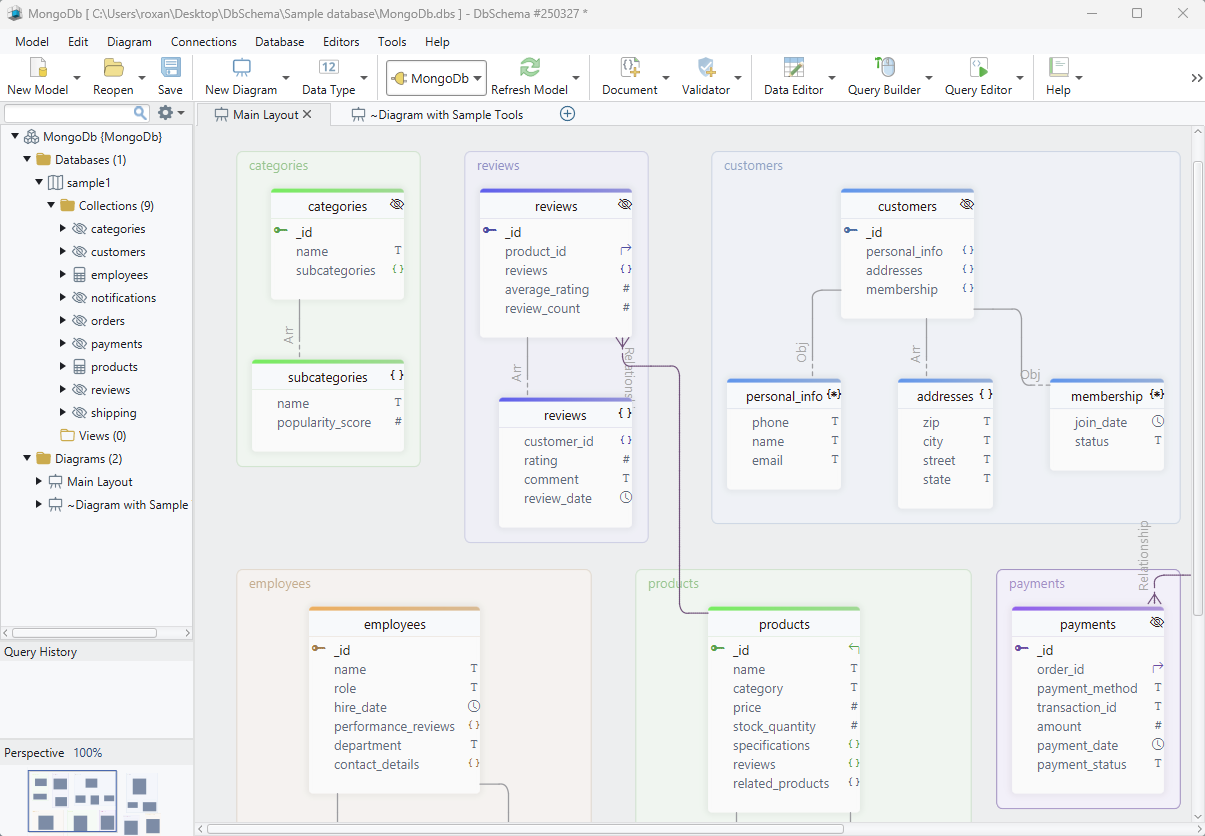
A MongoDB client is chosen for the one job that dominates all the others on your project. Where that job is understanding what the collections actually hold, designing against them and handing the result to somebody who will never open a shell, start with DbSchema: it infers the structure from the documents, records the relations MongoDB never declares, and exports documentation that opens in a browser. Six other tools follow, each named for the job it was built for.
mongosh, the MongoDB shell, remains the default way to query and administer a deployment, and every tool here sits on top of it rather than replacing it. What a graphical client adds is everything the shell cannot show at once: the shape of a collection, the links between collections, the plan behind a slow query, and a screen a colleague can be pointed at. The seven below are compared on schema visualization, aggregation design, query optimization, data editing and team workflow.
- DbSchema, for visual schema design, documentation and multi-database projects
- MongoDB Compass, for free administration and browsing from the vendor
- Studio 3T, for code-centric querying and SQL-to-MongoDB migration
- NoSQL Manager, for shell-driven administration on Windows
- NoSQLBooster, for running SQL SELECT statements against MongoDB
- Navicat, for cross-database administration and scheduled jobs
- Retool, for building internal applications over MongoDB data
How to choose a MongoDB tool
Five capabilities separate these tools in practice, and the order in which you check them is what decides the answer. Ask whether a candidate:
- shows what fields a collection holds, which of them are nested, and how one collection points at another
- builds aggregation pipelines and
$lookupstages, and reads back explain plans - produces a design you can commit, review and hand to a colleague who has no database credentials
- loads sample JSON and CSV, and generates test data for a collection you have just designed
- covers the PostgreSQL, MySQL or SQL Server the same team runs beside MongoDB
Schema visibility comes first because MongoDB gives you none by default. Aggregation comes next, since that is where a document database gets hard, and the difference between building a pipeline stage by stage and typing it blind is a working afternoon. The third capability is the one that separates a query you can share from a design you can hand over, and the fifth decides whether the team ends up paying for a second client as well.
DbSchema is built around the first and third of those. It turns collections into diagrams, records validation rules and virtual relations, and produces shareable HTML5 documentation in one workflow.
Quick comparison table
| Tool | Other engines | Schema inference | Desktop use | Free tier | Licensing |
|---|---|---|---|---|---|
| DbSchema | SQL and NoSQL | Yes | Yes | Community Edition | Perpetual or monthly |
| MongoDB Compass | None | Limited | Yes | Free | None needed |
| Studio 3T | SQL, for migration | Limited | Yes | Community, non-commercial | Per user, per year |
| NoSQL Manager | None | Limited | Windows only | 14-day trial | Perpetual per user |
| NoSQLBooster | None | Limited | Yes | Free edition, limited | Perpetual per user |
| Navicat | SQL, Redis and more | Yes | Yes | 14-day trial | Perpetual or subscription |
| Retool | Any API or database | No | Cloud or self-hosted | Free plan | Per seat |
1. DbSchema
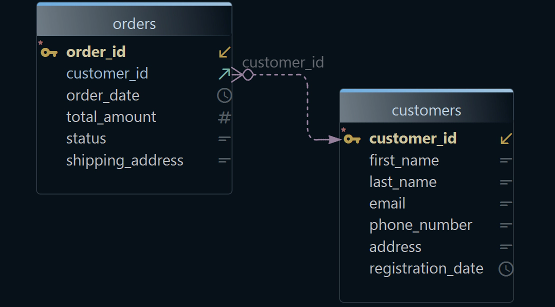
DbSchema is a visual database designer and client that covers MongoDB alongside SQL and NoSQL engines in the same project. Its subject is structure: what a collection contains, how collections relate, and how to write that down so the rest of the team can read it. What it puts around a MongoDB deployment is a chain of five links, and other tools cover parts of it rather than all of it:
- a schema inferred from a configurable sample of documents per collection, with field names, BSON types, nested objects and arrays
- collection validation rules, reverse-engineered as the authoritative structure wherever a collection carries one
- virtual relations between collections, created by dragging one field onto another
- multi-collection browsing in the Relational Data Editor over those relations
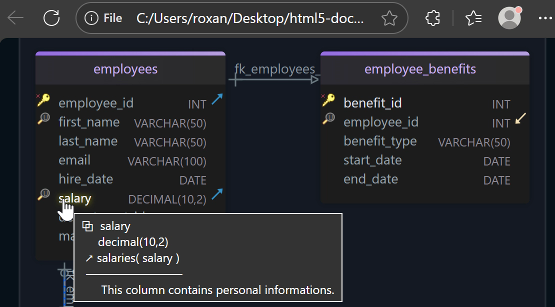
- interactive HTML5 documentation carrying a vector diagram, with collection and field comments as mouse-over tooltips
The inferred schema approximates what the documents actually contain; it is not a schema MongoDB itself enforces. Creating or editing a collection in DbSchema writes its validation rule back to both the database and the local model file. Virtual relations are drawn as connector lines on the diagram and saved in the model file, and MongoDB neither declares nor enforces them. Selecting a record in a parent pane of the Relational Data Editor refilters every child pane to the documents whose field values match, cascading as many levels deep as needed.
The Community Edition is free. Pro is one payment with a year of updates included and an optional renewal to keep upgrading, and Architect, which adds logical and conceptual design, sits a step above it on the same terms. The pricing page shows what each edition costs in your own currency, on separate tabs for Business, Personal and Universities & Students.
2. MongoDB Compass
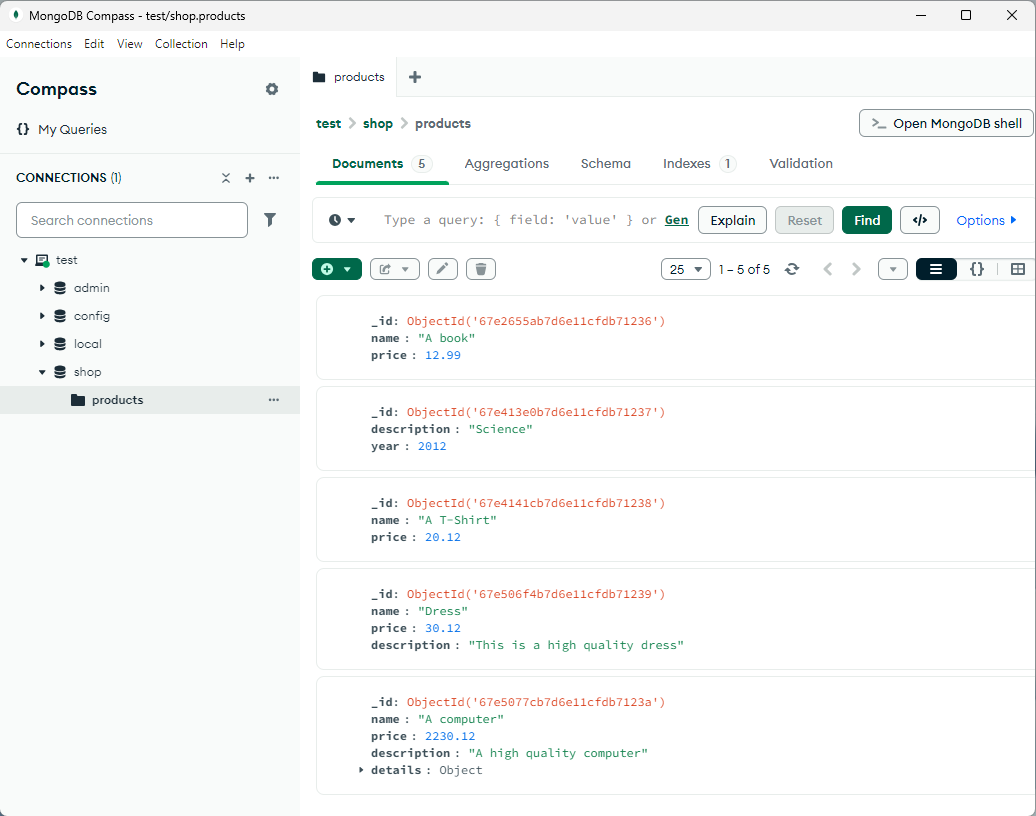
Compass is MongoDB's own graphical client, and it is free. For anyone already inside the MongoDB ecosystem it is the shortest path from a connection string to a document on screen, because the vocabulary of the interface is the vocabulary of the database.
It handles the everyday work:
- connects to several deployments in one window
- embeds the
mongoshshell - builds aggregation pipelines from more than 200 stages and operators
- generates queries from a natural-language description
- analyzes explain plans
- imports and exports JSON and CSV
Compass connects to MongoDB and to nothing else, so a team running PostgreSQL or SQL Server next to it needs a second client for those. It also has no model file, so a design shared with a colleague is shared as a screenshot or as prose.
3. Studio 3T
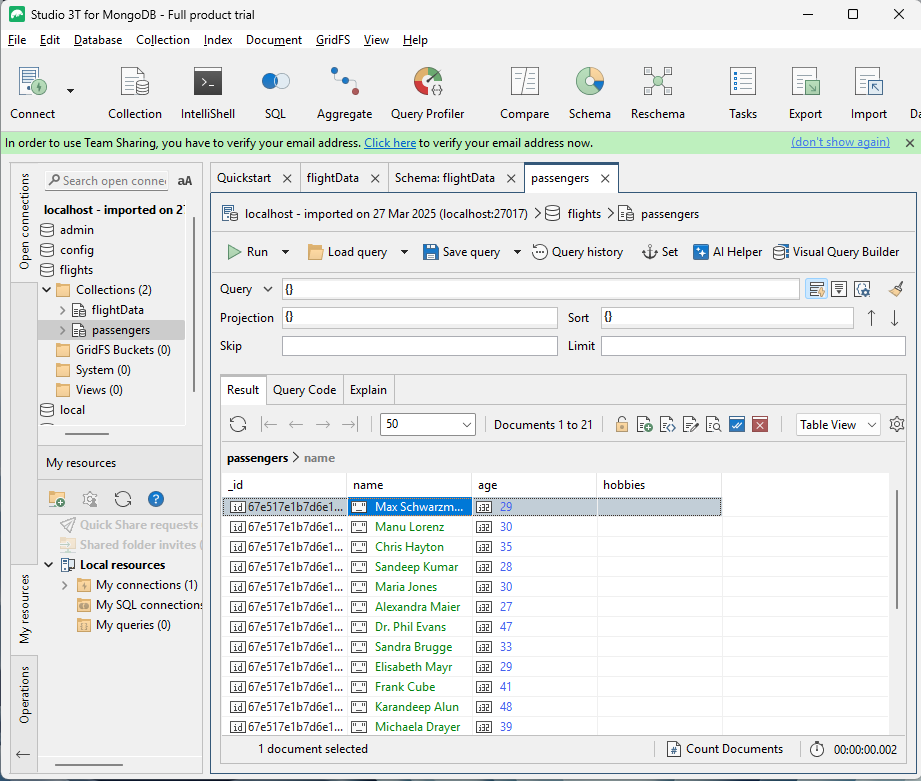
Studio 3T is a commercial MongoDB IDE, and its Desktop IDE is the product in this comparison. Its strengths are code-centric:
- IntelliShell autocompletion
- table, tree and JSON editing modes
- a stage-by-stage aggregation editor
- SQL-to-MongoDB migration from MySQL, PostgreSQL, Oracle, SQL Server, DB2 and Sybase
That migration path is the reason to look at it when data is arriving from a relational database.
The Desktop IDE is licensed per user per year, at 499 USD for Professional and 699 USD for Ultimate, with Enterprise priced on request; the vendor's buy page states that it is billed yearly only. A Community Edition exists, described there as being for non-commercial use by students, hobbyists and individual beginners. The Desktop IDE is now one product in a wider platform that also sells browser-based and agent-facing components, so when a price is quoted to you, check which of them it covers.
4. NoSQL Manager
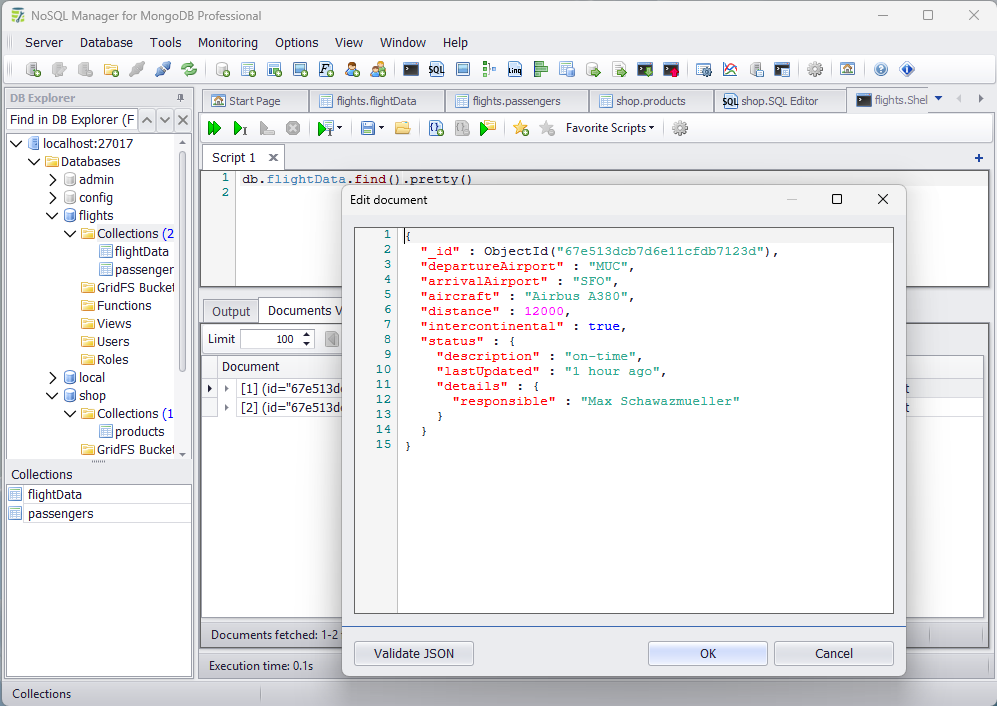
NoSQL Manager for MongoDB is an administration GUI built around the shell, for people whose day is spent in mongosh:
- autocompletion over your own collections, fields and operators while you type
- document management and routine DBA work beside that shell
- Windows only, with no macOS or Linux build
A single perpetual licence for one user is listed at 125 USD on the purchase page, with one, two or three years of support and upgrades to choose from, and a site licence for unlimited users at 1,952 USD. There is no free edition, only a 14-day trial, so a team that wants a permanently free client alongside it will pair it with Compass or with the DbSchema Community Edition.
5. NoSQLBooster
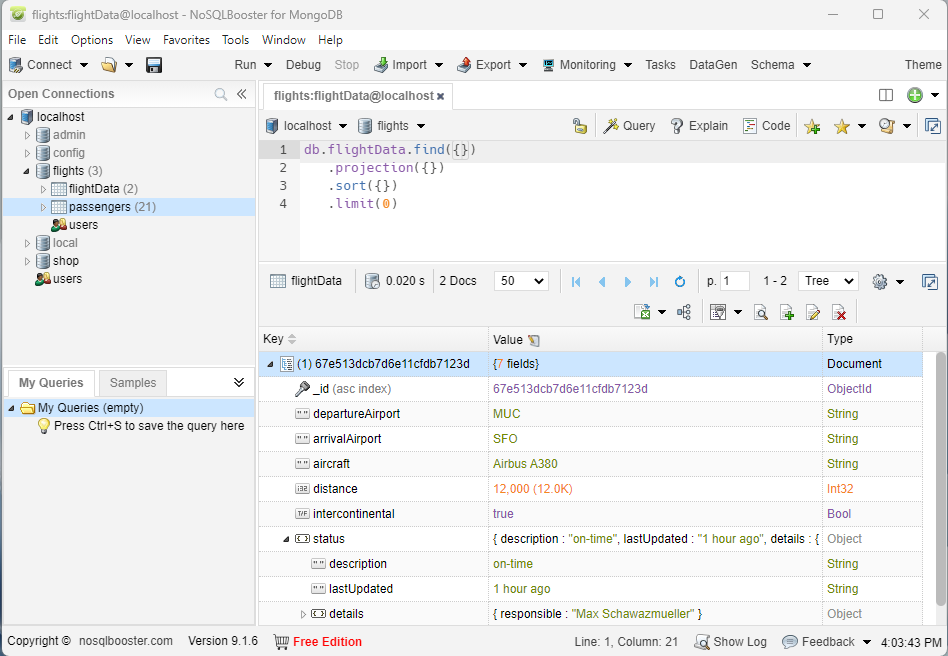
NoSQLBooster is a cross-platform MongoDB client with a scripting and debugging bent. Its distinguishing feature is SQL: it translates SQL SELECT statements, joins and aggregation included, into MongoDB queries, which suits anyone who thinks in SQL and would rather not learn the aggregation syntax first. It also carries:
- a script debugger
- IntelliSense over your own schema
- a set of interactive samples
Pricing is one-time and per user, for one user on two computers: a Personal licence at 129 USD and a Commercial licence at 239 USD on the purchase page, with optional software assurance adding 30, 45 or 55 percent for one, two or three years of upgrades. A free edition exists with limits on what it will do.
6. Navicat
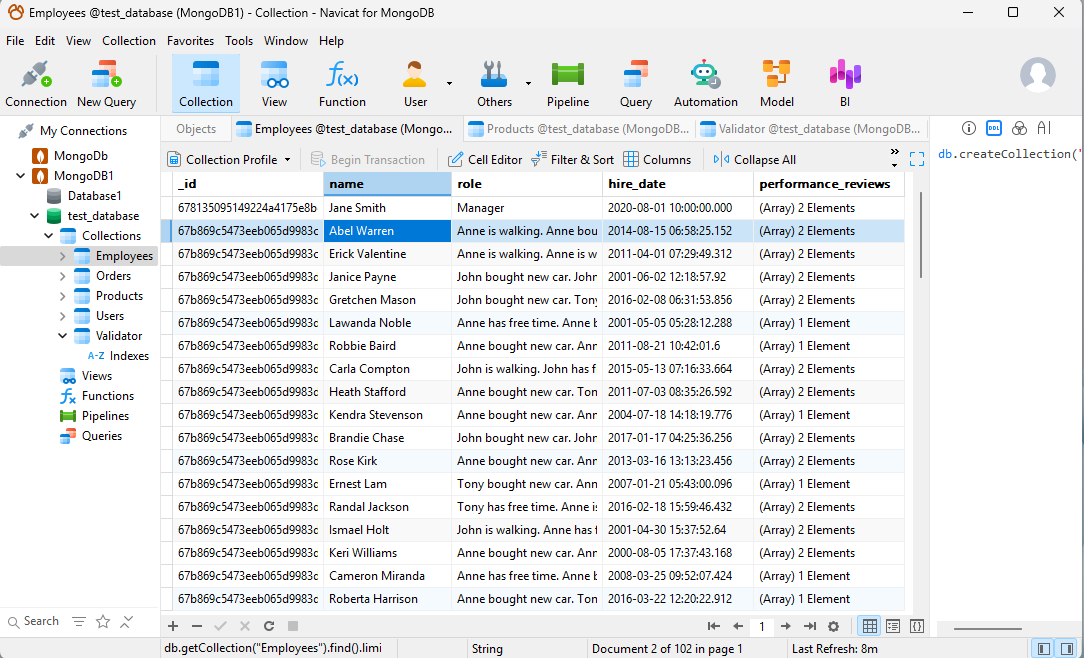
Navicat for MongoDB is part of a multi-database administration suite, and administration is where its weight sits:
- data synchronization
- scheduled batch jobs
- import and export
- test data generation
- BI-style reporting
- role-based collaboration
A team that already runs Navicat for MySQL or PostgreSQL gets a familiar interface for MongoDB.
Its product page lists three editions, each sold monthly, yearly or as a perpetual licence: Enterprise at 22.99, 229.99 or 449.00 USD, Standard at 14.99, 149.99 or 299.00 USD, and a non-commercial edition at 9.99, 99.99 or 199.00 USD. One licence covers whichever platform you activate it on, so Windows, macOS and Linux are not priced separately, and a 14-day trial is offered.
7. Retool
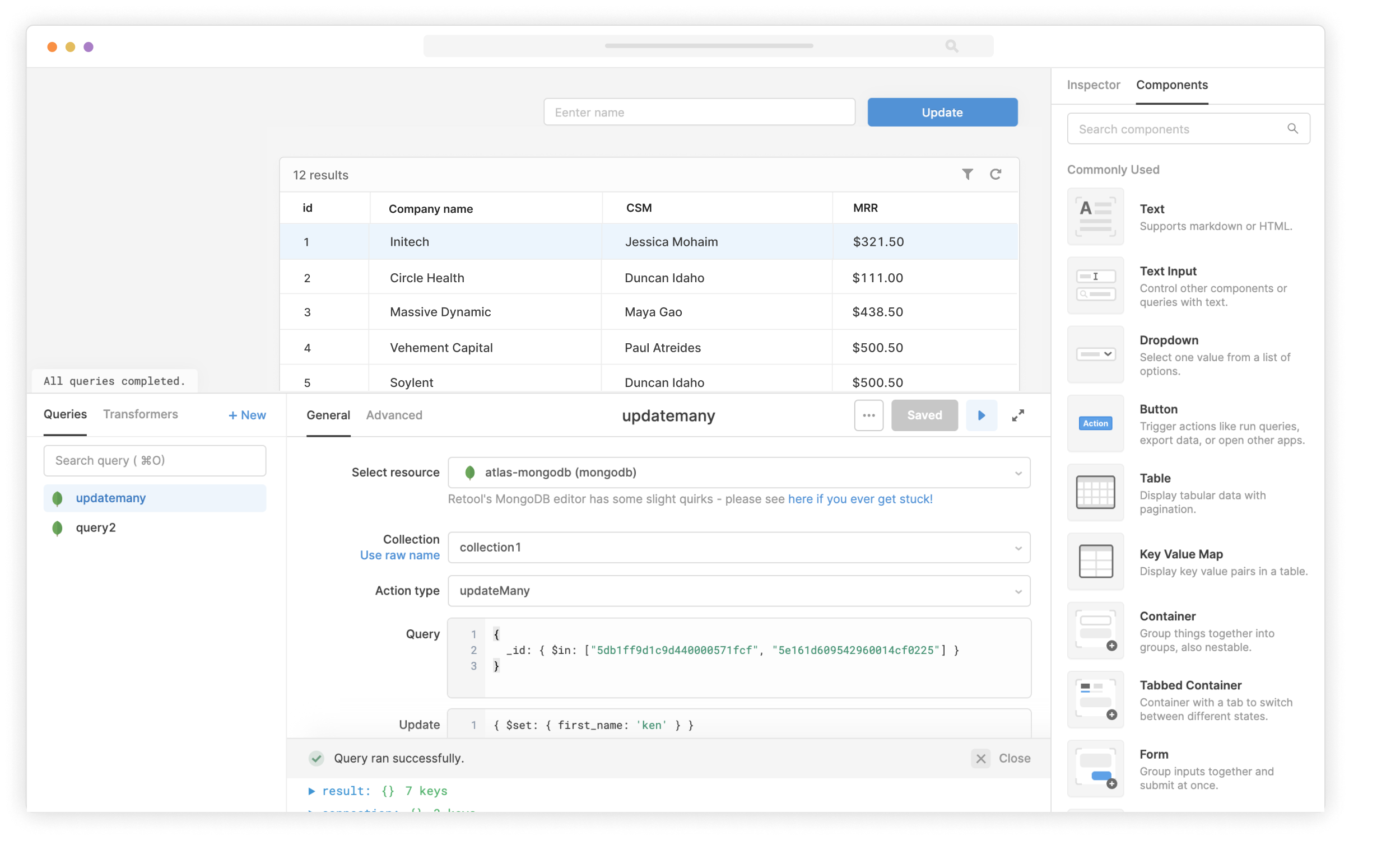
Retool is not a database client at all. It is a low-code platform for building internal applications over a data source, and MongoDB is one of the sources it connects to: prebuilt interface components, workflow automation, and a choice of cloud or self-hosted deployment. Turning a collection into a dashboard an operations team uses every day is the job it does, and none of the other tools here target it.
Because it is an application builder, there is no explain-plan analysis, no schema design and no database administration in it, so it complements a client rather than replacing one. The pricing page lists a free plan, then Team, Business and Enterprise, priced per seat with separate rates for builders and internal users; the figures shown depend on the visitor's region and on whether the annual or the monthly cycle is selected, so read them there rather than from any comparison.
Performance monitoring and profiling compared
Diagnosing a slow query means seeing the plan behind it and the load on the server, and each tool exposes a different part of that.
- DbSchema's Query Editor takes native MongoDB syntax and accepts the server's own diagnostic commands,
SHOW PROFILESamong them, so profiling output lands next to the diagram of the collection that produced it. - Compass analyzes explain plans and shows collection-level statistics from the vendor's own perspective.
- Studio 3T's Performance Suite holds a Query Profiler that reads MongoDB's own database profiler and lists slow queries with how long each ran and how many index entries it scanned, an Index Manager that creates, hides and drops indexes, and a Visual Explain that draws the query plan stage by stage with statistics for each stage.
- NoSQL Manager charts read and write operations, queued requests, active connections, memory use and page faults in real time.
- NoSQLBooster shows a visual explain plan, a live server view built on
mongostat, a viewer for in-progress operations that can kill one, and a database profiler that records the commands executed.
None of them replaces the server-side profiler you switch on with db.setProfilingLevel(); what they add is a readable view of what it records.
Best tool by use case
For reverse-engineering a MongoDB database into diagrams, designing validation rules against them and publishing documentation the team can read, DbSchema is the choice, and it covers the relational databases beside MongoDB in the same model. Where the dominant job is something else, the list at the top of this article says which of the seven was built for it, and the comparison table shows which of them also cover the SQL databases running beside MongoDB.
Each of these seven tools was built for a different day. If your day is spent understanding MongoDB collections, designing against them and explaining them to other people, download DbSchema at https://dbschema.com/download.html, connect to your deployment and read the diagram it draws: connecting, reverse-engineering and the diagrams are in the free Community Edition, while the model file, the documentation export and the Relational Data Editor are Pro. From there, the next steps are building a MongoDB database diagram, visualizing MongoDB relationships, and filling a new collection with test data from the Data Generator.
FAQ
What is the best MongoDB GUI for schema visualization?
DbSchema, because it is built around structure rather than around a query window. The section 1. DbSchema above covers what the diagram shows when a collection carries a validation rule and what it shows when none exists.
Are there good free MongoDB tools?
MongoDB Compass is free outright, and the DbSchema Community Edition is free and covers connecting, reverse-engineering, interactive diagrams and the SQL editor for every supported database. NoSQLBooster has a free edition with limits, and the Studio 3T Community Edition is described by the vendor as being for non-commercial use.
Which MongoDB tool is best for teams?
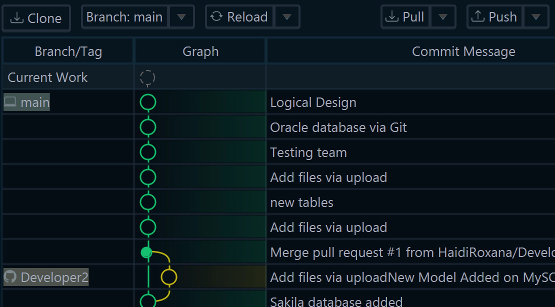
DbSchema, because its design lives in a model file rather than in one person's window. The file goes into the same Git repository as the application code, so a change to a collection's structure is reviewed in a pull request, and the HTML5 documentation exported from it opens for colleagues who have no database credentials.
Sources
Best MongoDB GUI for schema design
DbSchema draws your collections, their validation rules and the virtual relations MongoDB never declares. Connecting, reverse-engineering and diagrams are in the free Community Edition, with a 15-day Architect trial.