DbVisualizer Alternative in 2026: DbSchema for Database Design
For the DbVisualizer user who now has to design a schema, document it for the rest of the team and keep it in step with the database.
On this page
DbVisualizer does the querying: connections, a grid, SQL, and References graphs over what already exists. The moment the work turns into designing a schema rather than reading one, DbSchema is what you reach for. DbSchema draws tables before the database has them, saves the whole design to one model file your team versions in Git, compares that file against the live server, and exports documentation anyone can open in a browser.
Both products connect over JDBC, so nothing about your drivers or your credentials changes when DbSchema goes in beside DbVisualizer.
Why people look for a DbVisualizer alternative
The search starts when a question arrives that a query cannot answer. Somebody asks what the schema will look like after the next release, or asks for documentation a non-technical colleague can read, or asks why the test database and production have drifted apart.
Answering those needs a design that exists apart from the server: a diagram you edit rather than one generated from the connection, a file that travels through a pull request, documentation generated from that file, and a comparison that tells you what changed. DbVisualizer's own feature set documents version control over SQL scripts, with branches, history and change tracking[1], and no offline model file, so those four questions land outside it.
DbSchema answers all four from one place, and it reaches document stores as well as relational ones, MongoDB included.
What DbSchema is
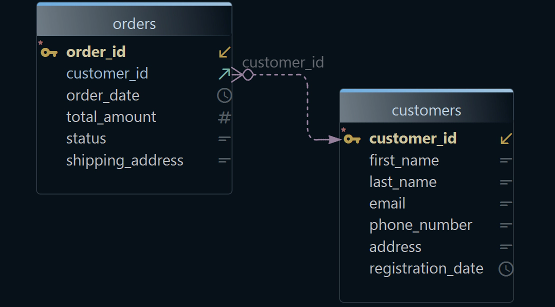
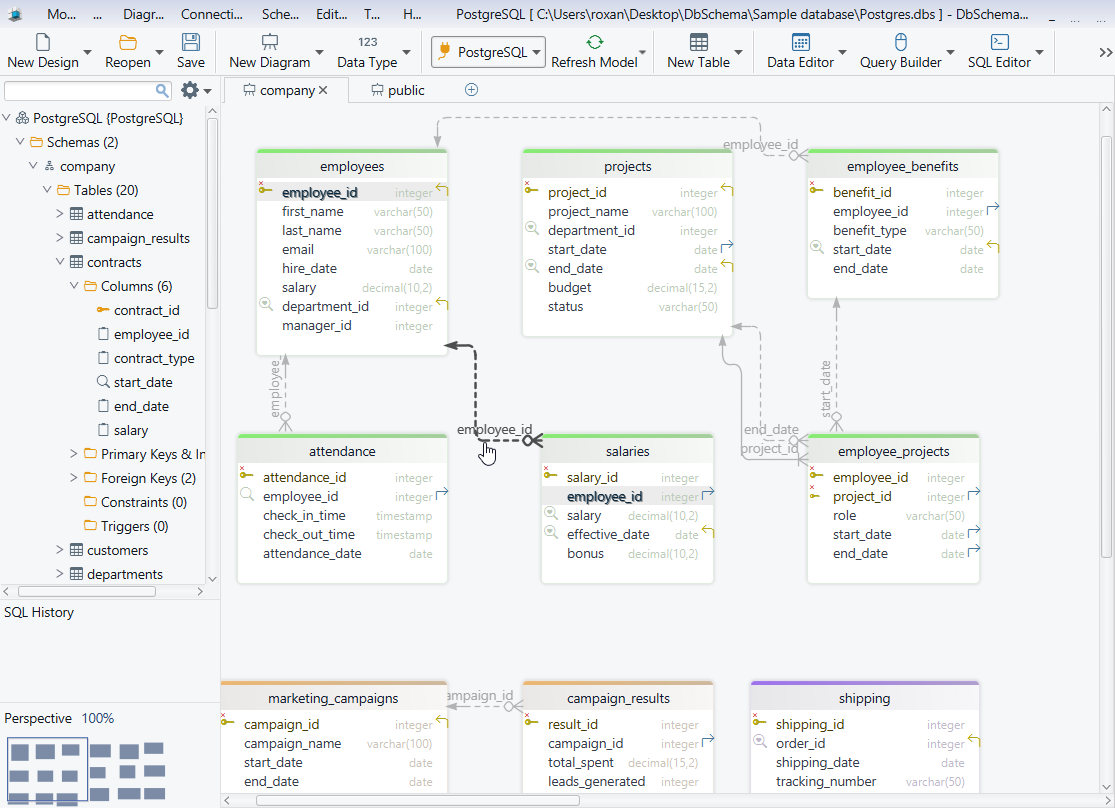
DbSchema is a desktop application for designing, exploring and documenting databases, on Windows, macOS and Linux. It connects over JDBC to 100+ SQL and NoSQL engines, downloads the driver when you pick one, and reverse-engineers what it finds into an interactive ER diagram rather than a list of tables.
The diagram is the design surface: click and drag to create tables, columns, indexes and foreign keys, and split a wide database into several diagrams in one project, each with its own layout and its own visible tables. Connecting, reverse engineering, the diagrams and the SQL editor are in the free Community Edition.
Around that canvas sit the pieces a query client has no reason to carry: a model file that holds the design between sessions, a comparison against the live database, documentation exported from the design, and Git over the same file. The rest of this page takes them one at a time, with the edition each one needs.
Core features of DbSchema
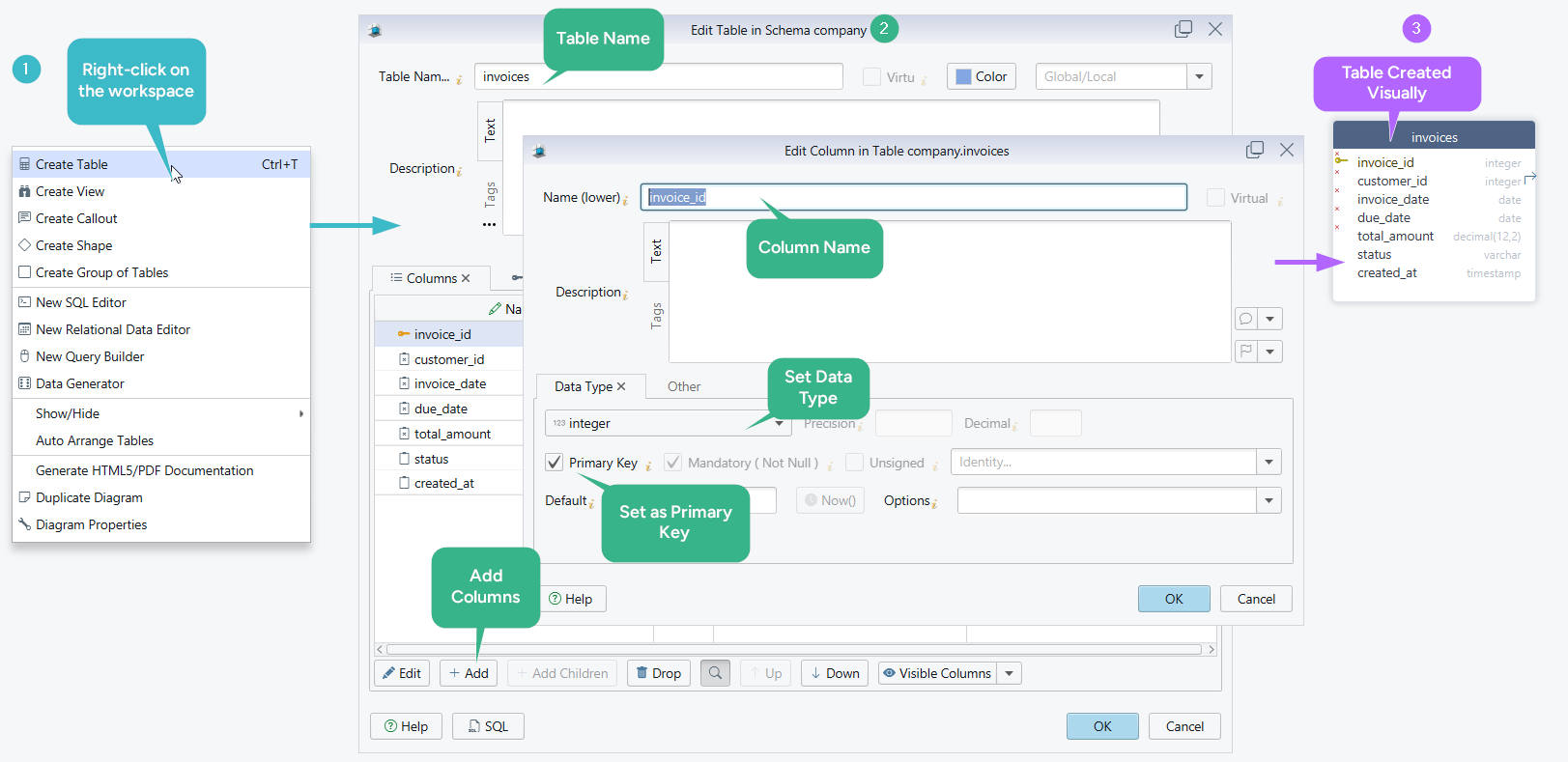
Diagram-based design
Tables, columns and relationships are created on the canvas, and every edit changes the model file rather than the database. The layouts, the table groups and the colours are saved with the design, so the arrangement you spent an afternoon on is the one that opens next week. Designing with no server reachable, and saving the model to a file, are Pro.
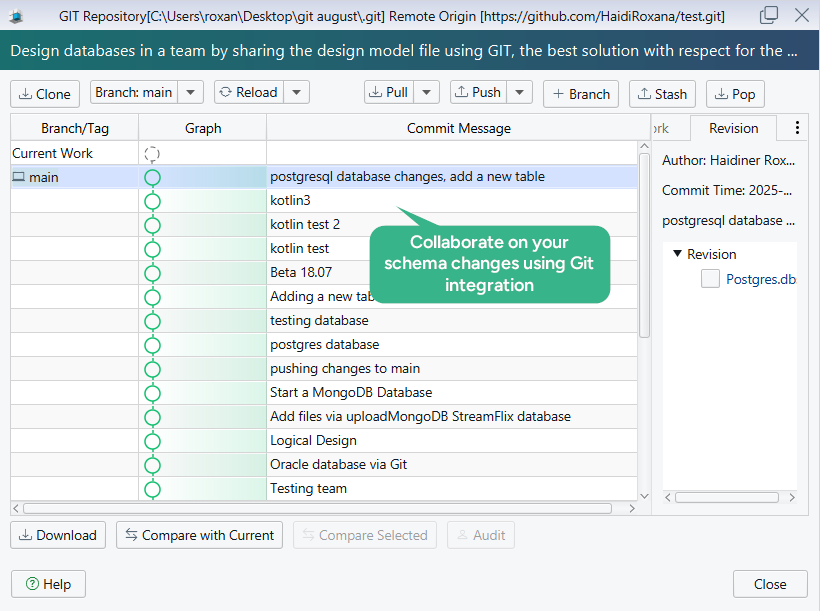
Version control with Git
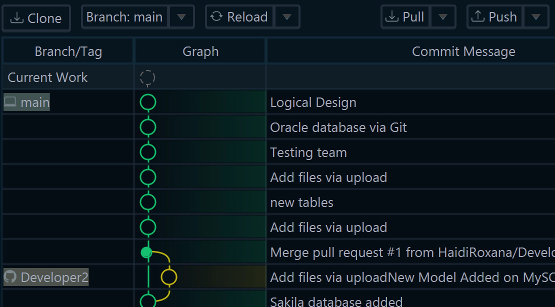
The design is a single .dbs file, plain indented XML holding the schema plus every diagram, layout, colour, virtual foreign key and comment. Open the Git dialog from the Model menu to clone a repository, stage the file, commit it, push it and pull what a colleague changed; Compare with Current opens the Synchronization Dialog on the version that arrived. A schema change then reads as added and removed lines in a pull request. Model versioning is Pro.
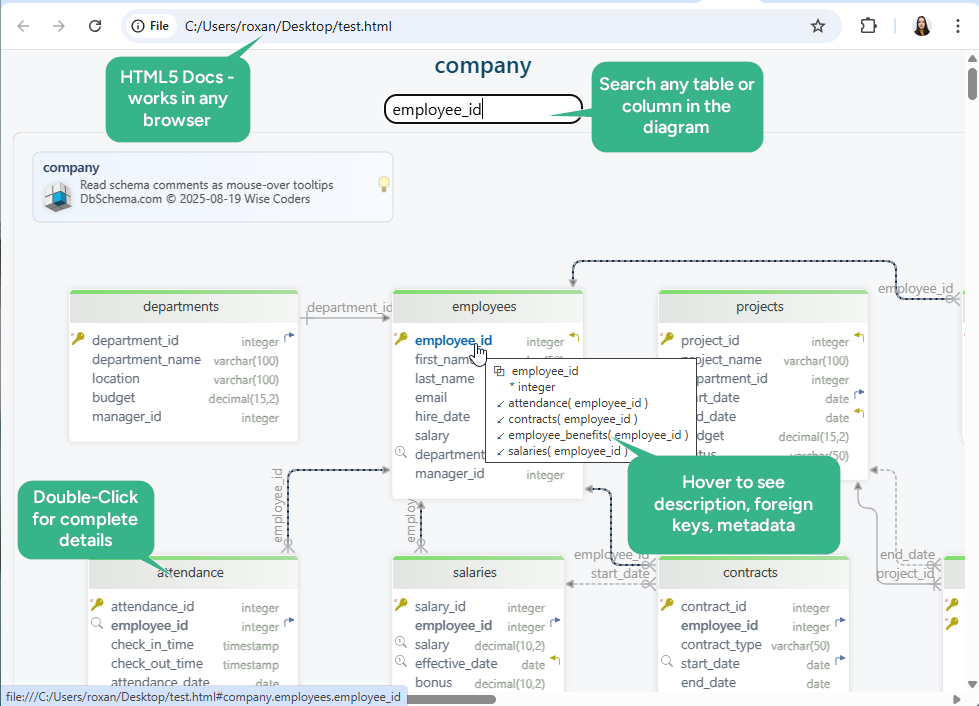
Documentation generated from the model
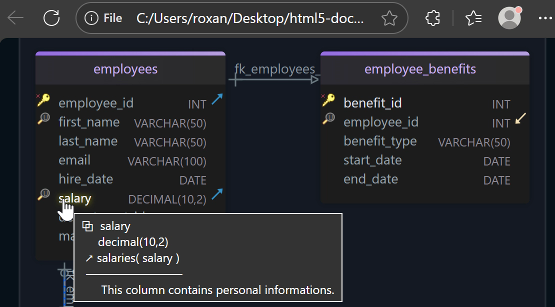
Diagram → Export HTML5 or PDF Documentation writes an interactive HTML5 page that opens in any browser with no server behind it, carrying the diagram as a vector image, a searchable table list, full column details, and table and column descriptions as mouse-over tooltips. The same dialog writes PDF for a formal review and Markdown for a repository or a wiki, and you choose which diagrams go in and how far the detail runs. Documentation export is Pro.
Schema compare and synchronize
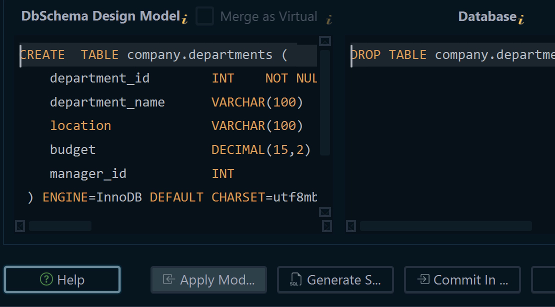
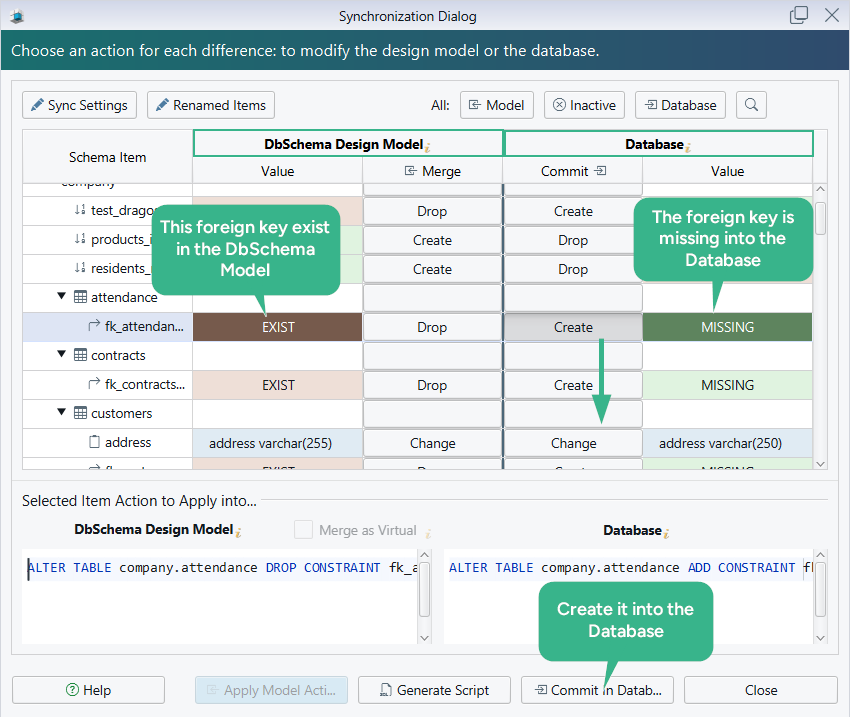
Schema → Compare Model with Database lists every difference between the design and the live database, object by object, and you decide for each one whether the model wins or the database does. Schema → Synchronize Model with Database then generates the SQL, which you read and edit before it runs. The same comparison works model against model, so two saved designs can be diffed with no server in the loop. Synchronization is Pro.
Data tools built on the foreign keys
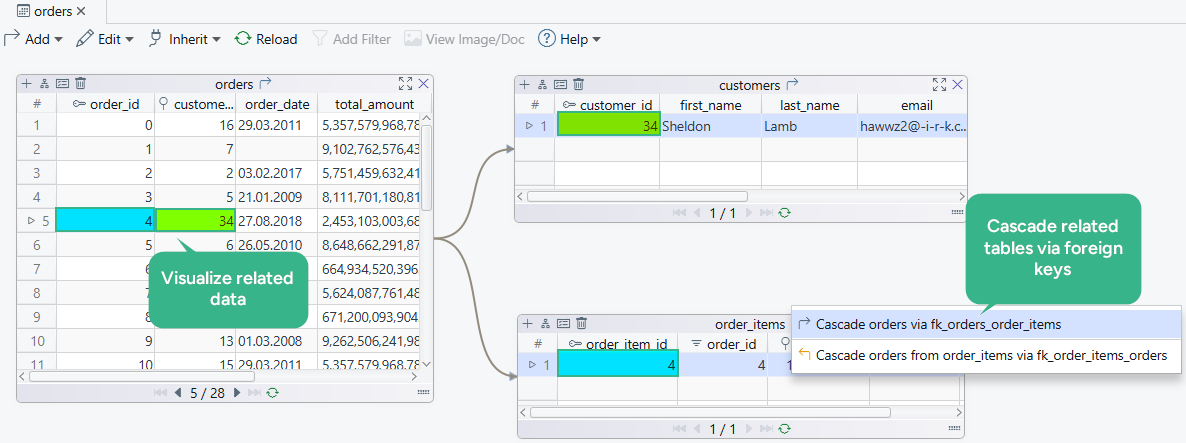
The Relational Data Editor opens parent and child tables side by side and refilters every child pane as you move through the parent, cascading as many levels as the schema has. Where the database declares no foreign key, drag one column onto another in the diagram to create a virtual one, saved in the model file and used exactly like a real key. The Data Generator fills a fresh schema with test rows in foreign-key-aware order, and the SQL editor handles the typed queries. The first two are Pro; the SQL editor is in Community.
DbVisualizer vs DbSchema side by side
The rows below are the ones people actually switch over, with the DbSchema edition named where a feature is paid. Read the middle four first: designing offline, documentation, synchronization and version control over the design are the four DbVisualizer's own pages do not describe, and they are the four that decide whether a schema can exist before the database does. The last row is the one to act on, because both trials run long enough to take a real schema through a full pass, and DbSchema extends its 15 days by another 15 if the evaluation runs over.
| Feature | DbSchema | DbVisualizer |
|---|---|---|
| Database support | 100+ SQL and NoSQL over JDBC | Any JDBC driver, extended support on a named list |
| Schema diagrams | Editable, several per model | References graphs, free edition |
| Design offline in a file | Yes, Pro | Not documented |
| Documentation output | HTML5, PDF and Markdown, Pro | Result-set export |
| Schema synchronization | Model against database, Pro | Not documented |
| Version control | The model file, inside the app, Pro | SQL scripts, with branches and history |
| Related-data browsing | Relational Data Editor over the foreign keys, Pro | Query by hand |
| Free trial | 15 days, extendable by 15 | 21 days |
A longer read of the same pair, with the current prices on both sides, is in DbSchema vs DbVisualizer. The two sit together comfortably: keep querying where you query today, and let DbSchema own the design, the documentation and the history of the model file.
Who gets the most value from DbSchema
DbSchema pays off fastest if you think in pictures rather than in table lists, and if somebody other than you has to understand the schema: a new starter reading the diagram on their first day, a reviewer looking at a pull request, a manager reading the HTML5 documentation without a database client installed. It also pays off when one team owns several engines, because the diagram, the documentation and the synchronization work the same way on all of them, relational and document stores alike.
Download DbSchema at https://dbschema.com/download.html, connect it to a database you already query, and let it reverse-engineer the schema into a diagram you can edit. Connecting, reverse engineering, the interactive diagrams and the SQL editor are in the free Community Edition; the model file, Git versioning, HTML5 documentation, schema synchronization and the data tools are Pro, and logical and conceptual design is Architect.