Design and Manage Oracle Databases Visually with DbSchema

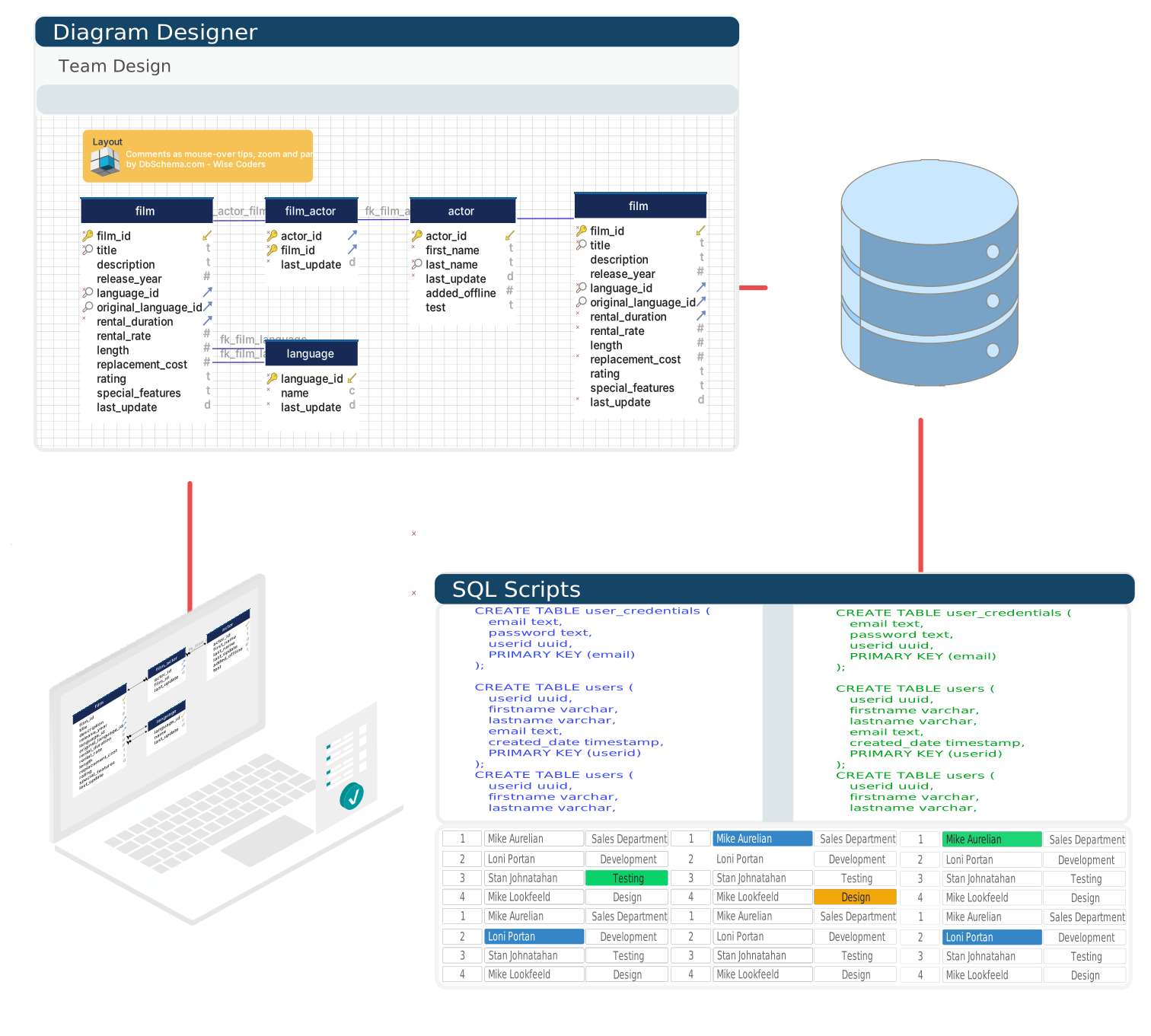
DbSchema lets you design, manage, and document Oracle databases. Create ER diagrams, define tables and columns, and generate SQL scripts - with or without a live database connection.

Use Git to share the design, compare it with the Oracle database, and deploy changes. DbSchema also includes a data editor, query builder, and HTML5 documentation - everything you need in one tool.

DbSchema Database Designer

Download DbSchema Download Oracle JDBC Driver

Navigating Oracle's Multi-Schema, Multi-Tablespace Architecture

Oracle databases are organized around user-owned schemas distributed across tablespaces, with privileges, synonyms, database links, and partitioned tables adding further structural complexity. Rather than querying DBA_TABLES and DBA_CONSTRAINTS by hand, DbSchema imports Oracle catalog metadata and renders the full object graph as an interactive visual model — accessible to both DBAs and application developers without requiring deep Oracle system knowledge.

Visual Schema Design Across Oracle Schemas


DbSchema supports multiple Oracle schemas in a single diagram, making it straightforward to trace foreign key relationships and synonym dependencies that cross schema boundaries. Tablespace assignments and partitioned table structures are preserved in the model so the diagram reflects actual production configuration rather than an abstraction of it.

Designing an Oracle schema visually in DbSchema

Oracle-Aware SQL Editor

The SQL editor provides autocomplete for Oracle SQL and PL/SQL keywords, table and column names, and built-in functions. Write and execute queries directly against the Oracle instance, or test SQL against the offline schema model when a live connection is unavailable. Result sets are displayed in a tabular grid with export options.

Oracle-aware SQL editor with autocomplete in DbSchema

Auto-Generated Schema Documentation

Large Oracle databases often lack current documentation. DbSchema generates a complete HTML documentation set from the live schema — including table descriptions, column types, constraint definitions, and embedded ER diagrams — that can be shared with auditors, developers, and stakeholders without granting them direct database access.

Auto-generated Oracle schema documentation in DbSchema

Connecting DbSchema to Oracle

Oracle Database listens on port 1521 by default. The Thin JDBC URL format is jdbc:oracle:thin:@//host:1521/service_name — use the service name rather than the SID for Oracle 12c and later. For Oracle Cloud Autonomous Database, download the wallet ZIP from the Oracle Cloud console, set the oracle.net.tns_admin JVM property to the wallet directory path, and connect using jdbc:oracle:thin:@tns_alias where tns_alias matches an entry in tnsnames.ora. DbSchema supports both the Thin and OCI driver modes.

Why DbSchema for Oracle Development

  • Map complex cross-schema relationships and synonym dependencies that span Oracle user accounts.
  • Generate schema documentation for audit trails, onboarding, and architecture reviews.
  • Compare two Oracle environments and produce DDL migration scripts for controlled deployments.
  • Edit tables, add columns, and modify constraints without writing raw ALTER statements.
  • Design new schema objects offline and deploy them to a target Oracle instance when approved.