Schema Mapping Tools Compared: 2026 Architect's Guide
For the database architect who has to map a schema onto a target and wants the map itself to survive review, branching and the next release.
On this page
The mapping between what your application expects and what the target database holds is currently a spreadsheet, and nobody can tell you which version of it shipped. DbSchema is the schema mapping tool to reach for when that map has to live in a file you can branch, review and merge: it models offline in a Git-versionable XML file, reverse-engineers over JDBC across SQL and NoSQL engines, and generates the migration script from a visual diff against a target database.
Navicat Data Modeler, erwin Data Modeler and Talend Data Mapper each take on a narrower version of that job, and one of them is not competing for it at all.
The schema mapping shortlist for 2026
"Schema mapping" covers three different tasks that get filed under one phrase, and picking a tool means naming which one you are doing. Visual entity-relationship modeling maps logical entities onto physical tables and is where DbSchema, Navicat Data Modeler and erwin Data Modeler all sit. Schema migration tools reconcile a design against a live target and write the DDL that closes the gap. Data transformation engines map record structures between systems in a running pipeline, which is Talend Data Mapper's job and nobody else's on this list.
DbSchema covers the first two from one model file, across relational and document engines. Navicat Data Modeler works through conceptual, logical and physical layers in a desktop GUI. erwin Data Modeler is bought for governance, with a repository and a change audit around the modeling. Talend Data Mapper transforms payloads inside integration Jobs and never draws a table.
How DbSchema keeps the map in a file you can review
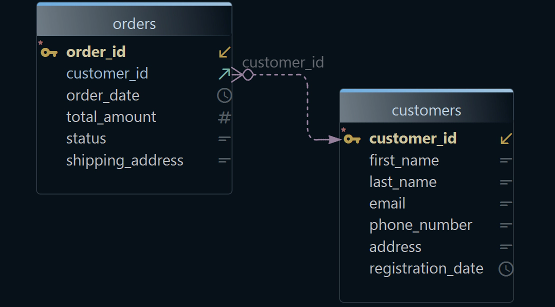
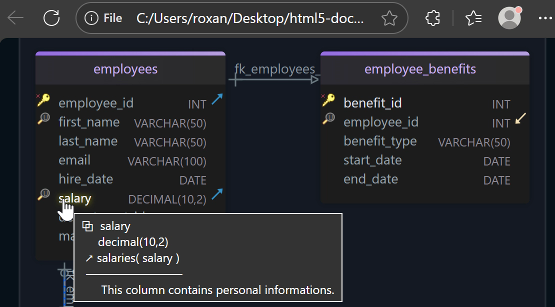
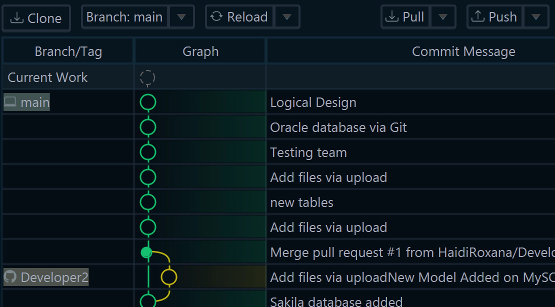
DbSchema separates the design from the connection. The model is a local XML file holding table structures, data types, foreign keys, diagram layout and the documentation you typed, and none of that needs a server to be reachable. Because the file is plain indented XML, a mapping change lands in a pull request as readable text, which is what makes the design reviewable in the same way as the code around it, and is the basis of a collaborative design workflow in Git.
Point DbSchema at a target and it reverse-engineers the live schema over the engine's JDBC driver, across 70+ SQL and NoSQL databases, drawing tables, keys and indexes with that engine's own data types. Reverse-engineering reads the database and writes only the model.
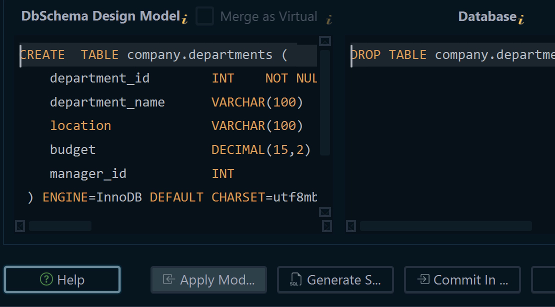
Deploying the mapping is a separate, explicit step. Schema → Compare Model with Database lists what differs object by object, and for each difference you choose to update the model, push the change to the database, or skip it. Schema → Synchronize Model with Database then generates the SQL that would close the gap; you can read and edit those statements before anything runs, and clicking Execute is the one action in this whole workflow that changes the live database.
Connecting, reverse-engineering, the diagrams and the SQL editor are in the free Community Edition. Saving the model to a file and schema synchronization are Pro; the database-independent logical and conceptual layers are Architect.
What Navicat Data Modeler builds in the desktop GUI
Navicat Data Modeler works through the three modeling layers in one desktop application: a conceptual diagram, a platform-independent logical model, and a physical schema generated for the target engine. It reverse-engineers an existing database into a visual model, compares structures visually, and gives the diagram editor styling presets, alignment tools and export formats for handing a picture to somebody.
It is sold per user as a perpetual licence, and the store lists the cross-platform Enterprise Edition at 599.00 US dollars, with volume discounts of 15 per cent from five licences and 20 per cent from ten[1]. The page has an edition selector alongside the quantity, so that figure is the Enterprise Edition at a single licence.
Where it differs from DbSchema is what the design is saved as. Team sharing runs through Navicat's own project format rather than a plain text file you commit next to the application code, so the review of a mapping change happens inside Navicat rather than in the pull request.
erwin Data Modeler and the governance repository
erwin Data Modeler, now sold by Quest, is bought where the modeling has to answer to an audit. Quest publishes technical documentation for it up to release 15.2, alongside a separate erwin Mart Portal, which is the server-side repository the modeling clients share[2].
It is licensed as an annual subscription per named user, in two editions. Standard includes reusable standards: model templates, domains, automation macros, naming and datatype standards, and erwin's model integration and interoperability bridges. Workgroup adds the centralized model management repository, collaborative modeling with conflict resolution, and change management with auditing[3]. Today the store listed Standard at 3,130.89 euros and Workgroup at 4,379.20 euros per named user per year; the page prices in the visitor's currency, so those are the euro figures.
That is the trade the erwin licence makes: the change audit and the shared repository are what the annual per-seat cost buys, and a team whose mapping review already happens in Git is paying for a second place to do it.
Where Talend Data Mapper sits in the stack
Talend Data Mapper is not an alternative to a visual modeler; it works one tier away. It is a mapping component used inside Talend Jobs and Routes, mapping fields between hierarchical formats such as XML documents, JSON payloads, EDI transactions and COBOL copybooks, rather than drawing relational tables.
Talend's documentation notes that Data Mapper is not bundled with Talend Runtime by default: you install it as a runtime feature before you can deploy a Job or Route that uses a data mapping component[4].
So it sits alongside DbSchema rather than against it. You model the relational structure and deploy it from the model file, then use the mapper to move records into and out of it in the pipeline.
Pricing, licensing and free tiers compared
The four differ less on features than on what happens when you stop paying.
| Tool | Core focus | Offline model file for Git | Licensing |
|---|---|---|---|
| DbSchema | Visual design, offline modeling, schema sync | Yes, .dbs XML | Community free; Pro or Architect, one time or monthly |
| Navicat Data Modeler | Conceptual, logical and physical layers in a GUI | Proprietary project format | Perpetual per user, Enterprise Edition 599.00 USD |
| erwin Data Modeler | Governance, audit, shared repository | Mart Portal repository | Annual per named user, Standard or Workgroup |
| Talend Data Mapper | Payload transformation in ETL Jobs | Runtime feature, not a model file | Part of the Talend platform |
DbSchema's Community Edition is free for any use and covers all databases, connect and reverse-engineer, interactive diagrams, creating tables and columns, and the SQL editor. Pro adds saving your work to a file, HTML5, PDF and Markdown documentation, the visual query builder, schema synchronization, relational data browse, the data generator and the data importer. Architect adds logical modeling and conceptual design plus own-key AI.
Pro is a one-time perpetual licence per user plus taxes, with the first year of updates included and an annual renewal afterwards to keep receiving them; Architect is the same arrangement one tier up. Both are also sold monthly, and a floating licence covers teams that share seats[5]. Renewing is optional in both perpetual cases, because the licence does not expire. The purchase page carries separate tabs for business, personal and academic buyers, and it shows the amounts in your own currency, so read the tab that applies to you.
How to choose your schema mapping tool
Start from where the mapping has to be reviewed. For a schema that ships with an application, that is the same pull request as the code, and DbSchema is the one to run: the model is a text file a reviewer reads, and the migration script comes out of a diff against the real target rather than out of somebody's memory of the last release. Relational and document engines both land in that one model file.
The other three are bought for jobs sitting beside that one. erwin Data Modeler is built around a shared repository with a formal change history, which is what an auditor asks to see. Navicat Data Modeler puts the three modeling layers in one desktop GUI and shares through its own project format. Talend Data Mapper transforms payloads in a running pipeline, next to whichever modeler drew the tables.
Download DbSchema at https://dbschema.com/download.html, connect it to the target database, and let it reverse-engineer the schema so you can compare it against the design you meant to ship. The free Community Edition covers the connection, the reverse-engineering, the diagrams and the SQL editor; the offline model file and schema synchronization are Pro; conceptual and logical design is Architect.
Frequently asked questions
What is a schema mapping tool?
A tool that records how logical entities map onto physical tables and columns, and then keeps that record in step with a real database. The range runs from visual modelers like DbSchema, where the map is an XML file you commit, to governance platforms like erwin Data Modeler, where it lives in a shared repository with an audit trail.
How much does erwin Data Modeler cost?
Quest sells it as an annual subscription per named user, in a Standard and a Workgroup edition, and the store quoted 3,130.89 and 4,379.20 euros per user per year today[3]. The page prices in the visitor's currency, so check it for the figure in yours.
Does Navicat Data Modeler offer a perpetual license?
Navicat sells one, per user: the store listed the cross-platform Enterprise Edition at 599.00 US dollars with volume discounts from five licences upward[1]. DbSchema Pro is also perpetual, priced per user on the purchase page, and adds the plain-XML model file that Git can diff[5].
How does DbSchema handle schema changes?
A change made on the DbSchema diagram writes to the model file only. Comparing that file against a live database lists the differences object by object, and the Synchronization Dialog generates the SQL to close them, which you can read and edit before you execute it.
Are schema mapping tools different from data integration tools?
The two work at different tiers. A schema mapping tool deals with structure: tables, relationships and the DDL that creates them. An integration tool such as Talend moves and reshapes the rows once that structure exists, which is why Talend Data Mapper installs as a Talend Runtime feature rather than as a modeling application[4].
Sources
Map your schema in a file you can review
DbSchema models offline in a Git-versionable .dbs file, reverse-engineers live SQL and NoSQL databases over JDBC, and generates the migration script from a visual diff. Interactive diagrams and the SQL editor are in the free Community edition.