Desktop or Browser: Where Your Data Model Should Live
For the architect standardizing where a team's schema designs are kept, who has to answer for the privacy of the metadata and for what happens when a subscription lapses.
On this page
Somebody on the team has started a diagram in a browser tab, and now the question is whether the whole team should follow. Keep the model on the desktop in DbSchema: it saves the design as a local XML file that diffs next to the application code, works with no network at all, and is sold as a perpetual licence rather than a seat you rent. The browser platforms, SqlDBM and dbdiagram.io, are built for handing a stakeholder a link, and they ask for a copy of your table definitions in exchange.
The decision criteria that matter
What separates the two has nothing to do with how the diagram looks.
Start with where the metadata sits. DbSchema, as a desktop modeler, keeps the DDL, the layout and the saved connections on the workstation and in your own repository; a browser modeler needs the table definitions uploaded to the vendor's infrastructure before it can render anything, because that is where the rendering happens.
The next question is what happens with no network. A DbSchema model opens on a train, in an air-gapped subnet, and during the outage that takes the VPN down. A browser workspace does not.
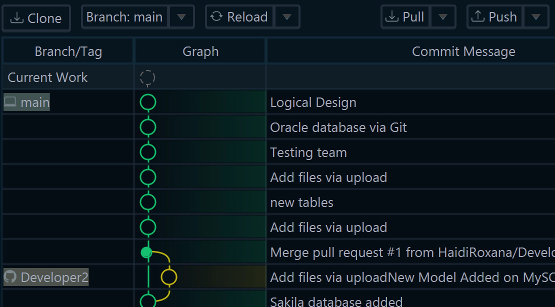
The third difference is what the version history is made of. When the model is a plain text file, the history is Git: branches, pull requests, a diff a reviewer reads, and a merge that behaves like every other merge in the repository. Cloud platforms keep their own internal history instead, which is a real history but not one your existing review process can see.
Sharing is the last of them, and the one the browser tools are built around: a URL, opened by somebody who installs nothing, who can leave a comment on the diagram. That has a cost on the other side, which the rest of this article works through.
Desktop modeling with local model files, Git and offline privacy
DbSchema connects to 70+ SQL and NoSQL databases through their own JDBC drivers, including PostgreSQL, MySQL, Oracle, SQL Server, Snowflake and MongoDB, and reverse-engineers the schema into an interactive diagram. The whole design, including the schema, the diagram coordinates, the virtual relations and the colours, is stored in a single XML .dbs file on your disk.
Because that file is plain text, a schema change shows up in git diff as lines somebody can read, and it travels through the same branch and pull request the application code does. Nothing is sent to a vendor to make that work: the credentials stay in the local connection, and the model file goes only where you push it. We build DbSchema under an ISO/IEC 27001:2022 certified information security management system.
The connection is separate from the design, so DbSchema will keep working when the database is unreachable. Set the connection to Disconnected and you can add tables, alter columns and rearrange the diagram with no server involved; every change is saved to the model file and nothing is sent to the database[1]. When you reconnect, Schema → Compare Model with Database lists what differs, and the Synchronization Dialog generates the SQL that would close the gap. Reading and editing that script is the last step before it runs, and clicking Execute is the single action that changes the live database.
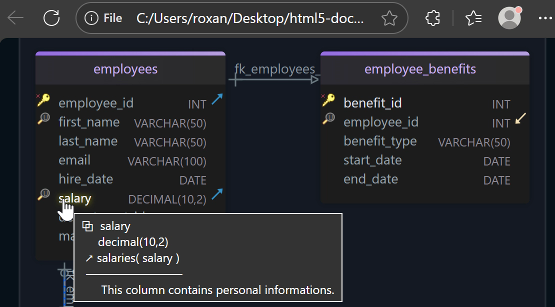
What DbSchema does not do is host a live URL that a stakeholder comments on in the browser. What it does instead is export the design as self-contained interactive HTML5 documentation: a vector diagram, a searchable table list, and every column description as a mouse-over tooltip, in a file you can attach to a release or put on an internal web server where the same stakeholders read it without an account anywhere. Diagram → Export HTML5 or PDF Documentation writes it, and it regenerates from the model file whenever the schema moves.
Saving the model to a file, the documentation export and schema synchronization are Pro features; connecting, reverse-engineering, the diagrams and the SQL editor are in the free Community Edition.
What is the Microsoft tool for data modeling?
Inside the Microsoft stack, the answer is SQL Server Management Studio, which carries three Visual Database Tools designers: Database Diagram Designer, Table Designer, and Query and View Designer[2]. Database Diagram Designer gives you a canvas on which to create, edit and show the tables and relationships in a database, and Microsoft's page notes against each designer that it "works with Microsoft SQL Server databases"[2].
Two things follow for a team choosing where its models live. The designers apply to SQL Server, Azure SQL Database, Azure SQL Managed Instance and Analytics Platform System[2], so a PostgreSQL or MongoDB database in the same estate has to be modeled somewhere else. And SSMS 22 installs through the Visual Studio Installer, with no standalone package[3], which decides for you where the modeling happens.
There is also no design file in the picture. Microsoft states that each database diagram you create is stored in the associated database[4], so the diagram is not something a pull request can review, and it does not exist before the database does. For a mixed estate, or for designing a schema that has not been created yet, DbSchema covers both from the one model file.
Browser-based modeling in SqlDBM and dbdiagram.io
Cloud modeling platforms run entirely in the browser, which is what makes the link-sharing possible and also what requires the upload.
dbdiagram.io is code-first: you type DBML, the open schema definition language its team publishes[5], into one pane and the ER diagram renders in the other. Diagrams can be shared publicly or embedded on the free plan, and password-protected and private sharing arrives with the paid plans[6].
SqlDBM aims at cloud data platforms: Snowflake, Databricks, BigQuery, Amazon Redshift, Azure Synapse and Microsoft Fabric, alongside PostgreSQL, SQL Server, Oracle, AlloyDB and MySQL[7]. Its Data Modeling platform lists conceptual, logical and physical modeling, reverse and forward engineering, alter scripts, version control, lineage, concurrent working with comments, and integrations with dbt, Confluence, Git, Jira and an API[7].
Both give a reviewer a diagram in a browser tab with nothing to install. Both need your table definitions, data types and relationships stored on infrastructure the vendor manages, and neither opens when the network is down. Whether that trade works depends on one question: is the schema you are modeling one you are allowed to upload?
How to test each one
Test against a staging database that mirrors your real table count and foreign key density, not against a sample schema with eight tables. Five checks, in this order:
- Reverse-engineer the full staging database and time it, then look at whether composite primary keys, check constraints, schema namespaces and cross-schema references all came through.
- Disconnect the network adapter and try to create a table, change a data type and rearrange the diagram.
- Save the model, run
git diffin a terminal, and read the output. If a reviewer could not tell from it what changed, the version control criterion has failed. - Introduce a difference between the model and the live database, generate the migration script, and read it before running it: check that it alters rather than drops.
- On the cloud candidates, zoom and pan across a diagram with several hundred entities and see what the browser does.
The fourth check is the one that separates a diagramming tool from a design tool, and these compare-tool checks go into it in more detail.
What the cost is over three years
The gap is not the first-year figure, it is what year three looks like.
| Product | Licensing model | Cost | What year three costs |
|---|---|---|---|
| DbSchema Pro | Perpetual, optional renewals | One time + taxes, or a monthly subscription | Nothing required; the licence does not expire |
| dbdiagram.io Team | Monthly subscription per workspace | 75 USD a month billed annually, 100 billed monthly | The same again; access ends with the subscription |
| SqlDBM | Quoted subscription | Custom pricing, quoted on request | Quoted again |
A DbSchema Pro licence is bought once, plus taxes, with the first year of updates included and an optional yearly renewal afterwards if you want to keep receiving them. The licence itself never expires, so the version you bought keeps opening whether or not you renew. Architect, which adds database-independent logical and conceptual design, is the tier above Pro, and both editions are also sold monthly. The amount for each is on the DbSchema purchase page[8], which prices in your own currency and carries separate Business, Personal and Universities & Students tabs.
The browser platforms bill for as long as you want the diagrams. A dbdiagram.io Team workspace is 75 US dollars a month billed annually or 100 billed monthly, with three users included and 5 or 7 US dollars a month per extra user depending on which way that billing toggle is set[6]. SqlDBM publishes no figure at all: both its platforms are quoted on request[7]. In both cases the workspace and the diagrams in it are reachable while the subscription is, which is the part to put in the three-year number rather than the monthly one.
The questions to ask a vendor
Five things to put in writing before a purchase order goes out:
- Ask where the table definitions, column names, comments and relationship keys are stored: on local disks, on a server you run, or in multi-tenant cloud storage.
- Ask whether an engineer can open and edit a model with no network connection.
- Ask what a schema change looks like in
git diff, and whether a reviewer can read it. - Ask which format the models export into if the service closes or the price changes, and what else can open that format.
- Ask whether database credentials are handled by a local driver or proxied through the vendor servers.
The answers sort the candidates faster than any feature grid, because each one has a factual answer that the sales call cannot soften.
The quickest way to answer the third question for yourself is to run it. Reverse-engineer your own schema into a DbSchema model, save the file, and read the diff; DbSchema downloads at https://dbschema.com/download.html. Connecting, reverse-engineering, the diagrams and the SQL editor are free in the Community Edition; the offline model file, schema synchronization and the HTML5 documentation export are Pro; conceptual and logical design is Architect.
Frequently asked questions
What is the Microsoft tool for data modeling?
SQL Server Management Studio, where Database Diagram Designer is the one that draws tables and relationships[2]. The section above works through what its SQL Server scope means for an estate that also runs PostgreSQL or MongoDB. A DbSchema model is database-independent instead: Model → Model Properties retargets the same design at another engine and previews how every data type converts before you commit to it[1].
Can database architects build ER diagrams offline?
In DbSchema, yes: the desktop section above covers what Disconnected mode leaves you free to do with no database reachable. Even the first connection works on a workstation with no internet access, because Connections → Manage JDBC Drivers takes a driver .jar you upload by hand where the automatic download from the DbSchema driver repository cannot run.
How much does the dbdiagram.io Team plan cost?
75 US dollars a month billed annually, or 100 billed monthly, with three user licences included and each extra user charged per seat[6]. The plan is shared between dbdiagram.io and dbdocs, so one subscription covers both.
What does SqlDBM cost?
SqlDBM publishes no list price: both the Data Modeling platform and the Context Layer platform are quoted on request[7]. Budget it as a per-seat annual subscription that recurs for as long as you need the diagrams open.
Why do teams use Git for database schemas?
Because it puts the schema change in the same review as the code change that depends on it. That only works when the model is a text file: DbSchema's .dbs is indented XML, so a reviewer sees the added column as a line rather than as a new binary blob.
Sources
Keep the model on your own machine
DbSchema reverse-engineers your database into an interactive ER diagram and saves the model as a local file that versions in Git, so no schema metadata leaves your network.