SQLite Database Design Tools Compared in 2026
For a developer or architect comparing SQLite design tools: what each one does, where it fits, and what it costs.
On this page
The SQLite file arrives with the project, and the only description of the schema is the file itself: no diagram, no migration history, nothing a reviewer could read. Pick DbSchema when you want that design drawn, kept in Git beside the code, and compared against the database it came from. DB Browser for SQLite, Letos and DBeaver each cover a narrower part of the same work.
The shortlist of SQLite design tools
DbSchema reverse-engineers a SQLite file into an interactive entity relationship diagram, stores that design in its own model file, and generates the SQL that brings a database in line with it. DB Browser for SQLite gives you a spreadsheet-style grid over the tables in a file. Letos, the project formerly called SQLiteStudio, is a portable desktop manager with an ERD editor and a query console. DBeaver is a multi-engine client that opens SQLite alongside PostgreSQL, MySQL and many other engines.
The four split into two jobs. Browsing and patching data in a file you already have is one job, and a grid does it. Designing the schema, keeping its history, and rolling it out to a database is the other, and it needs a model that exists apart from the file: something you can open with no database in front of you, diff, and hand to a colleague through a pull request. That second job is the one this comparison is about.
How each tool handles a SQLite schema
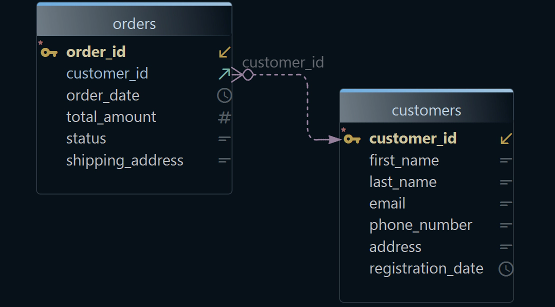
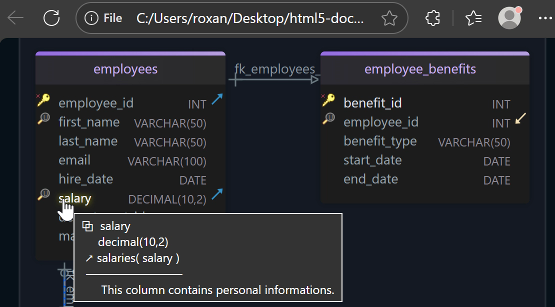
DbSchema connects to the .db or .sqlite file and reads its tables, columns, indexes and foreign keys into a diagram you can lay out and edit. SQLite disables foreign key constraints by default, for backwards compatibility. Each database connection turns them on for itself with PRAGMA foreign_keys = ON[3]. Plenty of SQLite files therefore carry relationships that nothing in the file declares. DbSchema lets you draw those as virtual foreign keys: they live in the DbSchema model file and leave the database untouched, the diagram draws them like declared ones, and the Query Builder and the Relational Data Editor in Pro follow them from one table to the next.
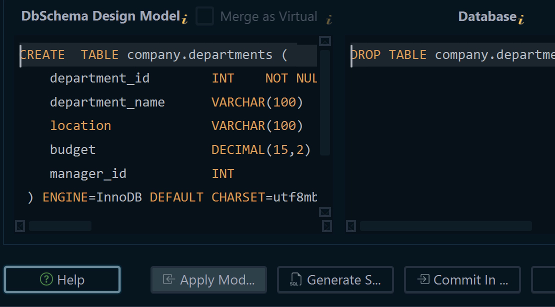
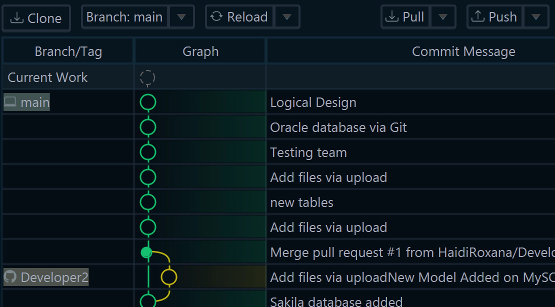
Two kinds of change are worth telling apart while you work. Connected, DbSchema applies each schema edit to the SQLite file as you make it and lists the statements it ran in the SQL History pane. Disconnected, the same edits are saved only to the design model, an XML .dbs file you keep beside your code and commit to Git, and nothing is sent to the database. Reconnect, click Refresh Model from Database, and the Synchronization Dialog shows each difference so you can write it to the database, take it into the model, or generate a migration script from it. Saving the model to a file and the synchronization are Pro features; connecting, reverse-engineering, the diagram and the SQL editor are in the free Community Edition.
DB Browser for SQLite describes itself as a visual, open-source tool for people who want to create, search and edit SQLite or SQLCipher database files, with a spreadsheet-like interface on the database and a full SQL query facility, on Windows, macOS and most versions of Linux and Unix[4]. Its wizards cover creating and compacting database files, defining tables and indexes, editing records, importing and exporting CSV, and plotting simple graphs from a table or a query. It draws no entity relationship diagram and keeps no design file of its own.
Letos runs from a decompressed folder with nothing to install, on Windows, Linux and macOS[5]. Release 4.0.3 added relationship highlighting to its ERD editor, so selecting an entity highlights the entities and connections related to it[5]. It also takes scripting extensions. It reads and writes the database file directly rather than a separate model.
DBeaver opens a diagram for a single table or a whole schema, and its documentation states that diagrams are read-only by default, with an Edit mode that turns the diagram into schema editing and produces SQL scripts. Diagram export covers PNG, GIF, BMP and GraphML, with SVG marked as available only in PRO[9]. DBeaver reaches SQLite from the same window as the other engines it supports.
| Tool | Diagram | Design file kept apart from the database | Compare and generate migration |
|---|---|---|---|
| DbSchema | Interactive, editable, virtual foreign keys | XML model file, versionable in Git (Pro) | Yes, with migration scripts (Pro) |
| DB Browser for SQLite | No | No | No |
| Letos | ERD editor with relationship highlighting | No | No |
| DBeaver | Read-only by default, Edit mode available | No | Edit mode produces SQL scripts |
What each tool costs
The DbSchema figures below are the list prices on the Business tab of the DbSchema pricing page, in US dollars and before tax. That page shows the amount in the visitor's own currency, and the Personal and Universities & Students tabs price the same editions differently, so read the tab and the currency before you budget.
DbSchema Community Edition is free with no time limit and connects to every supported database, reverse-engineers the schema, draws interactive diagrams and includes the SQL editor[7]. Pro is a one-time 294.00 USD and adds saving your work to a file, HTML5, PDF and Markdown documentation, the visual Query Builder, schema synchronization, and the data tools; the first year of maintenance and upgrades is included, and renewing afterwards costs 75.00 USD a year[7]. Architect is a one-time 470.40 USD, builds on Pro with database-independent logical and conceptual design and own-key AI, and renews at 120.00 USD a year[7]. A floating licence for teams and a monthly subscription of each edition are listed on the same page.
DB Browser for SQLite is free software, bi-licensed under the Mozilla Public License Version 2 and the GNU General Public License Version 3 or later[6]. Letos is free as well, released under the GPL and free to use for any purpose[5]. DBeaver Community is free and open source, while DBeaver PRO for the desktop is an annual subscription that includes product usage, version updates and one year of technical support: 113 USD a year for Lite, 255 for Enterprise and 510 for Ultimate, per licence, with a 14-day trial licence to evaluate it[8].
| Product | Price | Licence | What the price covers |
|---|---|---|---|
| DbSchema Community | Free | Free desktop software | Connect, reverse-engineer, diagrams, SQL editor |
| DbSchema Pro | 294.00 USD one time | Perpetual, first year of updates included | Model file, schema sync, HTML5, PDF and Markdown docs, Query Builder, data tools |
| DbSchema Architect | 470.40 USD one time | Perpetual, first year of updates included | Everything in Pro, logical and conceptual design, own-key AI |
| DB Browser for SQLite | Free | MPL 2.0 and GPL 3.0 or later | Grid editing, SQL execution, CSV import and export |
| Letos | Free | GPL | Portable desktop manager, ERD editor, scripting |
| DBeaver Community | Free | Open source | Multi-engine querying, read-only diagrams |
| DBeaver PRO desktop | From 113 USD a year | Annual subscription | One year of updates and support |
Before paying for anything, it is worth knowing what a free database design tool can and cannot do, because the line usually falls at the model file: DbSchema gives away connecting, reverse-engineering, the diagram and the SQL editor, and asks for Pro when you want to save that design and compare it against the database.
Who each SQLite tool is for
If you write the backend that owns the SQLite file, DbSchema is the fit: the schema is drawn, the model file goes into the repository with the code, and every change to it arrives through the same review as a code change, with the schema comparison telling you what a branch would do to the database. If you design before the engine is settled, the Architect edition draws a logical model with no database chosen, and generates the SQLite schema from it afterwards.
If your day is inspecting rows in a file an application produced, DbSchema's Relational Data Editor, part of Pro, opens the parent table and its child tables in one view. Click a row in the parent and every child pane reloads to the records related to it, cascading as many levels deep as the schema goes. The Relational Data Editor follows virtual foreign keys exactly as it follows declared ones, which is what makes it usable on a SQLite file that declares none. If you administer a dozen engines, DbSchema connects to 70+ SQL and NoSQL databases and keeps a diagram and a model per connection; DBeaver also opens many engines in one window, as a query client. Students and independent developers can start on the free DbSchema Community Edition, which draws the diagram from day one, and pick up Pro when a design file is worth keeping.
SQLite or MySQL behind the schema
The engine the schema ends up on shapes the design more than anything in the sections above. SQLite is an in-process library implementing a self-contained, serverless, zero-configuration SQL database engine: no separate server process, direct reads and writes to ordinary disk files, a complete database with tables, indexes, triggers and views inside one cross-platform file, up to 281 terabytes of it[1]. That removes the network round trip, the connection handshake and the serialization on every query, which is where its speed on local, single-process, read-heavy work comes from.
Published head-to-head timings deserve care: SQLite's own speed comparison against MySQL and PostgreSQL is kept only as a historical document, because the measurements were made on long-obsolete versions of all three[2]. The structural difference is the durable part of the story, and so is its limit. SQLite locks the database file for writes, so concurrent writers queue, while MySQL with InnoDB uses row-level locking and a server process that many application instances connect to at once.
| Workload | Engine that suits it | Why |
|---|---|---|
| Local single-row lookups | SQLite | In-process, no server round trip |
| Full-table scans on a local file | SQLite | No client-server protocol between query and storage |
| Concurrent writes from many clients | MySQL | Row-level locking instead of a file lock |
| A shared datastore behind scaled web tiers | MySQL | One server process, many connections |
Either way the design work is the same, and DbSchema can retarget a model from SQLite to MySQL or PostgreSQL when the project outgrows the file, which is the reason to keep the design in a model file rather than only in the database.
Download DbSchema at https://dbschema.com/download.html, choose Connect to Database, pick SQLite, and point the connection at your own file: the diagram is drawn from the tables, indexes and foreign keys already in it, and connecting, reverse-engineering, the diagram and the SQL editor are in the free Community Edition. Add Pro when you want to save that design as a model file, put it in Git, generate the HTML5 documentation, and synchronize the model against the database.
Frequently asked questions
Can DbSchema reverse-engineer a SQLite database?
Reverse-engineering a SQLite file into a diagram is in the free Community Edition, and how each tool handles a SQLite schema above says what DbSchema reads out of the file. Keeping the result as a .dbs model file is a Pro feature, and that file carries the schema structure, the diagrams, the virtual foreign keys and the comments from one session to the next.
What is the best free SQLite database design tool?
DbSchema Community Edition is the free one that draws the schema, and what each tool costs above sets out what every tool here charges and what its free version includes.
Why does DbSchema offer virtual foreign keys for SQLite?
SQLite files carry relationships they never declare, for the reason how each tool handles a SQLite schema gives above. You create a virtual foreign key by dragging one column onto another in the DbSchema diagram, and it is saved in the model file rather than in the database.
Sources
Model your SQLite database visually
DbSchema reverse-engineers a local SQLite file into an interactive ER diagram, adds the virtual foreign keys SQLite does not enforce, and keeps the model in a versionable file. Diagrams and the SQL editor are in the free Community edition.