DbSchema Cross-Platform Database Design Tool for Windows, macOS, and Linux
For the person installing DbSchema on a team where not everyone runs the same operating system.
On this page
Half the team is on macOS, the rest on Windows, and whoever looks after the warehouse is on Linux. DbSchema runs natively on all three, from the same installation kit, and the design model each of them saves opens unchanged on the other two. The current release is DbSchema 10.5.2.
What the same kit means in practice
The interface, the supported databases and the project format do not change between operating systems, so an instruction that works on one machine works on the others. The same file installs both editions as well: which one you get is decided by your licence, not by the download you took. A new installation starts the 15-day Architect trial, with no credit card, and the trial can be extended by a further 15 days. When it ends without a licence key, the application keeps working as the free Community Edition.
Java is not a prerequisite. DbSchema is a desktop application built on Java, and each native package carries its own runtime inside the application directory, which is the one the FAQ's debugging commands point at. The download page asks for no registration and no account.
Download and install DbSchema
Take the package that matches your operating system and, on Windows and Linux, your processor architecture. Every package named below is on the download page, and each one installs the same application.
Windows
The download page offers four Windows packages. The Exe Installer is the ordinary choice: it unpacks the application, creates the shortcuts and puts the bundled runtime in place, so DbSchema starts as soon as the wizard closes. Take the Zip Package instead when you have no administrator rights, because it is a portable build you extract and run from wherever you put it. The MSI Installer is the one to hand to whoever does scripted or network-wide deployment, and the ARM-64 EXE is for Windows machines on ARM hardware.
macOS
Two packages: the DMG Installer, which you mount and drag into the Applications folder, and the TGZ Installer, a compressed archive for a scripted deployment. On the first launch macOS may ask you to confirm that you want to open an application downloaded from the internet. Click Open, and the question is not asked again.
Linux
Take the package your distribution understands: the Debian Package for Debian and Ubuntu, the RPM Package for Red Hat, Fedora and CentOS, the GZIP Package where you would rather extract an archive yourself, and the ARM-64 GZIP Package on ARM hardware. Where none of those fits, the SH Package runs a graphical setup wizard and works nearly everywhere. Make it executable first:
chmod +x DbSchema_unix_*.sh
./DbSchema_unix_*.sh
Moving a project between operating systems
DbSchema keeps the whole design, tables, relations, diagrams and layouts alike, in one .dbs project file, which is plain indented XML. A file written on Windows opens unchanged on macOS or Linux: no conversion step, no per-platform variant of the format. Opening a model changes nothing in any database, so a colleague can read your design before anyone has a connection to run it against.
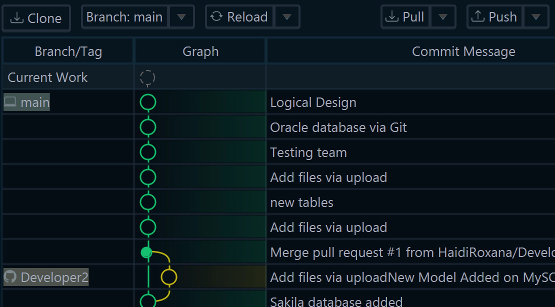
Because it is XML, the file also diffs line by line in a pull request, which is what lets a mixed team keep the model in Git next to the application code and review a schema change the way it reviews everything else. DbSchema has a Git client of its own, opened with Git — Collaborative Design from the Model menu, so the model gets cloned, staged, committed and pushed without leaving the application. Saving that model to a file is a Pro feature.
When DbSchema installs but will not start
Two things outside the application stop a first launch, and both have a one-line fix. On macOS, the confirmation described above has to be granted. On Linux, the launcher script has to be executable, and on a minimal or headless machine the display libraries the interface needs have to be present.
If the start still fails, the installer and the executable write a log that says how far they got. The FAQ gives the command per platform:
# Windows
DbSchema.exe /create-i4j-log

# macOS
export INSTALL4J_LOG=yes
/Applications/DbSchema/DbSchema.app/Contents/MacOS/JavaApplicationStub
Download DbSchema at https://dbschema.com/download.html for whichever machine is in front of you and point it at your own database: connecting, reverse-engineering the schema and working in the interactive diagrams run in the free Community Edition on all three operating systems. Saving the design as a .dbs file, so that it travels between them, is in Pro, and the trial in the same kit covers it for 15 days.
Install DbSchema on Windows, macOS or Linux
One installation kit for every desktop platform, with the .dbs model file moving between them unchanged. Reverse-engineer your database into diagrams in the free Community Edition; the download includes a 15-day Architect trial.