Best PostgreSQL Database Tools in 2026: 6 GUIs Compared
For the developer or DBA settling on one PostgreSQL GUI for the team, who knows SQL and needs the engines, the free tier and the current price of each.
On this page
The shortlist for a PostgreSQL GUI comes down to six products, and they differ less in what they show you than in what they cost and which engines they open. DbSchema is the one to pick when the schema has to be designed offline, kept in a file beside the application code, and documented for people who never open a database client at all.
- DbSchema reaches 70+ SQL and NoSQL databases from one installation, and its free Community Edition has no time limit.
- pgAdmin is the PostgreSQL project's own client, free in full under the PostgreSQL licence.
- Navicat for PostgreSQL sells a perpetual licence, with a free Premium Lite capped at five accounts per organisation.
- DbVisualizer is a Java desktop client that also opens Redshift, Vertica and ClickHouse.
- DBeaver Community is open source under the Apache licence and connects to anything with a JDBC driver.
- dbForge Studio is a Windows studio for PostgreSQL and the engines compatible with it.
What matters when choosing a PostgreSQL tool
Five questions rule a product in or out before any feature list matters.
- Which engines it opens besides PostgreSQL.
- Whether it installs on a desktop or deploys as a browser application.
- What the free tier gives you, and for how long.
- Whether the licence is one-time, annual, or perpetual with paid updates.
- What it does for more than one person.
Engines narrow the field fastest. pgAdmin opens PostgreSQL and EDB Postgres Advanced Server; dbForge Studio for PostgreSQL opens PostgreSQL and the engines compatible with it. Add MySQL, Oracle or MongoDB to the stack and the choice narrows to DbSchema, DBeaver and DbVisualizer, which reach all of them from one installation.
pgAdmin is the only one here that deploys free as a multi-user web application, and CloudBeaver is DBeaver's paid browser option; everything else installs on a desktop.
The free tiers run from the whole product, in pgAdmin's case, down to a capped or reduced edition. The price models behind them are not comparable either: one-time licences, annual subscriptions and perpetual-plus-updates all appear in the table below, so a yearly figure for one product does not mean what a yearly figure for another does.
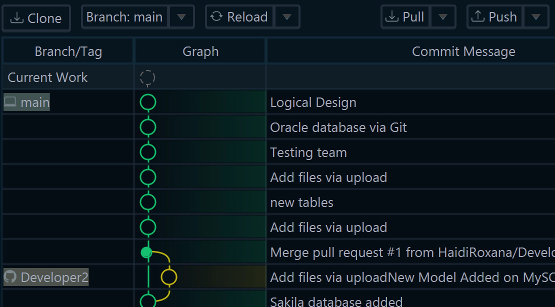
Sharing a model, versioning SQL scripts and licensing several seats are three different problems. DbSchema answers two of them: the model file goes into Git, and a floating license shares a pool of seats. The other products each answer one.
PostgreSQL tools compared
The prices below are the vendors' own list prices, read on their pricing pages on 5 September 2026, and they exclude tax.
| Tool | Engines beyond PostgreSQL | Desktop or browser | Free tier | Licence and price | Team features |
|---|---|---|---|---|---|
| DbSchema | 70+ SQL and NoSQL databases | Desktop, offline design in Pro | Community Edition, no time limit | Pro and Architect, one-time perpetual licences | Floating license, a shared pool of seats |
| pgAdmin | None; PostgreSQL and EDB Postgres only | Desktop runtime or multi-user web server | The whole product is free | Free, PostgreSQL licence | Server mode gives every user a browser login |
| Navicat for PostgreSQL | A separate Navicat product per engine | Desktop | Premium Lite, 5 accounts per organisation | Perpetual, priced at checkout | Navicat Collaboration cloud sync |
| DbVisualizer | Yes, Redshift, Vertica and ClickHouse included | Desktop | Free tier, essential features | Pro $199 first year, $89 to renew | Git version control for SQL scripts, in Pro |
| DBeaver | Yes, anything with a JDBC driver | Desktop; CloudBeaver adds a browser | Community Edition, open source | Lite $113; Enterprise $255; Ultimate $510 per year | Team Edition, licensed separately |
| dbForge Studio for PostgreSQL | None; PostgreSQL and compatible engines only | Desktop, Windows | Express edition | Standard $89.95; Professional $139.95 | Command-line automation in Professional |
DbSchema
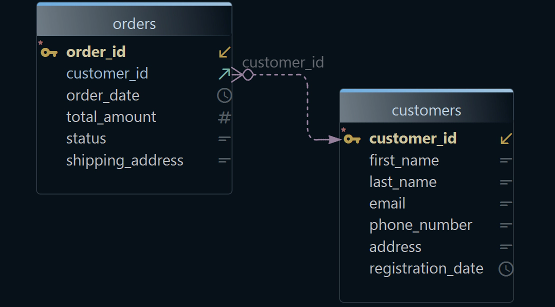
DbSchema keeps the schema in a local .dbs project file and treats the live database as a deployment target. What each edition covers:
- Connecting to PostgreSQL over JDBC, reverse-engineering the schema and reading it as interactive diagrams, with the SQL editor in the same window, in the free Community Edition.
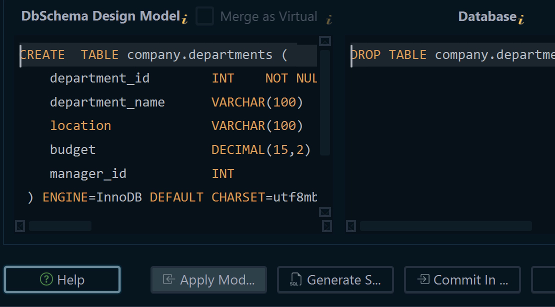
- Saving that model to a file and editing it while disconnected, in Pro.
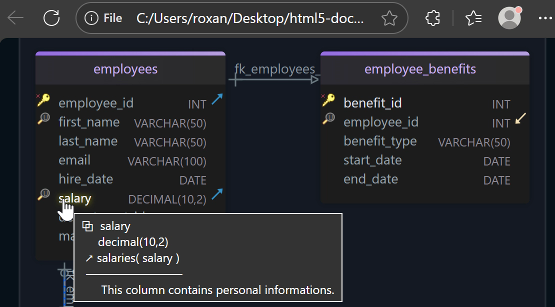
- HTML5, PDF and Markdown documentation of the schema, in Pro.
- Schema synchronization against the live database, in Pro.
- The Visual Query Builder, and the Relational Data Editor that follows foreign keys from a parent row into its children, in Pro.
- Logical and conceptual design, in Architect.
The model file is where the design work happens. When you reconnect, the Synchronization Dialog compares it against the database and writes back only the differences you approve, or hands you the migration script instead. Pro and Architect are one-time licences that include the first year of maintenance and renew yearly after that, at the figures on the DbSchema pricing page. A floating license shares a fixed number of concurrent seats across a team that is larger than the pool.

pgAdmin
pgAdmin 4 is the reference PostgreSQL client, released free under the PostgreSQL licence. It runs two ways: a desktop runtime, or a server deployment that gives a whole team browser access at no per-seat cost. It supports the PostgreSQL and EDB Postgres Advanced Server versions current at the time of each release, and no other engine.
The feature list is aimed at running a server rather than designing one:
- A monitoring dashboard, with backup, restore, vacuum and analyze on demand.
- An SQL, shell and batch job scheduling agent.
- A procedural language debugger for pl/pgsql and edb-spl.
- Graphical query plan display.
- A Grant Wizard for updating ACLs.
- An ERD Tool for designing and documenting schemas, and a schema diff tool for managing the differences between two of them.
- A query tool with colour syntax highlighting and export to CSV, Excel and JSON.
Add MySQL or Oracle to the stack and a second product has to sit beside it.

Navicat for PostgreSQL
Navicat for PostgreSQL sells a perpetual cross-platform licence in two editions, and the edition footnote is the part to read before buying: the Data Modeling Tool and the BI features are Enterprise only, so the Standard tier does not model a database at all.
- Navicat Premium Lite is free, may be used commercially, and gives each organisation up to five accounts.
- Both paid editions synchronize connection settings, queries, snippets and virtual group information through Navicat Collaboration.
- Synchronizing model and BI workspaces is Enterprise.
- The Report Builder exports HTML, PDF and Excel.
- Connection profiles cover Amazon AWS, Microsoft Azure, Google Cloud, Alibaba Cloud, Tencent Cloud and Huawei Cloud.
- The store page prices each edition at checkout rather than on a list.
Collaboration is what the paid tiers are sold on: a team works from one shared workspace instead of passing connection files and scripts around, and the split between the two editions decides whether the model goes into that workspace with everything else.

DbVisualizer
DbVisualizer is a Java desktop client whose supported engines run from PostgreSQL and Greenplum through Redshift, Vertica, ClickHouse, Presto and Netezza, which is the analytics half of a stack that the PostgreSQL-only products do not open. The free tier has no time limit.
- Pro is $199 for the first year and $89 to renew with basic support, or $229 and $119 with premium support.
- Every subscription carries a perpetual usage licence for the versions released during its term, so letting it lapse leaves the installed version working.
- Git version control for SQL scripts, with branches and history, is a Pro feature.
- The visual query builder is Pro as well.
- SQL Commander runs queries in parallel, keeps a history, and exports to CSV, JSON, XML, HTML, SQL and Excel.

DBeaver
DBeaver Community is free and open source under the Apache licence and connects to anything with a JDBC driver.
- Community ships a SQL editor with code completion, a data editor, and export to Excel, CSV and HTML.
- Community generates an ER diagram from a live connection.
- The paid editions are listed at $113 a year for Lite, $255 for Enterprise and $510 for Ultimate.
- CloudBeaver, the browser deployment, is $1,025 a year.
- Team Edition is licensed separately.
Because the ER diagram is drawn from the connection rather than from a file, it documents a database that already exists, and the design of one that does not yet exist happens elsewhere.

dbForge Studio for PostgreSQL
dbForge Studio for PostgreSQL is a Windows-native studio in three editions, and Express is free. It connects to PostgreSQL 18.x and to versions 8.4 through 17.x, plus Greenplum, Fujitsu Enterprise Postgres, Supabase and the managed PostgreSQL services of the major clouds.
- Standard is listed at $89.95 as a subscription and Professional at $139.95.
- The ordering page adds premium support by default, so check that toggle before comparing the figures with anything else.
- The query profiler and pivot tables are in Standard and Professional.
- Data reports, schema comparison and synchronization, data comparison and synchronization, data generation and the command-line interface are Professional only.
- Both editions are Windows only, and the MySQL, Oracle and SQL Server studios are separate purchases with their own price lists.

Connecting to PostgreSQL
All six connect to a running PostgreSQL server in under a minute, and the dialogs differ mainly in which driver sits behind them.
- DbSchema bundles a driver jar for each engine and lets you swap in your own from the JDBC Driver Manager.
- DbVisualizer and DBeaver connect over JDBC too.
- pgAdmin uses libpq and psycopg.
- Navicat and dbForge Studio use their own native drivers.
pgAdmin, DBeaver and DbVisualizer cannot open a schema without a live server, because they keep no offline model. The per-engine connection steps are on the PostgreSQL page, and the dialogs look like this.


Which PostgreSQL tool should you choose?
Match the product to the job you do most often. pgAdmin and dbForge Studio cover a single engine and go deep on it. DbSchema, DBeaver and DbVisualizer open a whole stack from one installation, and of those three only DbSchema keeps the offline model file described above.
| Tool | Built around |
|---|---|
| DbSchema | Offline schema design, Git-versioned model files and HTML5 documentation |
| pgAdmin | Free PostgreSQL administration, and browser access for a whole team |
| Navicat for PostgreSQL | Shared, cloud-synced model workspaces |
| DbVisualizer | Git-versioned SQL and analytics engines |
| DBeaver | Open-source SQL client for any JDBC database |
| dbForge Studio for PostgreSQL | Query profiling and data reporting on Windows |
Download DbSchema at https://dbschema.com/download.html and connect to your PostgreSQL server: the free Community Edition reverse-engineers the schema, draws the diagrams and runs your SQL. The .dbs model file, the HTML5 documentation and the schema synchronization described above are Pro, and a new installation starts a 15-day Architect trial that includes them.
FAQ
What is the best free PostgreSQL GUI?
DbSchema Community Edition, if what you want from a free client is the schema as a diagram you can read, split and query. pgAdmin is free in full and also deploys as a multi-user web application. DBeaver Community is free and open source across many engines.
Can I design a PostgreSQL schema without connecting to a database?
Only with a product that keeps its own model file. DbSchema Pro stores the design in a .dbs file, lets you edit it while disconnected, and generates the SQL when you reconnect. pgAdmin, DBeaver and DbVisualizer build their diagrams by reading a live server, so one has to be running.
Which PostgreSQL tools run in a browser?
pgAdmin runs in a browser when it is deployed in server mode, at no cost. CloudBeaver is the paid browser deployment of DBeaver. DbSchema runs on the desktop, which is what puts the .dbs model file on your own disk and in your own Git repository.
Do these tools support engines other than PostgreSQL?
DbSchema, DBeaver and DbVisualizer are multi-engine in a single installation, and DbSchema covers 70+ SQL and NoSQL databases. pgAdmin covers PostgreSQL and EDB Postgres Advanced Server only, and dbForge Studio for PostgreSQL is PostgreSQL-only, with Devart selling separate studios for the other engines. Navicat splits by product too, though Navicat Premium covers several engines at once.
Which tool is best for a team rather than one developer?
To share a design, a DbSchema floating license gives a team a shared pool of concurrent seats, and the .dbs model file travels through Git like source code. To share SQL scripts with history instead, DbVisualizer Pro has Git built in. To give many people governed access to the server itself, pgAdmin in server mode and DBeaver Team Edition are the browser-based routes.
Sources
Design your PostgreSQL schema visually
DbSchema reverse-engineers PostgreSQL into an interactive ER diagram in the free Community Edition. Offline design, HTML5 documentation and schema synchronization are Pro.