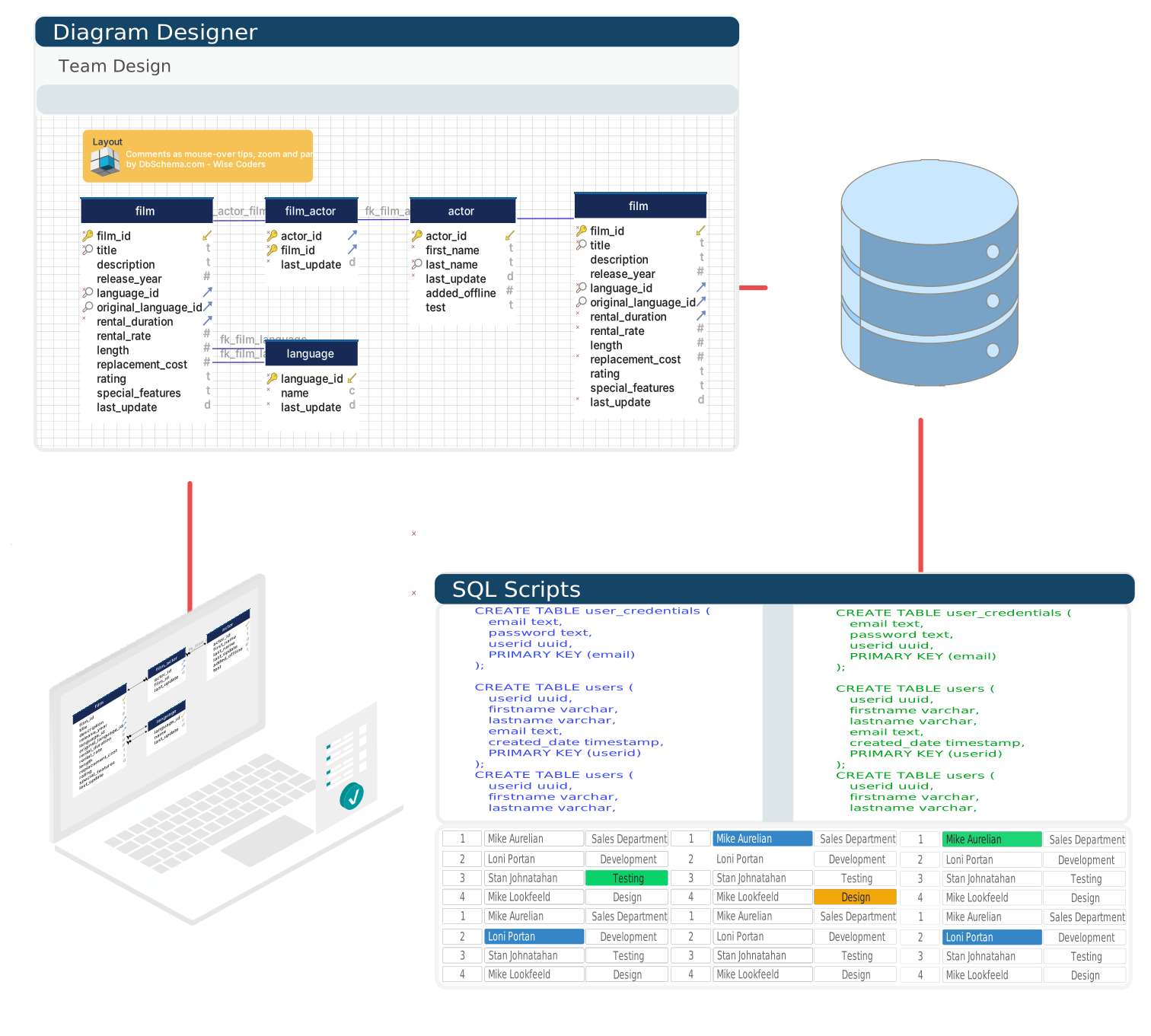

DbSchema lets you design, manage, and document Yellowbrick databases. Create ER diagrams, define tables and columns, and generate SQL scripts - with or without a live database connection.
Use Git to share the design, compare it with the Yellowbrick database, and deploy changes. DbSchema also includes a data editor, query builder, and HTML5 documentation - everything you need in one tool.
Download DbSchema Download Yellowbrick JDBC Driver
Yellowbrick is a cloud and hybrid data warehouse designed for high-performance analytical workloads. Its MPP (Massively Parallel Processing) architecture distributes query execution across many nodes, with each node storing columnar data on NVMe flash storage. Adaptive compression reduces storage footprint while keeping frequently accessed data in memory for scan-heavy analytical queries. Yellowbrick supports hybrid deployments — the same software runs on-premises in your data center and in public cloud, giving enterprises the flexibility to keep sensitive data on-site while scaling burst workloads to the cloud.
Yellowbrick uses a PostgreSQL-compatible wire protocol, which means standard JDBC clients and tools work without modification. DbSchema connects via the Yellowbrick JDBC driver and reverse-engineers the warehouse schema — tables, views, distribution keys, sort keys, and workload management resource groups — into a visual diagram. Distribution key information is particularly valuable in the diagram because it shows which column drives data placement across nodes, informing join strategies and identifying potential skew.
Yellowbrick supports the full spectrum of analytical SQL — multi-table joins, complex aggregations, window
functions, CTEs, and ANSI SQL set operations. Its PostgreSQL-compatible dialect also supports
COPY for bulk loading and advanced data type handling. DbSchema's SQL editor connects via the
Yellowbrick JDBC driver and provides a full query environment where you can iterate on analytical SQL and
review results in the built-in results grid.
Yellowbrick's workload management (WLM) system assigns queries to resource pools based on user, query type,
or explicit routing hints. When authoring queries in DbSchema's editor, you can add WLM routing hints as SQL
comments (e.g., /* ybworkload:adhoc */) to control resource allocation during interactive
development. EXPLAIN output shows the distributed query plan including redistribution operations
and node-level sort/aggregate steps, helping you identify expensive data movement across nodes.
The DbSchema data explorer lets you browse Yellowbrick table data row by row without writing SQL. Column-level filtering is pushed down to Yellowbrick where possible, leveraging its columnar storage and zone maps to avoid full scans. This makes the explorer practical even on very large tables — filtering by date or ID range returns results quickly because Yellowbrick's storage engine skips non-matching column segments based on min/max zone map statistics.
The explorer also helps with schema-level investigations: you can inspect distribution key columns to verify that data is distributed evenly across nodes, or check sort key columns to confirm that insert order aligns with the declared sort. Bulk load connectors for Amazon S3 and Azure Data Lake Storage (ADLS) bring external data into Yellowbrick; the explorer lets you verify that loaded tables have the expected row structure and column values before running production reports against them.
Select Yellowbrick from the database list in DbSchema and provide the Yellowbrick JDBC driver
(yellowbrick-jdbc-*.jar), available from the Yellowbrick support portal. The driver class is
com.yellowbrick.jdbc.Driver. The JDBC URL format is:
jdbc:yellowbrick://yellowbrick-host:5432/mydb. Although Yellowbrick uses port 5432
(the same as PostgreSQL), it is not interchangeable with the standard PostgreSQL JDBC driver — use the
Yellowbrick-specific driver for full compatibility with its catalog metadata and query plan syntax.
Authentication uses a Yellowbrick username and password. SSL is strongly recommended and can be enforced by
adding ?sslmode=require to the JDBC URL. For hybrid deployments where Yellowbrick runs
on-premises behind a firewall, ensure that the DbSchema client host can reach port 5432 on
the Yellowbrick manager node. Yellowbrick Cloud deployments include a public hostname and require SSL by
default, with credentials managed through the Yellowbrick Cloud console.