A Visual GUI Client for ClickHouse Analytics

Connect DbSchema to ClickHouse and turn the live schema into an editable visual model: explore relationships in interactive ER diagrams, plan changes on the canvas, and generate reviewed SQL scripts for deployment.

The workflow is designed for visual modeling, schema documentation, and deployment — keep an offline model in Git, collaborate across teams, and publish documentation that developers, analysts, and stakeholders can navigate in minutes.

DbSchema Database Designer

Download DbSchema See ClickHouse Features Download ClickHouse JDBC Driver · All drivers

What happens after you download?

Get to your first ClickHouse schema diagram in minutes. No account, no credit card.

1
Install in minutes

Download the installer for Windows, macOS, or Linux and launch DbSchema. No signup required.

2
Connect to ClickHouse or open a sample

Reverse engineer an existing ClickHouse database or open a sample model to explore tables, relationships, and indexes.

3
Design, document, and deploy

Edit schema visually, generate documentation, and prepare reviewed migration scripts for safer releases.

Visualizing ClickHouse Table Engines and Schema Topology

ClickHouse's MergeTree family of table engines — including ReplicatedMergeTree, SummingMergeTree, and AggregatingMergeTree — combined with ordering keys, partition expressions, and materialized views creates a schema topology that carries significant semantic weight beyond column definitions. DbSchema connects to ClickHouse and renders tables, materialized views, and their relationships as an ER diagram, helping engineers understand which materialized views aggregate which base tables, how partitioning is structured, and which tables are part of a replicated cluster. This visual layer makes it easier to reason about query routing and data freshness in complex analytical deployments.

Download DbSchema Free See ClickHouse Features

Write and Execute Analytical SQL

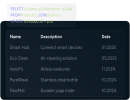
DbSchema's SQL editor connects to ClickHouse via JDBC with syntax highlighting and result display in a tabular grid. Run aggregations, window functions, array operations, and ClickHouse-specific functions with immediate feedback — taking full advantage of ClickHouse's sub-second response times on large analytical datasets.

Writing and executing analytical SQL against ClickHouse in the DbSchema SQL editor

Build Queries Visually Without SQL

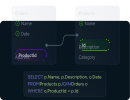
The visual query builder generates ClickHouse-compatible SQL from your table and column selections, letting analysts construct GROUP BY queries, apply WHERE filters, and join tables without writing SQL directly. This is particularly useful when onboarding analysts to a ClickHouse deployment for the first time.

DbSchema visual query builder generating ClickHouse analytical SQL queries

Explore Large ClickHouse Datasets Interactively

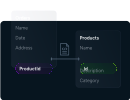
The data explorer fetches ClickHouse table rows with column filtering and pagination. Use it to inspect partition contents after ingestion, verify the output of materialized view refreshes, or sample rows from large MergeTree tables without writing a full query in the SQL editor.

Browsing ClickHouse table data with column filtering in the DbSchema data explorer

Set Up the ClickHouse Connection in DbSchema

Getting from a running ClickHouse server to a browsable diagram takes four steps:

  1. Download and install DbSchema — the installer requires no account or signup.
  2. Start a new connection and pick ClickHouse from the database list; DbSchema downloads the ClickHouse JDBC driver automatically the first time you connect.
  3. Enter the host and the HTTP port 8123 (native TCP 9000 is not used by the driver), along with your database name, so the JDBC URL resolves to jdbc:clickhouse://host:8123/dbname.
  4. Supply credentials if required and connect — DbSchema reads the MergeTree table definitions and builds the initial ER diagram.

For ClickHouse Cloud, connect to the HTTPS endpoint on port 8443 with your service username and password instead. Self-hosted clusters that require TLS should also use the HTTPS URL, with certificate trust configured in the connection properties.

Why Teams Use DbSchema with ClickHouse

  • Visualize MergeTree table engines, ordering keys, and materialized view relationships as an ER diagram
  • Write and run ClickHouse SQL with syntax support from a desktop SQL editor
  • Explore large dataset contents and verify ingestion and materialization results interactively
  • Document the ClickHouse schema including materialized view topology for analytics team reference
  • Enable analysts to query ClickHouse data through a visual builder without learning the SQL dialect

Once your MergeTree tables and materialized views are mapped out, keep the diagram as living reference material: download DbSchema free and turn your ClickHouse cluster into a documented, shareable schema in minutes.

Frequently asked questions

Yes, DbSchema connects to ClickHouse over JDBC using the HTTP interface and reverse-engineers tables and materialized views into an interactive ER diagram.

The JDBC driver connects over HTTP on port 8123 by default (native TCP port 9000 is not used). ClickHouse Cloud deployments use HTTPS on port 8443 instead.

Yes, DbSchema renders materialized views alongside their base tables in the ER diagram, making it easier to see which views aggregate which tables.

Teams working with ClickHouse often use these engines too. Explore dedicated guides and JDBC setup for each.

Browse all 100+ supported databases