Design and Manage Amazon Timestream Databases Visually with DbSchema

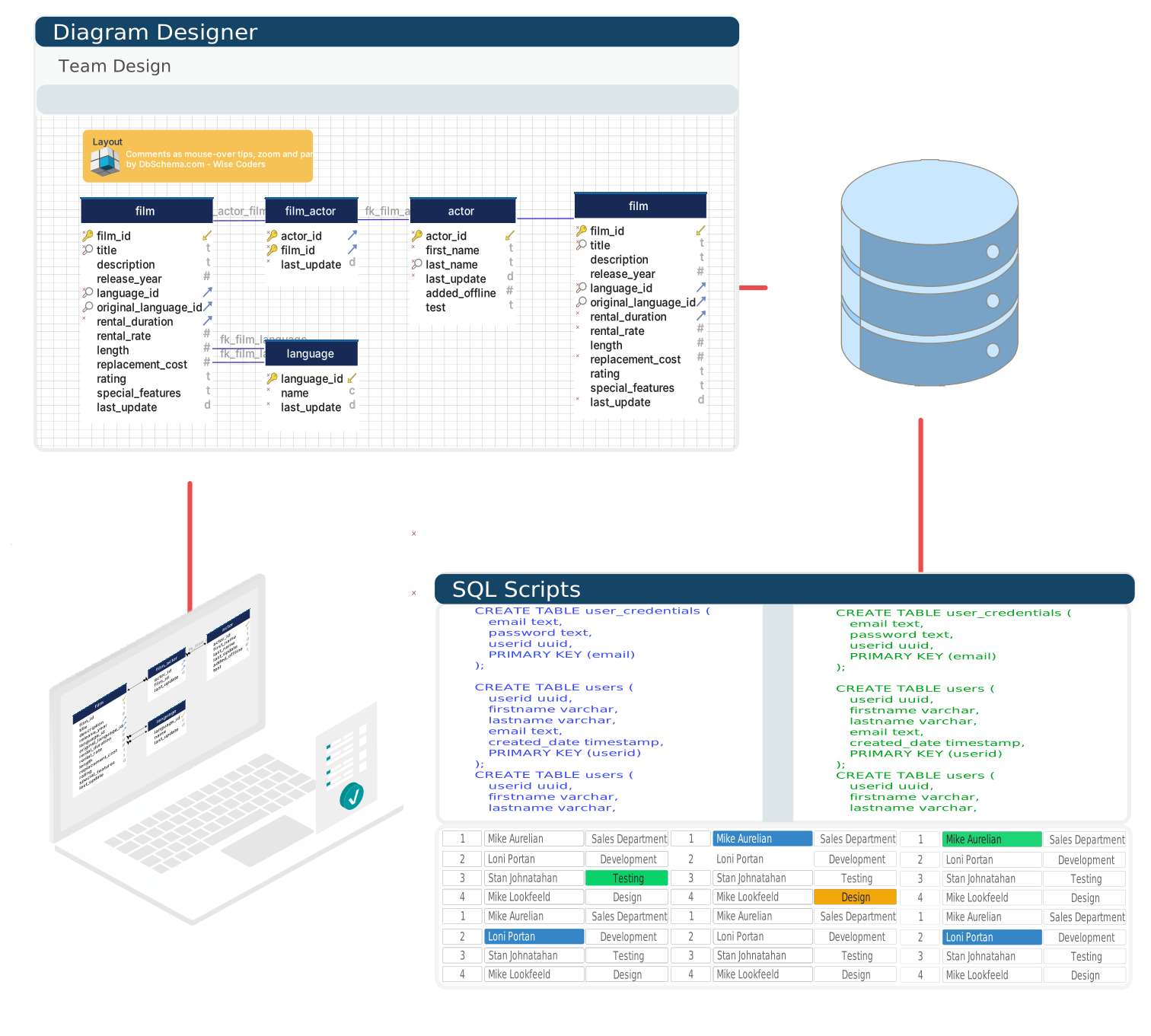
DbSchema lets you design, manage, and document Amazon Timestream databases. Create ER diagrams, define tables and columns, and generate SQL scripts - with or without a live database connection.

Use Git to share the design, compare it with the Amazon Timestream database, and deploy changes. DbSchema also includes a data editor, query builder, and HTML5 documentation - everything you need in one tool.

DbSchema Database Designer

Download DbSchema Download Amazon Timestream JDBC Driver

Time-Series Architecture and Schema Visualization

Amazon Timestream is a fully serverless time-series database hosted on AWS, purpose-built for storing and analyzing IoT sensor readings, application metrics, and operational telemetry at scale. Unlike relational databases, Timestream organizes data into tables that contain a mix of dimensions (categorical metadata) and measures (numeric or string observations) recorded alongside a timestamp. DbSchema connects to Timestream via the official JDBC driver and renders these tables as schema diagrams, letting you see at a glance which dimensions describe a time series and which measures are being tracked. You can group related tables into layout diagrams, annotate columns, and export the resulting documentation as HTML or PDF for engineering teams.

Writing Time-Series SQL in the DbSchema SQL Editor

Timestream exposes a SQL dialect with specialized time functions such as ago(), bin(), and date_trunc() that make it easy to bucket data into fixed-width intervals or select rolling windows of recent measurements. DbSchema's SQL editor supports these extensions with syntax highlighting, auto-completion of table and column names, and a results grid that presents timestamped rows in a readable tabular format. You can save frequently used queries, organize them into folders, and share them with colleagues by exporting the query file. The editor also shows query execution time, which is useful when tuning time-range predicates to avoid full table scans across Timestream's magnetic storage tier.

DbSchema SQL editor running time-series queries against Amazon Timestream

Exploring Telemetry Datasets with the Data Explorer

The DbSchema data explorer lets you browse Timestream table contents row by row without writing SQL. You can filter by measure name, restrict to a specific time range using Timestream's built-in time column, and sort results by any dimension or measure value. For IoT projects this is invaluable: you can quickly spot anomalous sensor readings, verify that an ingestion pipeline is populating the expected dimensions, or sample the latest records from a fleet of devices. The explorer supports pagination across large result sets and lets you copy individual cells or entire rows to the clipboard for use in external tools.

Browsing Amazon Timestream telemetry data with DbSchema data explorer

Connection Setup and JDBC URL

To connect DbSchema to Amazon Timestream, download the Amazon Timestream JDBC driver (software.amazon.timestream.jdbc.TimestreamDriver) and add the JAR to DbSchema's driver configuration. The JDBC URL follows the format jdbc:timestream://Region={REGION};Database={DB}, for example jdbc:timestream://Region=us-east-1;Database=mydb. Timestream uses port 443 over HTTPS and authenticates via AWS credentials — supply your Access Key ID and Secret Access Key in the connection dialog, or configure an IAM role profile on the host machine. Timestream is region-scoped, so make sure the region in the URL matches the region where your database was created. Auto-scaling means there are no server instances to manage; the JDBC driver handles connection pooling internally.

Amazon Timestream schema diagram in DbSchema showing dimensions and measures

Why Teams Use DbSchema with Amazon Timestream

  • Visualize the relationship between Timestream tables, dimensions, and measures in a clear schema diagram without writing documentation manually.
  • Use the drag-and-drop layout editor to organize multiple Timestream tables into logical groups for dashboards, IoT devices, or application metrics.
  • Write and test time-bucketing queries with bin() and date_trunc() in the SQL editor before embedding them in application code.
  • Explore raw telemetry records directly from DbSchema without needing AWS Console access or custom scripts.
  • Generate offline HTML or PDF schema documentation that can be shared with stakeholders who do not have AWS access.
  • Work with Timestream schemas in a disconnected (offline) mode using DbSchema's local model — useful when iterating on schema designs before applying changes.