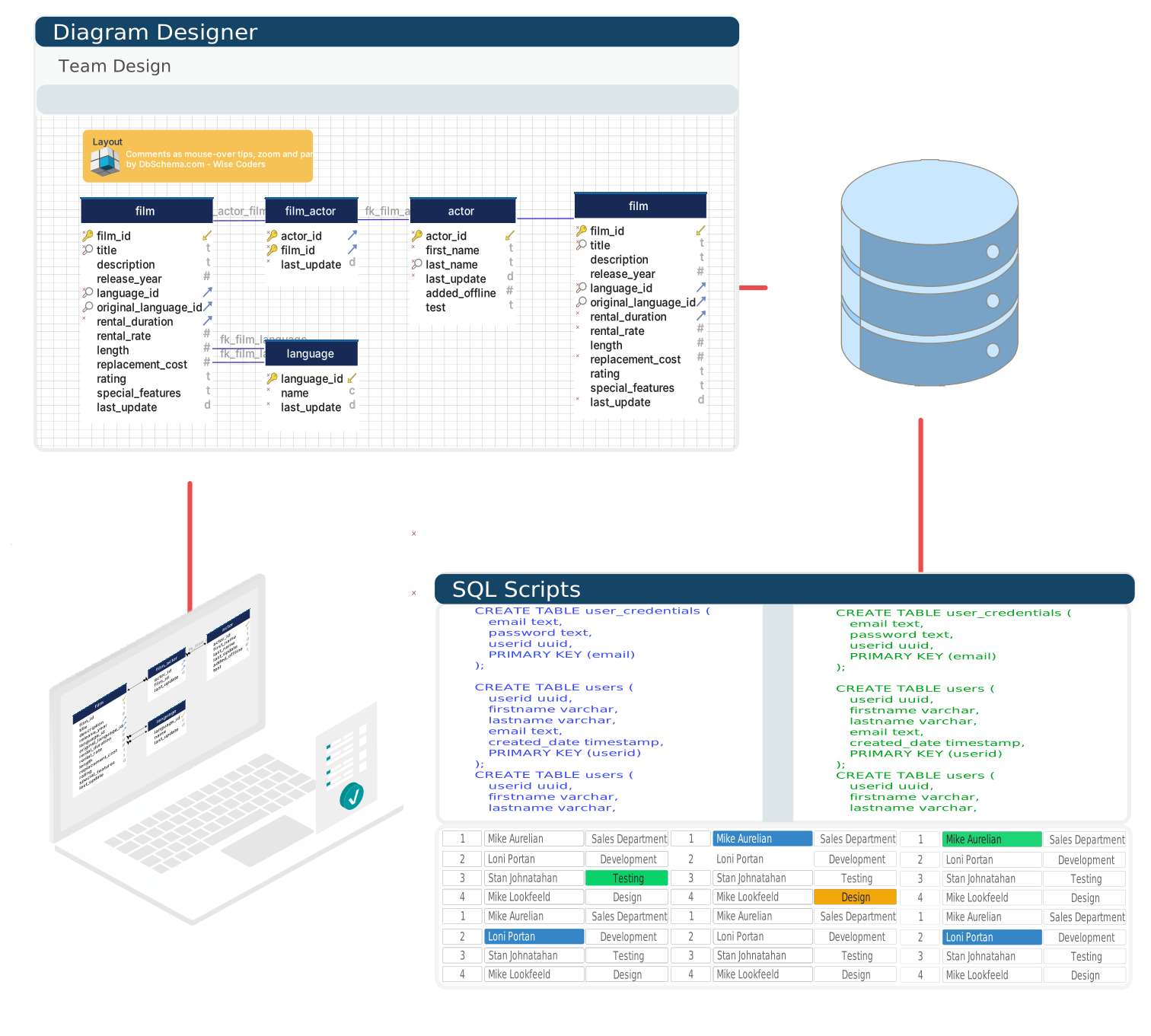
DbSchema lets you design, manage, and document Firebolt databases. Create ER diagrams, define tables and columns, and generate SQL scripts - with or without a live database connection.
Use Git to share the design, compare it with the Firebolt database, and deploy changes. DbSchema also includes a data editor, query builder, and HTML5 documentation - everything you need in one tool.
Download DbSchema Download Firebolt JDBC Driver
Firebolt is a cloud OLAP database purpose-built for sub-second analytics on large datasets, running on AWS and GCP. A key architectural differentiator is the separation of compute engines from databases: each Firebolt database can be associated with one or more named engines that are independently started, stopped, and sized, allowing teams to run isolated workloads (for example, ingestion vs. interactive queries) on dedicated compute without contention. Firebolt stores data in a proprietary compressed columnar format and builds sparse indexes, aggregating indexes, and join indexes automatically or on demand to accelerate common query patterns. DbSchema connects via the Firebolt JDBC driver and introspects table schemas and index definitions, rendering them as schema diagrams that show column types and index configurations together.
Firebolt's SQL dialect extends ANSI SQL with functions for approximate aggregations, array operations, and semi-structured data manipulation. DbSchema's SQL editor connects over the Firebolt JDBC driver and provides table and column name auto-completion, syntax highlighting, and a results grid that handles the wide, flat result sets typical of OLAP queries. You can write window functions, lateral joins, and Firebolt-specific array unnesting expressions, then save the queries to a shared library for reuse across the team. The editor also shows query execution time, allowing you to measure the impact of adding or modifying aggregating indexes on query performance.
The DbSchema data explorer lets you sample and browse Firebolt table contents without writing SQL, applying column filters and sort orders through a point-and-click interface. Because Firebolt's engines return results at sub-second latency even for large tables, the data explorer pages through results rapidly. This makes it practical to spot-check newly loaded data, verify that a dimension table join key is populated correctly, or inspect the output of a materialized aggregating index before referencing it in a production dashboard. You can export sampled rows to CSV directly from the explorer for use in external validation scripts.
To connect DbSchema to Firebolt, download the Firebolt JDBC driver JAR
(com.firebolt.FireboltDriver) from the Firebolt documentation and register it in
DbSchema's driver manager. The JDBC URL format is
jdbc:firebolt://api.app.firebolt.io/mydb, where mydb is your Firebolt
database name. Firebolt uses HTTPS on port 443 for all JDBC traffic. Provide your
Firebolt service account credentials (client ID and client secret) or user email and password in the
connection dialog. If you have multiple engines associated with a database, you can specify the engine
name as a JDBC URL parameter (?engine=my_engine) to direct queries to a particular
compute engine. For GCP-hosted databases, the URL host changes to the GCP endpoint.