Design and Manage Tibero Databases Visually with DbSchema

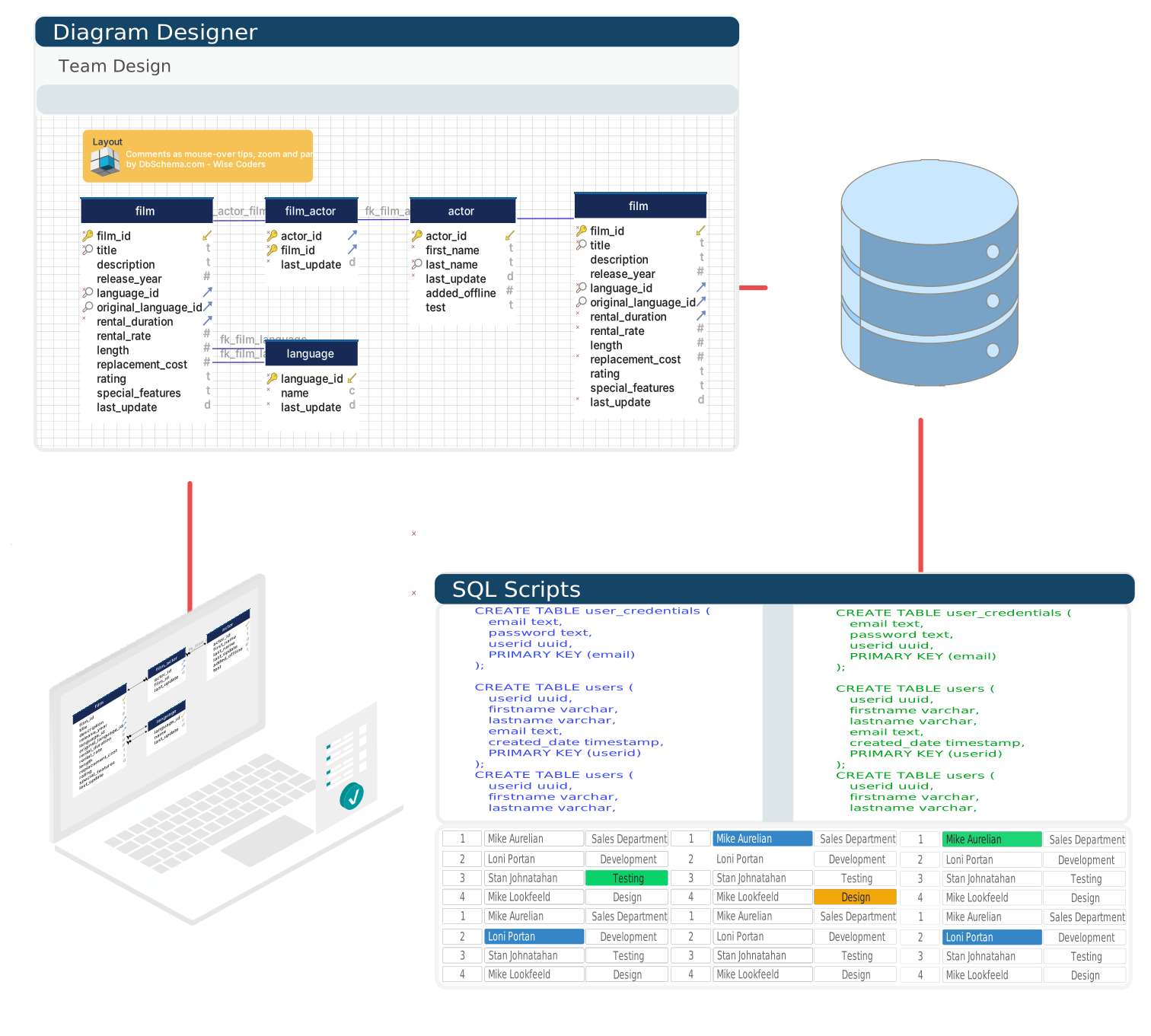
DbSchema lets you design, manage, and document Tibero databases. Create ER diagrams, define tables and columns, and generate SQL scripts - with or without a live database connection.

Use Git to share the design, compare it with the Tibero database, and deploy changes. DbSchema also includes a data editor, query builder, and HTML5 documentation - everything you need in one tool.

DbSchema Database Designer

Download DbSchema Download Tibero JDBC Driver

Tibero's Oracle-Compatible Architecture and Schema Visualization

Tibero is an enterprise relational database management system developed by TmaxSoft in South Korea. It is designed to be highly compatible with Oracle Database at the SQL, PL/SQL, and data dictionary levels, making it a viable migration target for Oracle workloads. Tibero supports Oracle-compatible data types, sequences, synonyms, database links, packages, stored procedures, functions, and triggers, as well as enterprise features such as table partitioning, online redo logs, and multi-tenant tablespace management.

DbSchema connects to Tibero using the Tibero JDBC driver and reverse-engineers the full schema, including tables, views, indexes, sequences, and stored procedures. The visual diagram renders foreign key relationships as directed edges between tables, giving your team a clear picture of the data model that mirrors what your Oracle-compatible applications expect. Schema objects like packages and stored procedures appear in the schema tree alongside tables and views.

Tibero Oracle-compatible schema visualized as an ER diagram in DbSchema

Writing Oracle-Compatible SQL and PL/SQL in DbSchema

Because Tibero supports Oracle's PL/SQL dialect (referred to as the Tibero Stored Procedure Language), you can write BEGIN...END blocks, DECLARE sections, cursor loops, exception handlers, and dynamic SQL directly in DbSchema's SQL editor. This is particularly useful for migrating Oracle scripts to Tibero, since you can test them interactively and iterate quickly without deploying to a full Oracle instance.

DDL statements such as CREATE OR REPLACE PROCEDURE, CREATE PACKAGE, and CREATE TRIGGER execute correctly through the Tibero JDBC interface. DbSchema's SQL editor supports multiple tabs, so you can have your schema DDL, your data validation queries, and your PL/SQL blocks open simultaneously and switch between them without losing your work. Query results are displayed in the built-in results grid with support for large result sets and CSV export.

Writing Oracle-compatible SQL and PL/SQL against Tibero in DbSchema

Exploring Tibero Tables and Views with the Data Explorer

The DbSchema data explorer lets you browse Tibero table and view contents row by row without writing SQL. You can page through records, filter by column values using simple expressions, and inspect individual rows to verify data after a load operation or a stored procedure run. Views defined via PostgREST-style row-level security equivalents in Tibero (using Oracle-compatible VPD — Virtual Private Database policies) are also browsable, though the data returned will reflect whatever policy context the JDBC user operates under.

The explorer is especially helpful when validating Oracle-to-Tibero migrations. After migrating data from an Oracle source, you can use the explorer to compare row counts and spot-check column values in Tibero against the expected values, all within the same DbSchema session that holds your schema diagram and migration SQL tabs.

Browsing Tibero tables and views in the DbSchema data explorer

Connecting DbSchema to Tibero

Tibero does not ship with a publicly downloadable JDBC driver in Maven Central. You must obtain tbclient.jar from your Tibero installation directory (typically under $TB_HOME/client/lib/) and add it as an external driver in DbSchema's driver configuration. The driver class is com.tmax.tibero.jdbc.TbDriver and the JDBC URL format is: jdbc:tibero:thin:@localhost:8629:TIBERO. The default Tibero listener port is 8629, and the last segment of the URL is the Tibero SID (database name), which is TIBERO by default.

Authentication uses the Tibero username and password. The default DBA account is sys or tibero depending on the installation. If Tibero is running on a remote host, replace localhost with the server hostname or IP address. For high-availability setups using Tibero TAC (Tibero Active Cluster), connect to the SCAN address rather than an individual node.

Why Teams Use DbSchema with Tibero

  • Provides a visual ER diagram for Tibero schemas, making Oracle-to-Tibero migrations easier to document and validate.
  • Enables PL/SQL-compatible script testing directly against Tibero without requiring a full Oracle environment.
  • Helps teams unfamiliar with TBAdmin navigate Tibero schema objects through a widely-used GUI alternative.
  • Renders stored procedures, packages, and triggers alongside table diagrams for a complete architectural view.
  • Generates offline schema documentation for regulatory compliance or architecture handoff documentation.
  • Supports mixed environments where Tibero coexists with other databases, all managed from a single DbSchema installation.