Design and Manage Aurora PostgreSQL Databases Visually with DbSchema

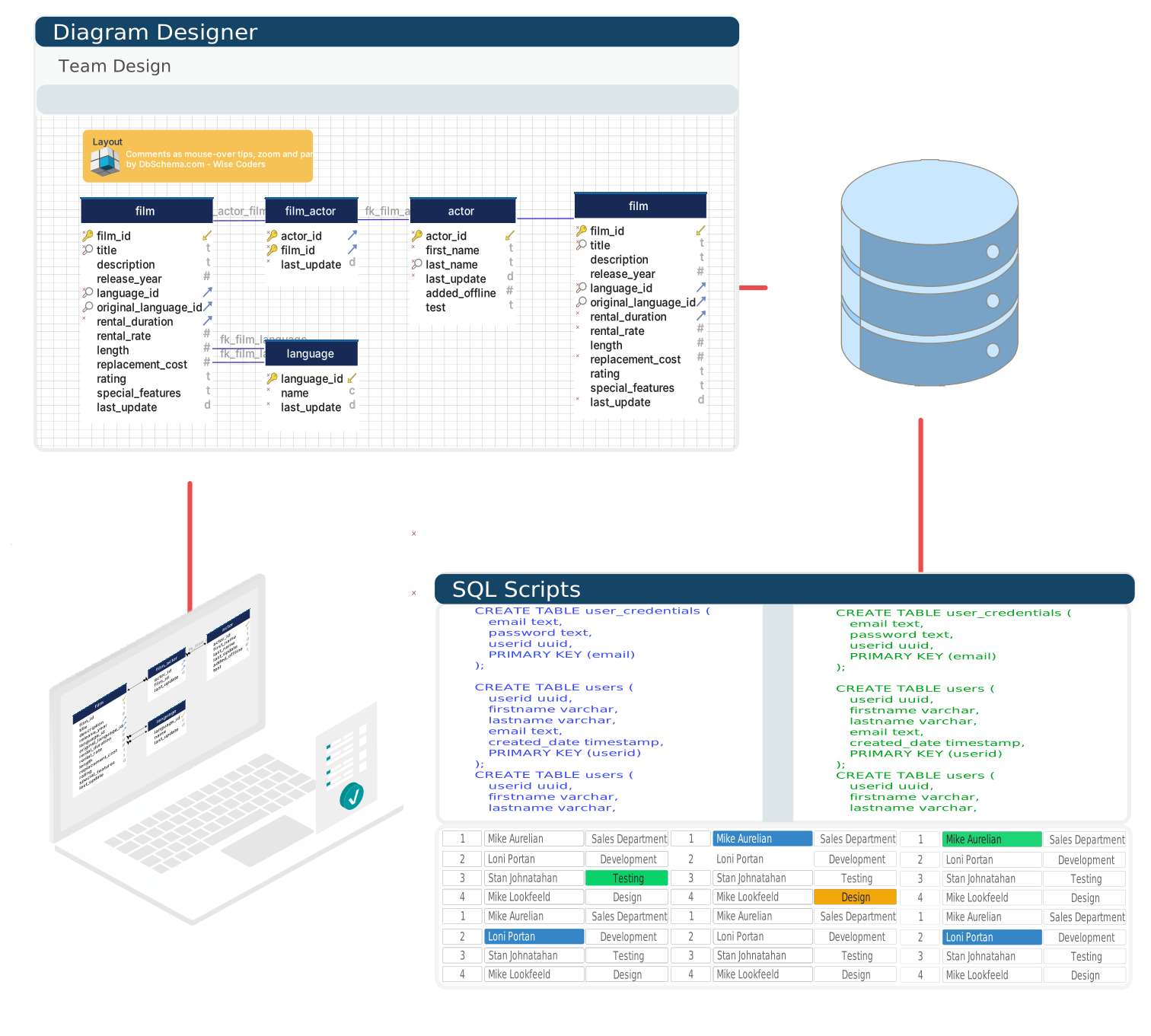
DbSchema lets you design, manage, and document Aurora PostgreSQL databases. Create ER diagrams, define tables and columns, and generate SQL scripts - with or without a live database connection.

Use Git to share the design, compare it with the Aurora PostgreSQL database, and deploy changes. DbSchema also includes a data editor, query builder, and HTML5 documentation - everything you need in one tool.

DbSchema Database Designer

Download DbSchema Download Aurora PostgreSQL JDBC Driver

Amazon Aurora PostgreSQL layers PostgreSQL wire compatibility on top of Amazon's distributed storage engine, providing automatic failover, up to fifteen read replicas, and Global Database support for cross-region replication. Because it speaks the PostgreSQL protocol, DbSchema connects using the standard PostgreSQL JDBC driver and exposes the full schema — tables, views, sequences, functions, and extensions — exactly as it would for a self-hosted PostgreSQL instance.

ER Diagram Design for Aurora PostgreSQL Schemas

DbSchema introspects all schemas in an Aurora PostgreSQL cluster and renders the result as interactive ER diagrams. Tables can be dragged into focused layouts that highlight specific bounded contexts, and the diagrams update automatically when the underlying schema changes.

Visualizing an Aurora PostgreSQL schema as an ER diagram in DbSchema

Visual Query Builder for PostgreSQL-Compatible SQL

The DbSchema Query Builder constructs SELECT statements visually — join tables, add WHERE conditions, and aggregate results without writing raw SQL. It generates standard PostgreSQL syntax that runs identically on Aurora PostgreSQL, Aurora Serverless v2, and self-managed PostgreSQL clusters.

Building a query visually against Aurora PostgreSQL in DbSchema

Git-Based Schema Version Control

DbSchema stores the schema model as a structured project file that can be committed directly to a Git repository. Every structural change — a new column, an added index, a dropped table — becomes a traceable commit. For Aurora PostgreSQL deployments where multiple engineers contribute schema changes, this provides a clear audit trail and enables pull-request-based schema reviews.

Committing Aurora PostgreSQL schema changes to Git from DbSchema

Connecting DbSchema to Aurora PostgreSQL

Aurora PostgreSQL uses the PostgreSQL JDBC driver, which DbSchema downloads automatically on first connection. The JDBC URL format is jdbc:postgresql://cluster.cluster-id.region.rds.amazonaws.com:5432/dbname. For production connections, append ?ssl=true&sslmode=require to enforce TLS in transit. IAM database authentication is supported: the database user must be granted the rds_iam role, and you supply a short-lived RDS auth token as the password. For Aurora Serverless v2, the endpoint and port are identical — the capacity scaling is transparent to the JDBC driver.

Why Teams Use DbSchema with Aurora PostgreSQL

  • Schema visualization — render complex multi-schema Aurora databases as navigable ER diagrams.
  • Cross-environment comparison — diff an Aurora dev cluster against production and generate targeted migration SQL.
  • Offline modeling — design schema changes locally without a live cluster, then synchronize when ready.
  • Git integration — track every schema change alongside application code in the same repository.
  • Global Database support — connect to primary and secondary regions in separate profiles within one project.