Design and Manage Aurora MySQL Databases Visually with DbSchema

DbSchema lets you design, manage, and document Aurora MySQL databases. Create ER diagrams, define tables and columns, and generate SQL scripts - with or without a live database connection.

Use Git to share the design, compare it with the Aurora MySQL database, and deploy changes. DbSchema also includes a data editor, query builder, and HTML5 documentation - everything you need in one tool.

DbSchema Database Designer

Download DbSchema Download Aurora MySQL JDBC Driver

Amazon Aurora MySQL is a cloud-native relational engine designed to deliver up to five times the throughput of standard MySQL by decoupling compute from distributed storage. Clusters expose a writer endpoint and one or more reader endpoints, and schemas evolve independently of instance scaling. DbSchema connects to Aurora MySQL using the standard MySQL JDBC driver — the same driver used for any MySQL 8-compatible database — so there is no extra driver installation required.

Visual ER Diagrams for Aurora Cluster Schemas

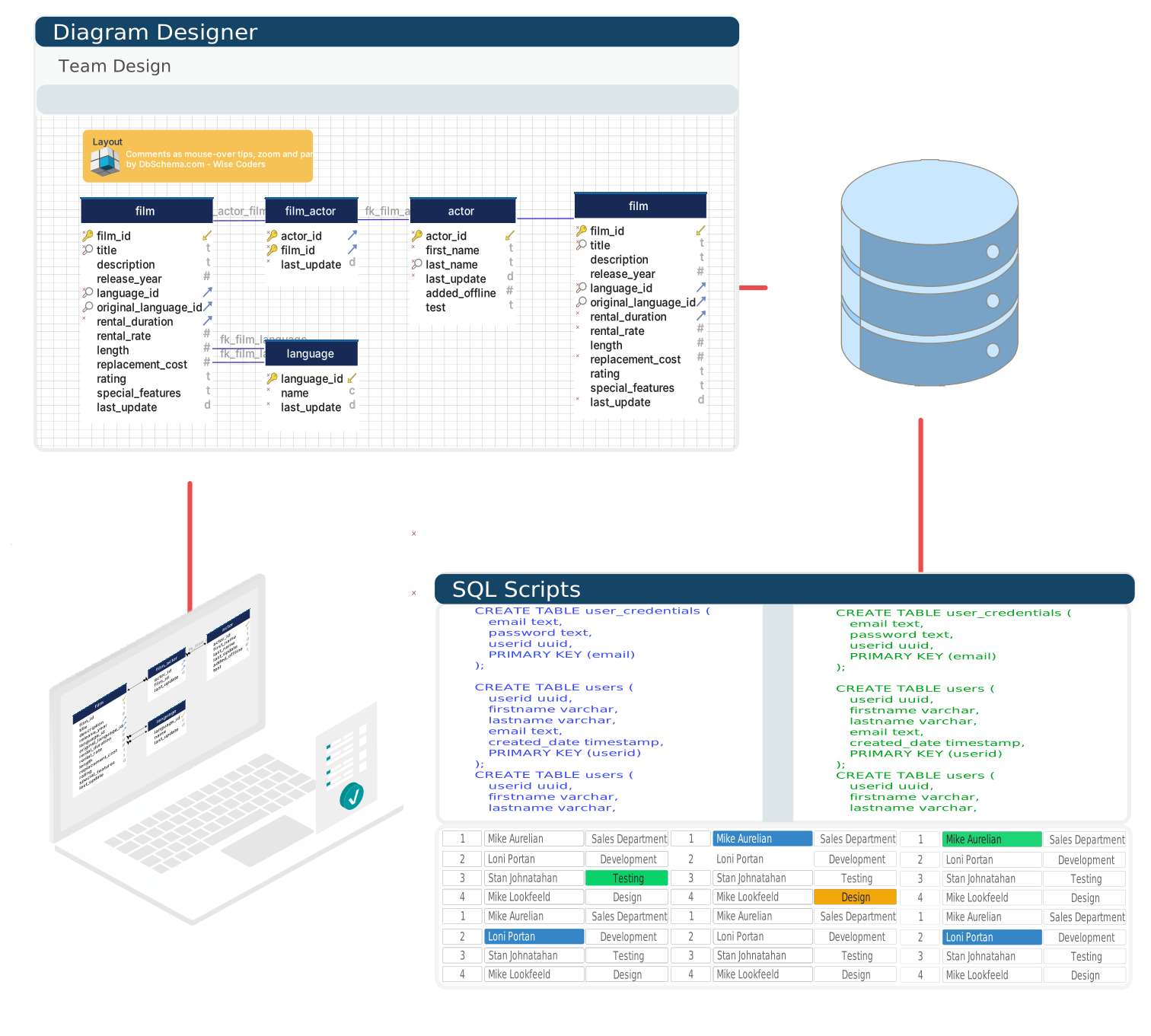
DbSchema introspects the Aurora cluster schema and renders every table, column, foreign key, and index as a navigable ER diagram. You can group related tables into diagram layouts, annotate relationships, and share diagrams with your team as HTML documentation — without keeping a live connection open.

Designing an Aurora MySQL schema with ER diagrams in DbSchema

Schema Synchronization Between Aurora and Upstream MySQL

Production Aurora clusters frequently diverge from development MySQL instances during feature work. DbSchema's schema comparison tool connects to two environments simultaneously — or compares a live cluster against a saved schema file — and generates the exact ALTER statements needed to bring them back into alignment. You review the diff before any SQL runs.

Comparing and synchronizing schema between Aurora MySQL environments in DbSchema

SQL Editor Connected to Aurora Writer and Reader Endpoints

The built-in SQL editor supports the full MySQL dialect and Aurora-specific extensions such as parallel query hints and SELECT INTO OUTFILE S3. You can maintain separate connection profiles for the writer endpoint and the reader endpoint, keeping analytical queries off the writer node.

Running SQL queries against an Aurora MySQL cluster in DbSchema's SQL editor

Connecting DbSchema to Aurora MySQL

Aurora MySQL uses the standard MySQL JDBC driver, which DbSchema downloads automatically. Use the cluster writer endpoint for schema changes and DDL operations: jdbc:mysql://cluster.cluster-id.region.rds.amazonaws.com:3306/dbname. For read-heavy workloads, point a separate profile at the reader endpoint (cluster.cluster-id-ro.region.rds.amazonaws.com). IAM database authentication is also supported: generate a short-lived token via the AWS SDK and supply it as the password with SSL enabled (?useSSL=true&requireSSL=true). The default port is 3306.

Why Teams Use DbSchema with Aurora MySQL

  • Offline schema design — model schema changes in DbSchema without a live Aurora connection, then apply them when ready.
  • Multi-environment diff — compare dev, staging, and production Aurora clusters and generate targeted migration scripts.
  • ER diagram exports — auto-generate HTML or PDF schema documentation for audit and onboarding.
  • Git-based versioning — commit the DbSchema project file to Git so every schema change is tracked alongside application code.
  • Query profiles — maintain named connection profiles for writer and reader endpoints within a single DbSchema project.