Design and Manage Neon Databases Visually with DbSchema

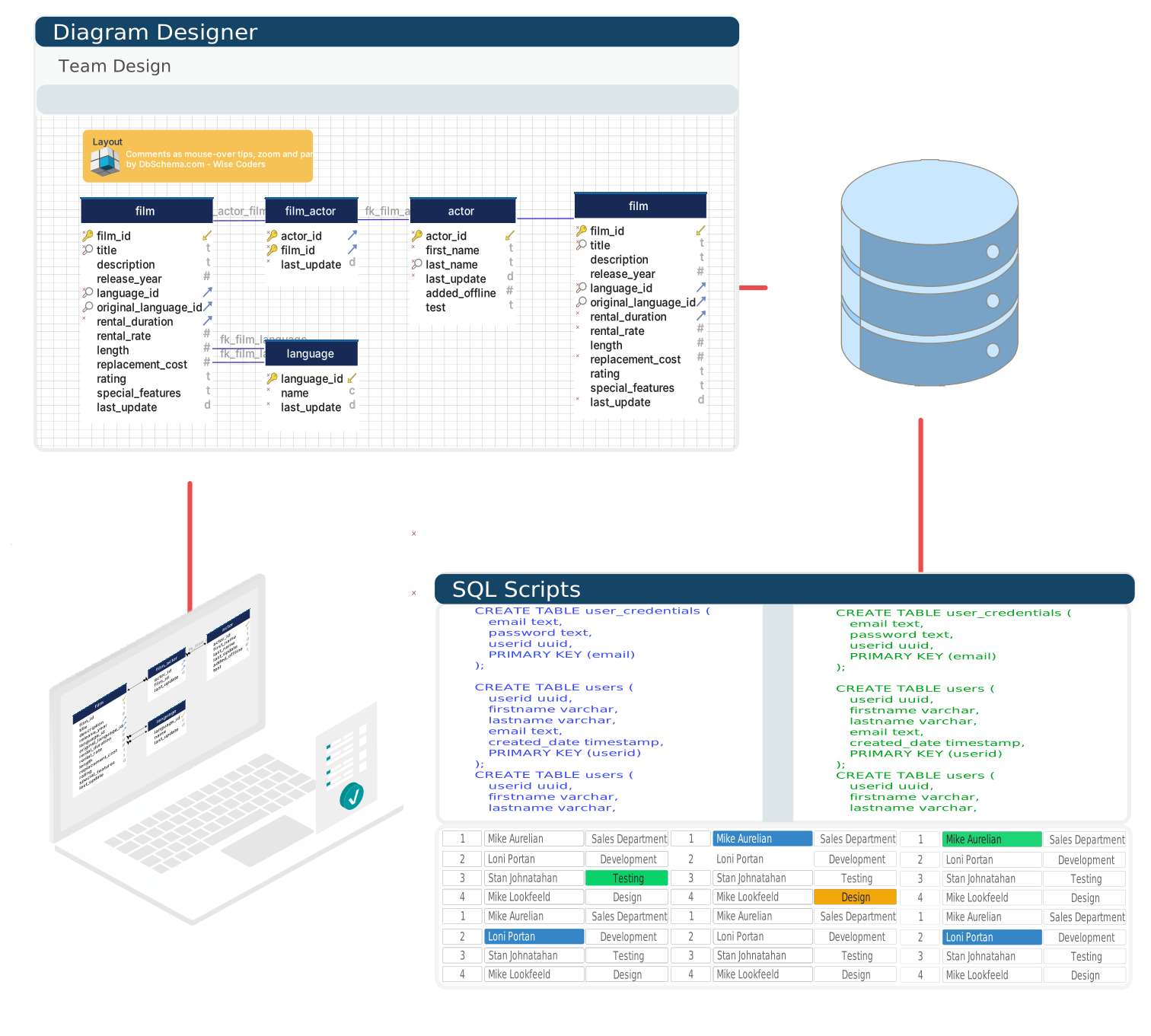
DbSchema lets you design, manage, and document Neon databases. Create ER diagrams, define tables and columns, and generate SQL scripts - with or without a live database connection.

Use Git to share the design, compare it with the Neon database, and deploy changes. DbSchema also includes a data editor, query builder, and HTML5 documentation - everything you need in one tool.

DbSchema Database Designer

Download DbSchema Download Neon JDBC Driver

Neon's Serverless Architecture and Branch-Specific Schemas

Neon is a fully serverless PostgreSQL service built around a separation of compute and storage. Its most distinctive feature is database branching — you can fork your production database into an isolated branch in seconds, similar to creating a git branch, giving each developer or CI pipeline their own copy of the schema and data without duplicating storage. DbSchema connects to any Neon branch independently by using that branch's dedicated connection string, letting you reverse-engineer and visualize the schema that is specific to that branch.

Because branches can diverge over time as migrations are applied independently, DbSchema's visual diagrams become a practical tool for reviewing schema differences between branches before merging. The auto-suspend feature means that idle compute spins down automatically, which makes Neon cost-effective for development databases that are only used during business hours. DbSchema reconnects transparently when the branch wakes.

Neon branch-specific PostgreSQL schema visualized in DbSchema

Writing PostgreSQL Queries Against Neon

Neon is wire-compatible with PostgreSQL, so every SQL feature you know — window functions, CTEs, lateral joins, full-text search — works without modification. DbSchema's SQL editor connects to Neon via the standard PostgreSQL JDBC driver and lets you author, execute, and iterate on queries directly against any branch. Results appear in the tabular results panel where you can sort, filter, and export them to CSV.

You can maintain separate query workspaces per branch by saving named connection profiles in DbSchema. This makes it easy to run the same query against both a feature branch and the main branch and compare results side by side, which is invaluable when validating that a schema migration does not change query output unexpectedly.

Writing PostgreSQL queries against a Neon branch in DbSchema

Exploring Neon Tables Including pgvector Data

Neon supports the pgvector PostgreSQL extension, which adds a vector column type for storing ML embeddings. DbSchema's data explorer renders vector columns as array-like values so you can visually confirm that your embedding pipeline is populating the right rows with the expected vector dimensions. This is particularly useful when building RAG (retrieval-augmented generation) pipelines that depend on Neon as their vector store.

Beyond vector data, the explorer lets you page through any table row by row, apply column-level filters, and inspect foreign-key relationships to understand how your application data is linked. Instant provisioning means you can spin up a fresh Neon branch for exploratory work and connect DbSchema within moments.

Exploring Neon table data including pgvector embeddings in DbSchema

Connecting DbSchema to Neon

Neon uses the standard PostgreSQL JDBC driver (org.postgresql.Driver), which DbSchema includes by default. To connect, select PostgreSQL as the database type and enter the connection string provided in the Neon dashboard. The URL format is: jdbc:postgresql://ep-xxx.us-east-2.aws.neon.tech/mydb?sslmode=require. The hostname encodes the compute endpoint ID (ep-xxx), the AWS region, and the Neon domain.

For applications making many short-lived connections, Neon provides a pooler endpoint whose hostname ends in -pooler.us-east-2.aws.neon.tech. Using the pooler URL in DbSchema reduces connection overhead and avoids exhausting the PostgreSQL connection limit on small compute tiers. SSL (sslmode=require) is mandatory for all Neon connections and is already enforced in the connection string Neon generates for you. Each branch exposes its own endpoint, so save a separate DbSchema connection profile per branch to switch between them without re-entering credentials.

Why Teams Use DbSchema with Neon

  • Visualizes per-branch schemas to make migration reviews and schema diffing faster and more visual.
  • Lets developers explore production-like data in ephemeral branches without connecting to the live database.
  • Provides a GUI query editor for branches where no other SQL tooling is configured, which is common in CI environments.
  • Surfaces pgvector embedding columns in the data explorer, simplifying AI/ML pipeline debugging.
  • Manages multiple Neon connection profiles (main branch, dev branch, CI branch) in one place.
  • Generates offline schema documentation for compliance and architectural review purposes.