Design and Manage Google AlloyDB Databases Visually with DbSchema

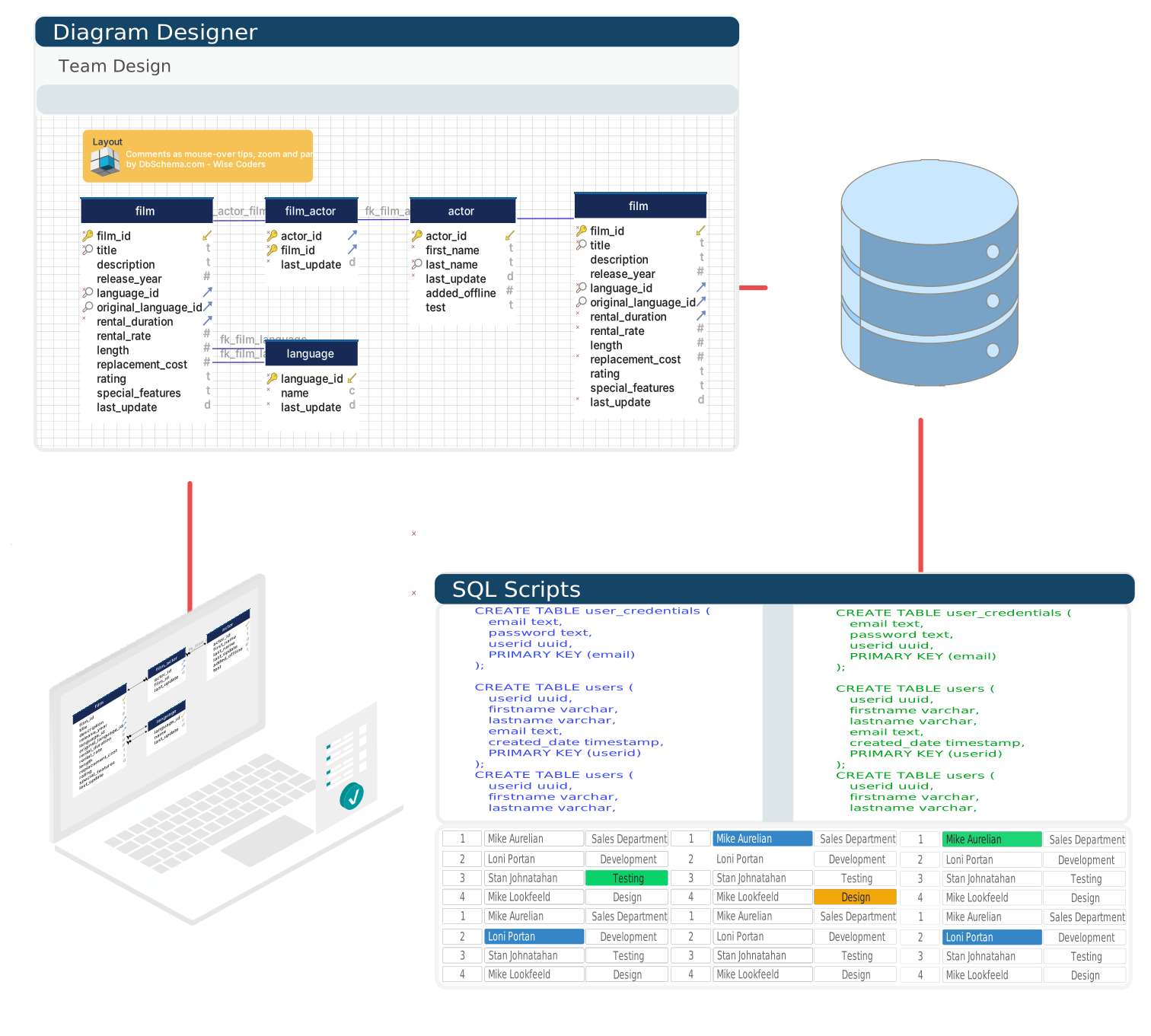
DbSchema lets you design, manage, and document Google AlloyDB databases. Create ER diagrams, define tables and columns, and generate SQL scripts - with or without a live database connection.

Use Git to share the design, compare it with the Google AlloyDB database, and deploy changes. DbSchema also includes a data editor, query builder, and HTML5 documentation - everything you need in one tool.

DbSchema Database Designer

Download DbSchema Download Google AlloyDB JDBC Driver

PostgreSQL-Compatible Architecture with Google's Columnar Engine

Google AlloyDB is a fully managed PostgreSQL-compatible database service on Google Cloud designed for demanding OLTP workloads while simultaneously supporting fast analytical queries through an integrated columnar engine. The columnar engine automatically selects hot columns based on query patterns and maintains an in-memory columnar store in parallel with the row-based primary storage, enabling hybrid transactional and analytical processing (HTAP) without separate ETL pipelines. Additional features such as ML-based query optimizer tuning, pgvector support for AI embeddings, AlloyDB AI integration, and AlloyDB Omni for on-premises deployments distinguish it from standard Cloud SQL PostgreSQL. DbSchema connects using the standard PostgreSQL JDBC driver and introspects AlloyDB schemas including extensions, foreign tables, and partitioned tables, rendering them as interactive schema diagrams.

Writing HTAP Queries in the SQL Editor

Because AlloyDB exposes a fully PostgreSQL-compatible SQL interface, DbSchema's SQL editor connects seamlessly and provides the same auto-completion, syntax highlighting, and result grid features as with any PostgreSQL database. You can write OLTP queries with row-level locking alongside analytical aggregations that benefit from the columnar engine, all within the same connection. AlloyDB's automatic columnar acceleration is transparent to the query author; DbSchema's editor shows actual execution time so you can observe the performance difference between queries routed to row storage and those accelerated by the columnar engine. The editor also supports pgvector operators for similarity search queries used in AI and machine learning workflows.

DbSchema SQL editor writing HTAP queries against Google AlloyDB with columnar acceleration

Exploring AlloyDB Tables and Columnar Data

The DbSchema data explorer lets you browse AlloyDB table contents row by row with full filter and sort support for all PostgreSQL data types including arrays, JSONB, and vector columns. For AlloyDB read replicas — which are extremely fast because they serve reads directly from the columnar cache — the data explorer delivers near-instantaneous pagination even on very large tables. You can connect DbSchema to both the primary instance and read replicas simultaneously, switching between them in the connection panel to compare data consistency or test replica lag scenarios.

Exploring Google AlloyDB table data including JSONB and vector columns in DbSchema data explorer

Connection Setup and JDBC URL

DbSchema connects to Google AlloyDB using the standard PostgreSQL JDBC driver (org.postgresql.Driver). The JDBC URL format is jdbc:postgresql://alloydb-instance:5432/mydb, where alloydb-instance is the private IP of your AlloyDB primary instance or the address exposed by the AlloyDB Auth Proxy. AlloyDB does not have a public IP by default; use the AlloyDB Auth Proxy or Private Service Connect to securely route JDBC traffic from outside Google Cloud. Supply a PostgreSQL-compatible username and password, or use IAM database authentication with a Cloud SQL Auth Proxy token. For high-availability deployments, point DbSchema at the AlloyDB cluster endpoint, which automatically routes to the current primary.

Google AlloyDB schema documentation with extensions and partitioned tables generated by DbSchema

Why Teams Use DbSchema with Google AlloyDB

  • Visualize AlloyDB PostgreSQL-compatible schemas — including partitioned tables, foreign tables, and pgvector columns — in a clear schema diagram for developer documentation.
  • Write HTAP queries that mix OLTP row reads with analytical aggregations in DbSchema's SQL editor and observe columnar engine acceleration in real time.
  • Explore table data via fast AlloyDB read replicas in the data explorer for near-instant row browsing on analytical workloads.
  • Connect DbSchema to AlloyDB Omni for on-premises environments using the same PostgreSQL JDBC driver configuration as cloud AlloyDB.
  • Generate schema documentation that captures AlloyDB-specific extensions (pgvector, pg_bigm) alongside standard PostgreSQL object definitions.
  • Use DbSchema's existing PostgreSQL driver support to connect to AlloyDB with zero additional driver configuration, leveraging full protocol compatibility.