Design and Manage Amazon DocumentDB Databases with DbSchema

Build a clearer workflow for Amazon DocumentDB: reverse engineer existing schemas into interactive ER diagrams, model changes visually, and generate reviewed SQL scripts before deployment.

DbSchema is built for visual modeling, schema documentation, and deployment. Keep an offline model in Git, collaborate across teams, and publish documentation that developers, analysts, and stakeholders can navigate in minutes.

DbSchema Database Designer

Download DbSchema See Amazon DocumentDB Features Download Amazon DocumentDB JDBC Driver

What happens after you download?

Get to your first Amazon DocumentDB schema diagram in minutes. No account, no credit card.

1
Install in minutes

Download the installer for Windows, macOS, or Linux and launch DbSchema. No signup required.

2
Connect to Amazon DocumentDB or open a sample

Reverse engineer an existing Amazon DocumentDB database or open a sample model to explore tables, relationships, and indexes.

3
Design, document, and deploy

Edit schema visually, generate documentation, and prepare reviewed migration scripts for safer releases.

Amazon DocumentDB is AWS's managed MongoDB-compatible document database, designed for teams that need the MongoDB API without the operational burden of running their own replica set. Because DocumentDB collections are schema-flexible, understanding what fields actually exist in your data requires sampling documents — not reading a DDL file. DbSchema connects via the MongoDB JDBC driver, samples each collection to infer field names and BSON types, and renders the result as a navigable schema diagram.

Infer and Visualize Collection Schemas

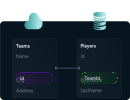

DocumentDB collections don't enforce a fixed structure, so DbSchema samples a configurable number of documents per collection to discover the fields in active use. Inferred field names and their detected types are displayed in the diagram canvas, giving you a visual map of the document model without writing a single aggregation pipeline.

Download DbSchema Free See Amazon DocumentDB Features

DbSchema showing inferred field types for an Amazon DocumentDB collection

Run MongoDB-Compatible Queries Without Writing Application Code

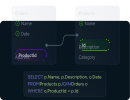
DbSchema's query builder constructs MongoDB-compatible find queries for DocumentDB, letting you filter and project documents interactively. Use it to verify that the document shape your application expects matches what is actually stored, or to explore production data without deploying a temporary script.

Query builder generating a MongoDB-compatible query against Amazon DocumentDB

Browse Document Data with the Data Explorer

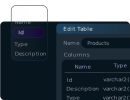
The data explorer displays collection contents in a paginated grid with column-level filtering. This makes it practical to audit documents after a migration, cross-check field values against application expectations, or investigate anomalies in production without any custom tooling.

Data explorer browsing documents in an Amazon DocumentDB collection

Connecting to Amazon DocumentDB

Amazon DocumentDB uses the MongoDB wire protocol on port 27017. The connection URI takes the form: mongodb://username:[email protected]:27017/dbname?tls=true&tlsCAFile=global-bundle.pem&replicaSet=rs0. Download the global-bundle.pem TLS certificate from the AWS documentation before connecting — DocumentDB requires TLS and rejects connections that omit the CA file. Because DocumentDB clusters run inside a VPC, you need either an SSH tunnel through a bastion host or a public-facing cluster endpoint to reach the database from outside AWS. Once the tunnel or endpoint is configured, register the MongoDB JDBC driver in DbSchema's driver manager and paste the URI into the connection dialog.

Why Use DbSchema with Amazon DocumentDB

  • Infer collection schemas by sampling documents — no manual DDL required
  • Visualize nested fields and array types in an ER-style diagram canvas
  • Run ad-hoc MongoDB-compatible queries without writing application code
  • Generate schema documentation for architecture reviews and team onboarding
  • Compare inferred schemas across environments to detect unintended field drift