MySQL JDBC Driver Download
Download the MySql JDBC driver, copy the JDBC URL into DbSchema, and start designing schemas with ER diagrams — free Community Edition.
About the MySql JDBC driver
A JDBC driver is a Java .jar library that lets applications connect to MySql.
DbSchema uses JDBC to reverse engineer schemas, run SQL, and generate documentation.
Driver files are usually published by the database vendor or an open-source project.
JDBC URL format
Host, port, database name, and SSL options are passed in a URL starting with jdbc:.
Each MySql driver uses its own syntax — see the connection details below.
The MySql JDBC driver
MySQL is the world's most widely deployed open-source relational database, powering everything from WordPress blogs to large-scale e-commerce platforms. It runs on every major OS and is the go-to choice for LAMP and LEMP stack web applications.
The MySQL JDBC URL
- Required File(s): mysql-connector-j-<version>.jar (MySQL Connector/J)
- Java Driver Class: com.mysql.cj.jdbc.Driver
- JDBC URL: jdbc:mysql://HOST[:PORT][/DB]
- Website: MySQL
Download the MySql JDBC Driver
Last updated August 2025 - verified for MySQL 8.4 / Java 21 compatibility.
The driver library files are compressed in a zip archive. Extract it and load the jar file using DbSchema's Driver Manager.
If you cannot connect, or you get issues with the driver, please ask DbSchema Team for help.
Solving Common MySQL Connectivity Issues
Enable Remote Access on MySql Server
Two separate things keep a remote client out: where the server listens, and where a user is allowed to log in from. Both usually have to be changed.
-
Check where the server listens.
MySQL's own default for
bind_addressis*, every interface. Debian and Ubuntu packages override it withbind-address = 127.0.0.1in/etc/mysql/mysql.conf.d/mysqld.cnf, which accepts loopback connections only.SHOW VARIABLES LIKE 'bind_address';reports the value in force. Set it to*, or to the specific address clients use, and restart the service. -
Grant the user access from your host.
A MySQL account is a pair of user and host, so
bar@'localhost'andbar@'202.54.10.20'are two different accounts. On the server, start the console withmysql -u root -p, create the account for the client host, then grant it privileges. MySQL 8 no longer acceptsGRANT ... IDENTIFIED BY, so these are two statements:
CREATE USER bar@'202.54.10.20' IDENTIFIED BY 'PASSWORD';
GRANT ALL ON foo.* TO bar@'202.54.10.20';
Replace the database, the user and the IP address of the machine running DbSchema.SELECT user, host FROM mysql.user;lists the accounts that already exist. - Open port 3306 in the server's firewall. The database listens on port 3306 unless it was installed with a different one. A host firewall on the server blocks incoming connections on that port until a rule allows them. The firewall guide has the commands for Windows, ufw, firewalld and iptables.
- Connect from DbSchema. In the Connection Dialog choose Remote computer or custom port, fill in the server host and the port, then press Test Connection to check that the server answers before you connect.
An Access denied message means the server was reached and the account or the host was wrong. A timeout instead means the traffic never arrived, so the cause is the bind address or the firewall.
-
Or reach the server through SSH.
When the database port is deliberately closed to the internet, open the Advanced tab of the
Connection Dialog and pick an SSH Tunnel configuration, to connect through a host that is exposed. The database host and port are then the ones
seen from the SSH host — often
localhost. See the SSH tunnel guide.
MySql Installation Tips
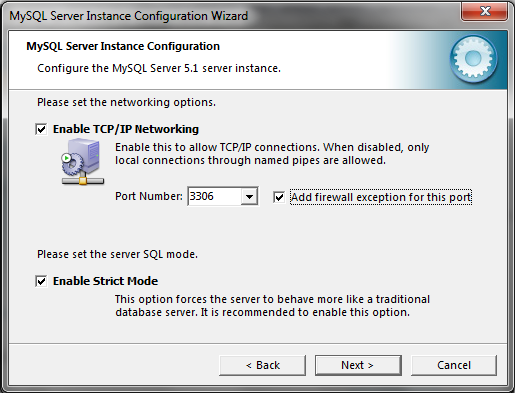 Install MySql from http://www.mysql.com. During installation go for a detailed install,
and when you are prompted for the user password check the 'Enable root access from remote machines'.
Install MySql from http://www.mysql.com. During installation go for a detailed install,
and when you are prompted for the user password check the 'Enable root access from remote machines'.
Enabling this you will be allowed to connect to MySql from another computer. Remember the password you set here, it will be requested when connecting to the database as user root.
DbSchema and MySQL
DbSchema's ER diagram tool is especially useful for MySQL's InnoDB schemas, where foreign key relationships between tables define the data model. Use the Schema Synchronization feature to safely roll out ALTER TABLE statements across dev, staging, and production without breaking foreign key constraints.
Test the driver with DbSchema
Connect MySql, build your first ER diagram in minutes. No account required.
Download driver & DbSchema
Get the MySql driver zip below and install DbSchema for Windows, macOS, or Linux.
Register the .jar
In DbSchema, open Driver Manager, add the extracted JAR, and paste your JDBC URL.
Design & document
Reverse engineer MySql, edit the model visually, and publish schema documentation.
Use MySql visually in DbSchema
After the JDBC driver connects, you get ER diagrams, SQL editor, schema sync, and HTML documentation in one desktop app. Compare DbSchema editions.
ER diagrams
Reverse engineer MySql into an interactive diagram and edit structures visually.
SQL & query builder
Run SQL with autocomplete or compose queries without writing every join by hand.
Schema documentation
Export HTML docs your team can browse without installing DbSchema.
Full MySql guide
Connection tips, ports, SSL, and schema design workflows on the database landing page.
Setup guides
JDBC driver FAQ
Related JDBC drivers
Other drivers teams often configure alongside MySql.
 MariaDb JDBC
 Aurora MySql JDBC
 PlanetScale JDBC
 TiDB JDBC
 SingleStore JDBC
 MemSQL JDBC
Related databases
Teams working with MySql often use these engines too. Explore dedicated guides and JDBC setup for each.